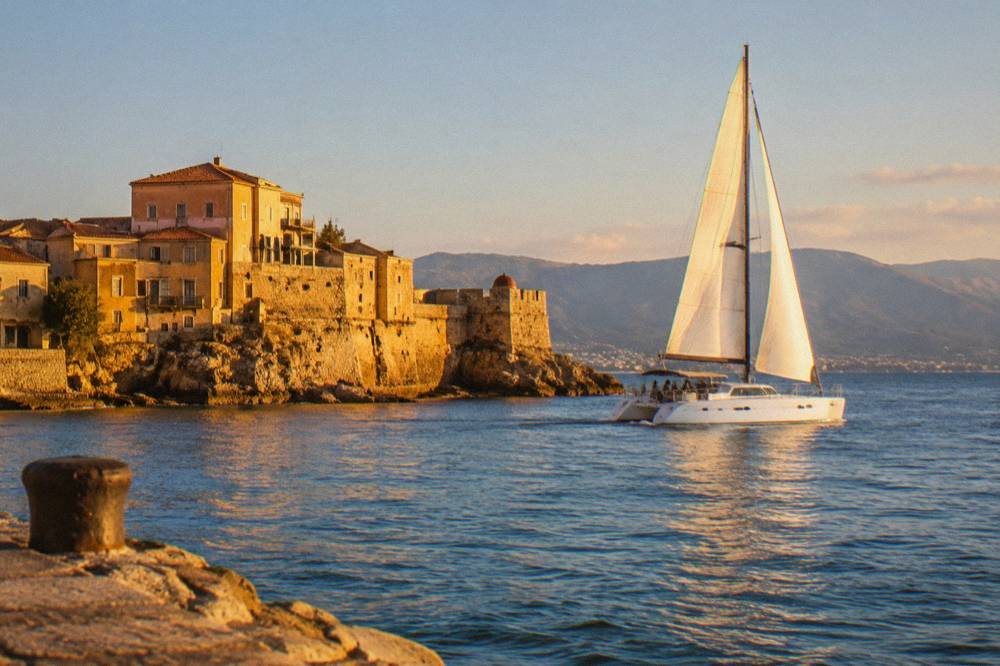
Nea Chora Beach Chania
Nea Chora is the sandy beach and fishing harbour just west of Chania's Old Town, the stretch of coast where the city's day-to-day life and its visitor life sit closest together.
Short answer
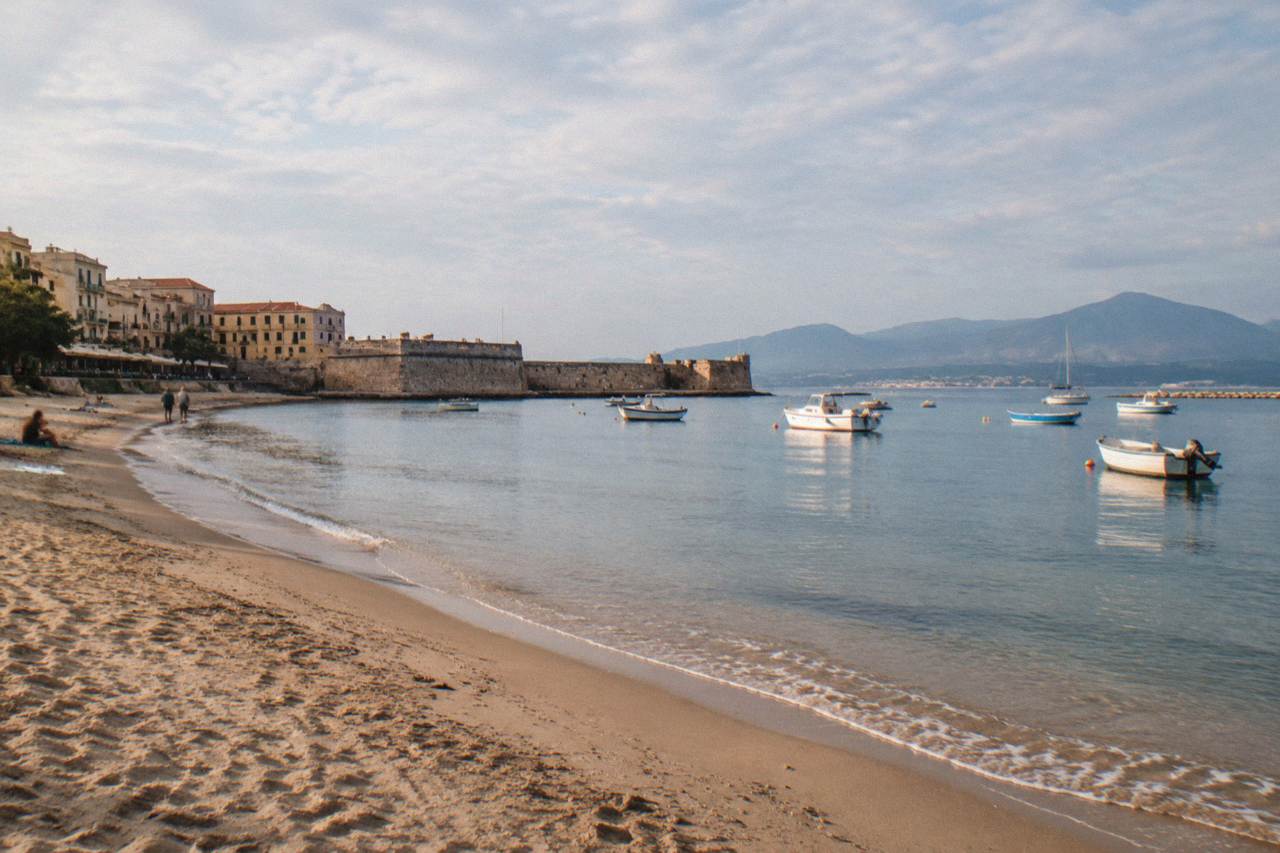
Nea Chora Beach is the sandy city beach of the Nea Chora quarter, immediately west of the Venetian Harbour and the Old Town in Chania, Crete. It is free to access, lined with fish tavernas along a small working harbour, and reachable on foot from the Old Town, which makes it the most convenient swim in the city.
Nea Chora is the quarter that begins where the Venetian Harbour ends, on the north-west coast of Chania in Crete, Greece, and its beach is the one the city actually lives with: a curve of sand backed by a small fishing harbour, apartment blocks and a taverna row, ten minutes of level walking from the edge of the Old Town. The municipality counts 111,375 permanent residents (2021 census), and this is one of the neighbourhoods where that resident population is most visible, morning swimmers and evening fishermen sharing the same water. This guide lays out what the beach is, what sits around it, how to reach it, and how it compares with the other beaches of the wider area.
The beach answers the first question every visitor to Chania asks, the swimming question, without a car, a bus or a boat. The answer to whether you can walk from the Old Town to a beach is set out on the site's dedicated page, walking from Old Town to a beach, and Nea Chora is the case that makes the answer yes. For everything else the region offers, from Balos to the gorges, start from things to do in Chania.
Where Is Nea Chora Beach In Chania?
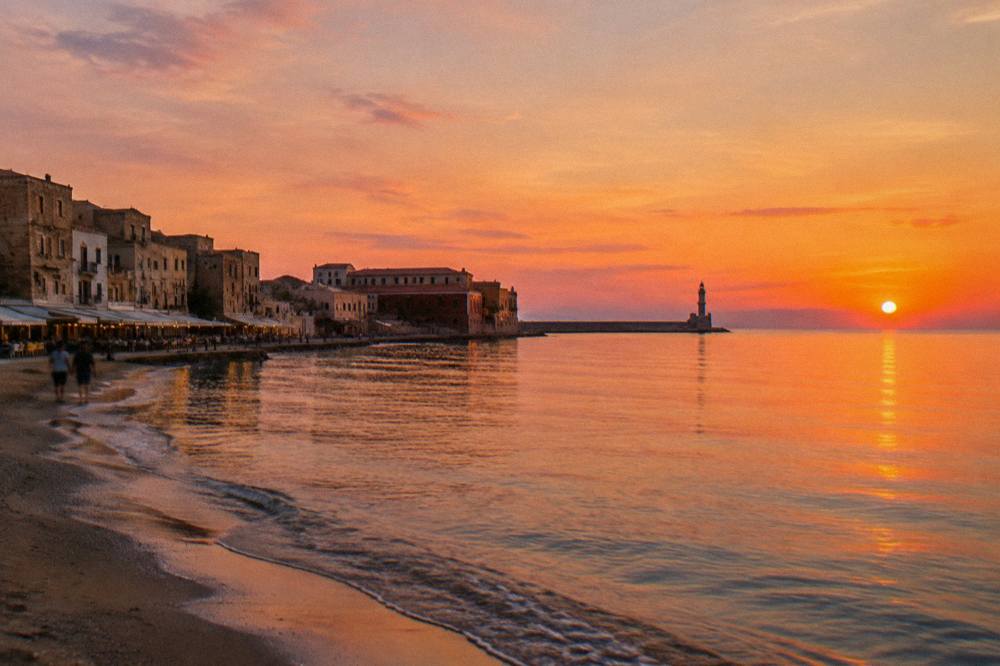
Nea Chora Beach sits immediately west of the Old Town and the Venetian Harbour in Chania, on the city's north-facing coast on the Cretan Sea, at the foot of the residential quarter of the same name. It is the first sandy beach west of the harbour mole and the closest one to the Old Town that needs no transport at all, which is exactly why it fills the role it does in a city visit.
The geography is simple once you have the harbour fixed in your head. The Old Town wraps around the Venetian Harbour, first built between 1320 and 1356, with the lighthouse standing on the mole. Follow the harbour's western arm away from the lighthouse and the waterfront continues as a promenade past the Neoria, the Venetian shipyards of which seven survive of an original seventeen from the 15th to 16th century, and then the shore turns to sand. That sand is Nea Chora. The quarter behind it is a grid of low apartment streets, bakeries and hardware shops rather than souvenir lanes, and its character comes from that mix.
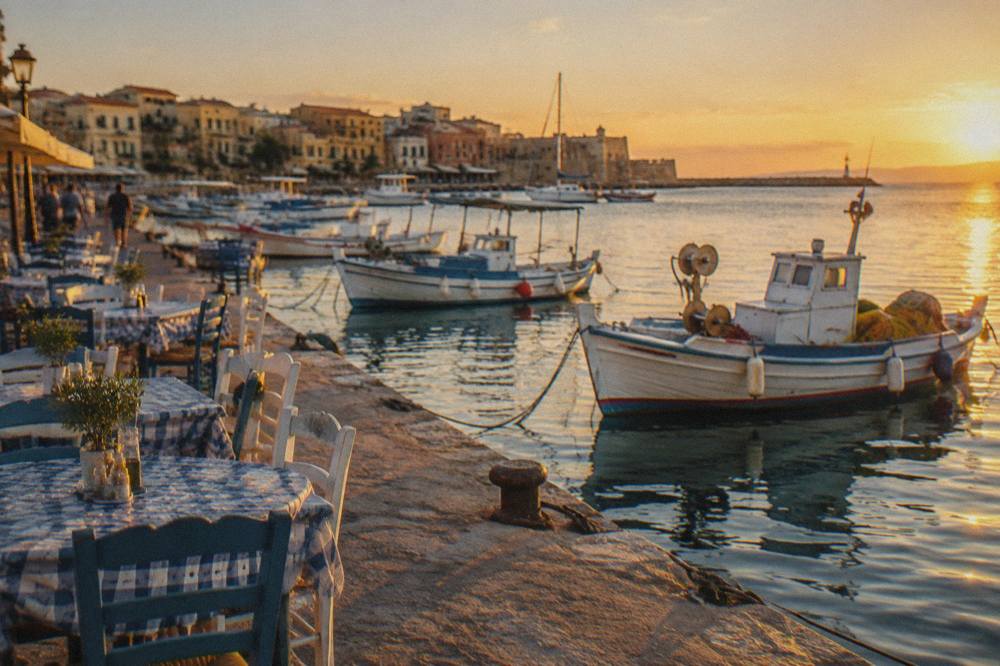
The fishing harbour is the anchor point. Small boats come and go from the little harbour at the beach's western end, and the taverna row faces them. Behind the quarter the ground rises gently toward the city, and to the south, on clear days, the outline of the White Mountains closes the view. The Venetian Harbour and the lighthouse of Chania are both within an easy level stroll back along the waterfront, which is what makes a Nea Chora swim so easy to slot into a sightseeing day.
One orientation note worth fixing early: ferries to Piraeus do not leave from anywhere near here. The Blue Star Ferries overnight service leaves from Souda port, about 7 km east of the Old Town, with a departure around 21:30 and a crossing of about 9 hours 15 minutes on the operator's published timetable. The Venetian Harbour and this coast serve excursion boats, not the mainland ferries, so nothing about a stay in Nea Chora puts you next to a big ferry terminal.
What Is The Sand And Water Like At Nea Chora Beach?
Nea Chora is a proper sandy beach rather than a stone or shingle strip, with shallow water that deepens gradually, a north-facing aspect on the Cretan Sea, and a small harbour wall at its western end that shelters the bay. Entry is free, no charge applies to the sand itself, and any sunbed or umbrella arrangement should be checked on the spot, since no verified price figure exists for this beach to print.
The sand is fine and light at the water's edge, and the gradient is gentle, which is the characteristic that defines who the beach suits: families with small children, swimmers who want laps before breakfast, and anyone whose day plan does not include a drive. The harbour wall blocks the worst of the wave action from the west, so the water inside the bay is usually calmer than the open coast beyond it. As anywhere on a north-facing Cretan shore, wind matters, and in July and August the prevailing wind at the Chania Souda station is from the north-west, which can rough up the surface on windy afternoons even when the morning was flat.
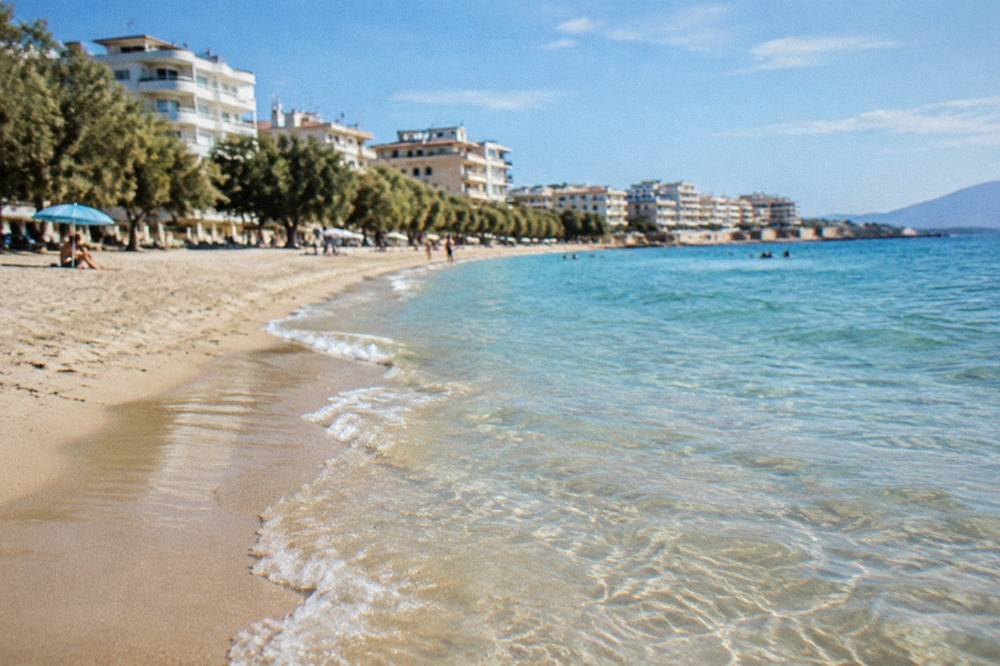
What the beach does not offer is solitude or a wilderness setting. This is a city beach in the fullest sense, with buildings at its back, a promenade along its length and a resident population using it from early morning. Visitors who want an empty strand need the beaches of the Akrotiri peninsula or the west, and this guide compares them below. What Nea Chora offers instead is the thing none of those can: a swim that costs no travel time at all from the Old Town, followed by lunch without moving the towel far.
The municipality does not publish a lifeguard, water-quality or Blue Flag statement that this desk can verify for this beach, so none is stated. The practical check any swimmer can make is the same one locals make: look at the water, look at the flag post if one flies on the day, and swim inside the bay rather than around the harbour wall.
What Food And Facilities Does The Nea Chora Taverna Row Offer?
The taverna row along the fishing harbour serves the fish the harbour lands, and it is the reason many people come to Nea Chora at all: a line of establishments facing the boats, backed by bakeries and small shops in the streets behind, plus showers and play areas that belong to the city beach rather than to any private club. No price figure for any taverna is verified here, so menus should be read at the door, but the setup, harbour, tavernas, sand, is the attraction.
The food tradition of the city is covered on the site's pages, and the fish restaurants of this quarter are part of it. Chania's food identity runs to its pies, its bougatsa breakfasts and its Cretan staples, and the harbour restaurants here lean toward the seafood end: whole fish priced by the kilo, small plates, grilled octopus. The bill-checking advice that applies anywhere on the island applies here too, read the menu and the chalkboard before sitting, since nothing on this page carries a verified taverna price.
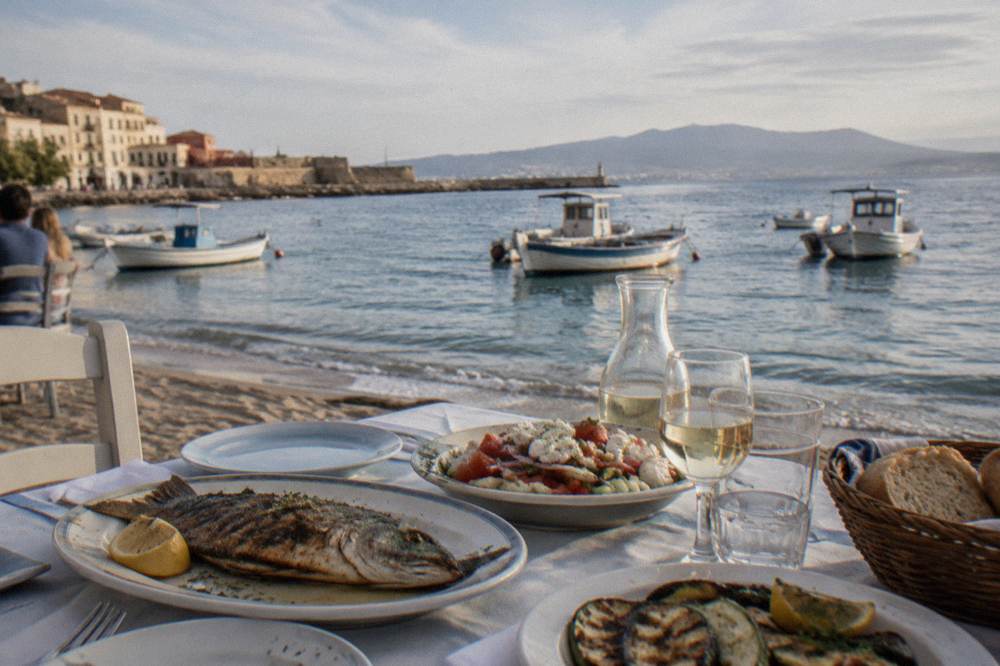
For visitors who want the food of the island rather than only its fish, the tasting and cooking side of the region is well served from the city. The site's featured pairing for this beach is a food-and-wine day: a wine and olive oil tasting tour from Chania with snacks that runs into the hills behind the city, and Check availability covers current dates and pricing on the operator's live listing. The municipal market in the city centre, covered on the municipal market page, is the other half of the food picture for anyone self-catering near the beach.
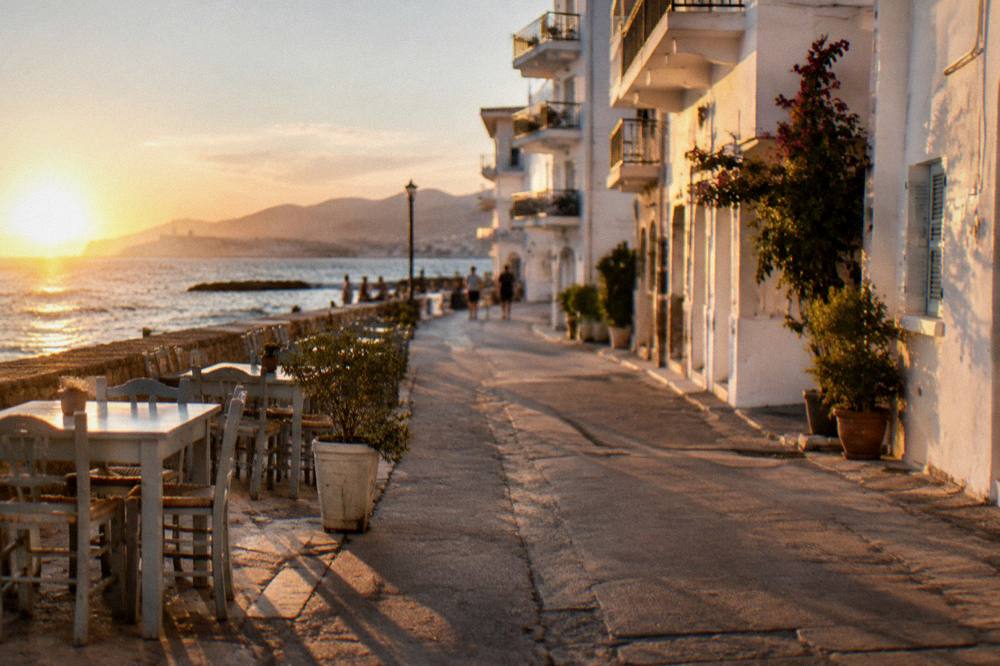
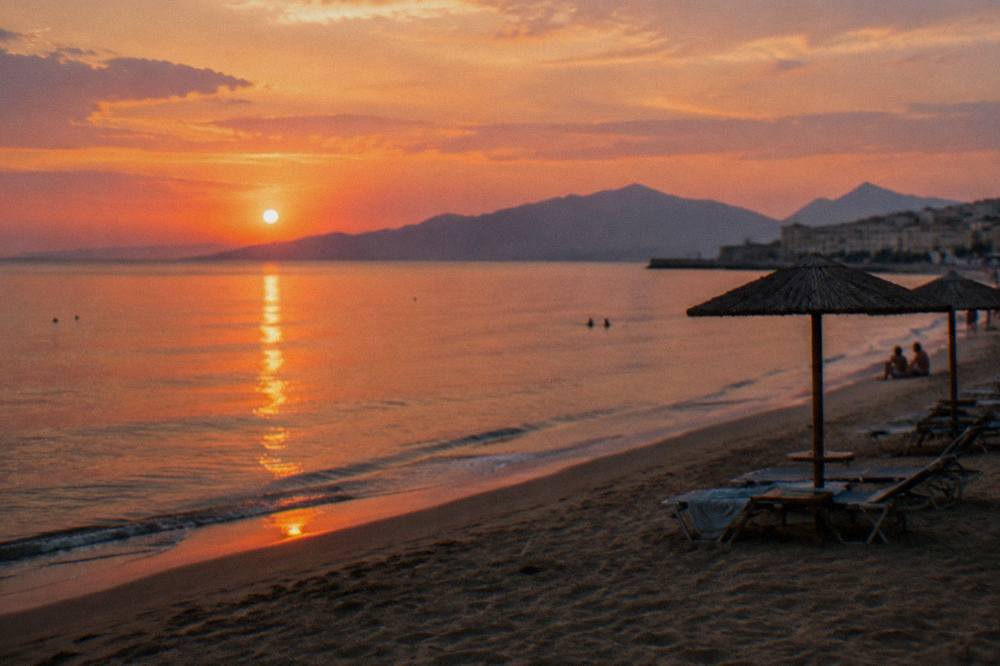
A morning-and-afternoon plan writes itself around this coast. Swim early while the water is calm, eat at the harbour at midday, and give the evening to the Old Town, where Firka Fortress, built in 1620 with free grounds, guards the harbour mouth. The sunset here faces west along this same shoreline, which is why the taverna tables fill early in the later part of the day.
| Feature | What to expect at Nea Chora |
|---|---|
| Access | On foot from the Old Town, level promenade the whole way |
| Entry | Free, no charge for the sand |
| Sand | Fine sand, shallow gradient into the water |
| Shelter | Harbour wall at the western end of the bay |
| Food | Taverna row facing the fishing harbour |
| Sunbeds | Check prices on the spot |
| Best time of day | Morning for calm water, evening for sunset |
How Do You Get To Nea Chora Beach?
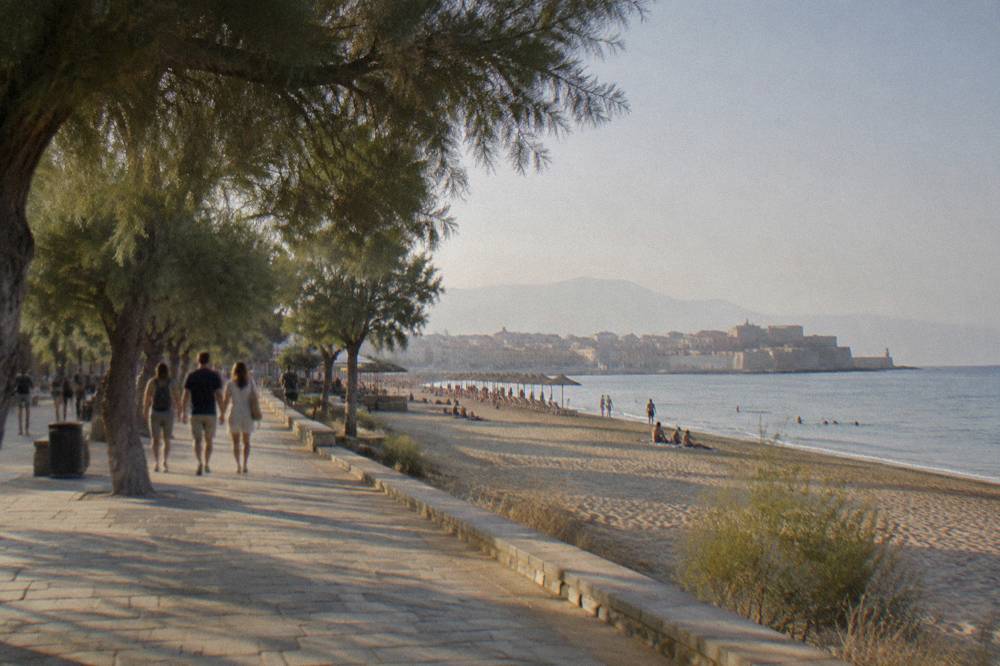
Nea Chora Beach is reached on foot from the Old Town along the flat waterfront promenade that continues west from the Venetian Harbour, and that walk is the standard way to arrive; for travellers based further out, the beach sits in the built-up city, so city buses, taxis and hire cars all reach the streets behind it, and no transport fare of any kind is printed here because none is verified.
The walk is the whole point. Leave the harbour's western edge by the Neoria shipyards and the promenade carries you along the shore to the sand without a single hill. The site's dedicated answer page, can you walk to a beach from Chania Old Town, deals with the question in full, including the other options further afield. For cruise passengers the calculation is different again, and the harbour-side attractions are covered on the harbour page already linked above.
For travellers arriving by air, the geography to know is this: Chania International Airport "Ioannis Daskalogiannis" (CHQ), operated by Fraport Greece, sits on the Akrotiri peninsula about 14 km from the city centre, and public bus and taxi information is published on the airport's own site. Interurban buses use the KTEL station on Kydonias street, from which routes run to Heraklion, Rethymno, Kissamos, Paleochora, Omalos and, in summer, Elafonisi. Nea Chora itself is inside the city fabric, so once you are in Chania you are, in practice, already near the beach.
A car is not needed for this beach and is arguably a hindrance, since parking in a residential quarter in high summer is its own project; the site's parking guidance covers the wider question. Cars earn their keep for the beaches beyond the city, the peninsula and the west, which is where the comparison below comes in.
When Is The Best Time Of Year To Swim At Nea Chora?
The swim season at Nea Chora is governed by air temperature, and the HNMS Chania Souda station table, 1958 to 2010, shows why the water is warmest and the coast driest from late June through September: July means 26.7 C with 1.0 mm of rain on 0.4 rain days, August 26.3 C with 1.4 mm, and June 24.7 C with 3.4 mm, while January, at 11.0 C and 129.5 mm, is the wettest month in the table.
Those figures are station means for the period 1958 to 2010 from the Hellenic National Meteorological Service's Chania Souda station, which sits inland of Souda Bay at 148 m, and they describe the air, not the sea; no official monthly sea-temperature normal exists for this coast, so none is printed. In practice the months that pair warm air with almost no rain run from May through September, with 13.5 mm in May dropping to the July minimum, and rain returning as a planning factor from October, at 67.7 mm across 9.3 rain days.
| Month | Mean temp C | Rain mm | Rain days |
|---|---|---|---|
| Jan | 11.0 | 129.5 | 16.3 |
| Feb | 11.0 | 104.0 | 14.5 |
| Mar | 12.7 | 76.0 | 11.5 |
| Apr | 15.9 | 31.5 | 7.7 |
| May | 20.2 | 13.5 | 4.2 |
| Jun | 24.7 | 3.4 | 1.2 |
| Jul | 26.7 | 1.0 | 0.4 |
| Aug | 26.3 | 1.4 | 0.6 |
| Sep | 23.2 | 15.4 | 3.2 |
| Oct | 19.4 | 67.7 | 9.3 |
| Nov | 15.8 | 77.0 | 11.2 |
| Dec | 12.7 | 101.9 | 16.1 |
The shoulder reading matters for planning. May has a mean of 20.2 C and June 24.7 C, with mean maximums of 24.5 and 28.9 C respectively, so June already behaves like summer. September stays at a mean of 23.2 C with only 3.2 rain days. October drops to 19.4 C with a mean maximum of 23.5 C, which is still swimmable for many people but carries the month's 67.7 mm of rain as a scheduling factor. The site's page on the best time to visit Chania treats the whole year in detail, and the Chania weather page carries the full station table with maximum and minimum columns.
Two seasonal notes finish the picture. First, the meltemi pattern, the general summer north-westerly wind of the Aegean, can freshen afternoons on any north-facing shore, so the calm-water hours at this beach are usually the early ones, and the station's prevailing-wind record shows west overall and north-west in July and August. Second, humidity in the station table runs from 50 percent in July to 73 percent in January, which is a small part of why the high-summer heat feels heavier in the city than the raw temperature suggests.
How Does Nea Chora Compare With The Other Beaches Near Chania?
Nea Chora trades beauty for convenience: it is the only sandy beach within walking distance of the Old Town, while Marathi, Stavros, Kalathas and Agia Marina on the Akrotiri peninsula and the western coast are broader, quieter or more spectacular but all require a bus, taxi or car, and Seitan Limania is the dramatic cove at the far end of that scale with a hike attached. The choice is really a choice about transport, not about water quality, which no verified comparison covers.
The peninsula beaches sit on Akrotiri, the same headland that carries the airport. Marathi Beach and Kalathas Beach are the calm, family-oriented options on the peninsula's sheltered side, Stavros Beach is the enclosed bay ringed by a cliff on the north side, and Agia Marina Beach is the long developed sandy stretch west of the city toward Platanias. Each has its own page on the site with the detail. All of them reward the visitor who has sorted a car or studied the bus routes.
| Beach | Character | Getting there | Who it suits |
|---|---|---|---|
| Nea Chora | City sand, fishing harbour, tavernas | On foot from the Old Town | Swimmers without a car, families, sunset diners |
| Marathi | Sheltered peninsula bay | Vehicle or bus from the city | Calm-water swimmers, families |
| Kalathas | Small peninsula bay | Vehicle or bus from the city | A quiet half-day swim |
| Stavros | Enclosed cliff-ringed bay | Vehicle from the city | Photographers, calm water |
| Agia Marina | Long developed sandy coast | Vehicle or bus west of the city | Long beach days, resorts |
| Seitan Limania | Steep dramatic cove | Vehicle plus a hike down | Adventurous swimmers |
The big-name beaches of the region are a different category again, day trips rather than beach hops. Elafonisi Beach is the Natura 2000 protected area on the south-west corner with free entry and a strict prohibition on taking sand, shells or plants, and its pink sand has its own explanation page, why Elafonisi Beach is pink. Falassarna Beach is the wide west-facing coast beyond Kissamos. Balos and Gramvousa sit at the end of the peninsula beyond that, reachable by boat from Kissamos or by an unpaved road from Kaliviani followed by a walk down, with a EUR 1 Kissamos municipal fee collected on the boat ticket for over-13s and no other confirmed charge; the site's page on how difficult it is to get to Balos Beach and the dedicated is Elafonisi worth it answer cover both honestly. A beach-by-beach verdict across the whole island also exists at the prettiest beach in Crete.
For travellers using Nea Chora as a base rather than a beach, the accommodation angle is covered on the site's beach hotels in Chania page, and the quarter itself has its own area page, Nea Chora, covering where it sits among the city's neighbourhoods.
Thinking of basing yourself in this quarter? Book a hotel room here.
What Else Can You Combine With A Nea Chora Day?
A Nea Chora day pairs naturally with the Old Town sights along the same waterfront, Firka Fortress with its free grounds, the Archaeological Museum of Chania at 15 Skra Street in Halepa with a EUR 15 full ticket and an EUR 8 concession, and the harbour and lighthouse walk, and beyond the city the gorge, boat and wine-country day trips all start from points within reach of this coast.
Inside the city the loop is obvious. Swim, then walk east along the water: Firka Fortress at the harbour mouth, then the harbour itself, then the lighthouse on the mole, a Venetian structure of about 1595 to 1601 restored during the Egyptian period of 1830 to 1840. The Archaeological Museum of Chania is further out in Halepa, and its visit page should be checked for current opening arrangements before the walk out there, since hours change; the ticket prices above are the museum's own published figures. The Maritime Museum of Crete sits at Firka for anyone who wants the island's seafaring story with the fortress.
Beyond the city, two kinds of day trip dominate, and both have caveats this desk is bound to. The gorges: Samaria Gorge normally runs a season of 1 May to 31 October, but storms in late September and early October 2026 destroyed sections of the path and no reopening decision is on record, so the NECCA status must be checked before any plan is made; the separate EUR 10 entrance via the NECCA e-ticket portal and the ferry fee from Agia Roumeli are not covered by tour prices. Imbros Gorge, the shorter alternative, is covered on the site's Imbros Gorge page and pairs with villages of the Sfakia side. The second kind is the beach-and-boat day: Balos by boat from Kissamos, Balos with Falassarna, or the jeep tours that reach beaches a normal car treats carefully.
The quieter inland alternatives suit anyone who has had enough sand. Lake Kournas, the freshwater lake of the area, and the monasteries of the Akrotiri peninsula make a contrast day, and the site's page on a rainy day in Chania is the plan for the days the station table says will come from November onward.
Where Does Nea Chora Fit In A Longer Chania Stay?
For a stay of three days or more, Nea Chora works best as the daily default swim, the beach used on the mornings between the big excursions, since every major day trip of the region, Balos, Elafonisi, the gorges, Rethymno, Knossos, departs from or through the city and returns in time for an evening swim here. The itineraries on this site sequence exactly that rhythm, and a beach this close to the Old Town is what makes a car-free week in Chania realistic.
The site's planning pages handle the sequencing. Start with one day in Chania if time is short, then two days and three days as the trip grows, with five days in Chania and a week in west Crete for the full region. Cruise passengers with a single port day have their own page, a cruise port day in Chania, where the harbour walk matters more than the sand.
A practical note on money closes the planning. Greece uses the euro, in the euro area since 1 January 2001, and is a full Schengen member with internal checks abolished since 26 March 2000; the EU's Entry/Exit System was fully deployed across Schengen on 10 April 2026, while ETIAS is not yet in operation and collects no applications as of October 2026. Accommodation in the city collects the climate crisis resilience fee per room or apartment per night at seasonal rates, and the amount should be confirmed at booking rather than assumed. None of that touches the beach itself, which charges nothing.
| Sighting or stop | Verified detail | Where it sits relative to Nea Chora |
|---|---|---|
| Firka Fortress | Built 1620, grounds free | Harbour mouth, walk east along the water |
| Venetian Harbour | First built 1320 to 1356 | Immediately east of the quarter |
| Lighthouse | Built about 1595 to 1601, restored 1830 to 1840 | End of the harbour mole |
| Neoria shipyards | Seven survivors of seventeen, 15th to 16th century | Waterfront between harbour and beach |
| Archaeological Museum | EUR 15 full, EUR 8 concession, 15 Skra Street, Halepa | Halepa district, east of the centre |
| Nea Chora beach itself | Free sand, fishing harbour, taverna row | The quarter west of the Old Town |
The short verdict, in the desk's reporting voice rather than in superlatives: Nea Chora is not the beach photographs of Crete are built on, and it is the one a visitor to this city will actually use on the days between those photographs. Walk out of the Old Town, swim, eat facing the boats, walk back. The whole of Chania Crete Travel Guide is organised around exactly that kind of day, and this beach is where the simplest version of it happens.
Common Questions About Nea Chora Beach
These are the questions this desk fields most often about Nea Chora Beach in Chania, answered short and directly: the beach is free, sandy, walkable from the Old Town, served by a fish taverna row, and best in the morning calm between May and September. Each answer below repeats the essentials without new figures, and anything not verified, from sunbed prices to water-quality verdicts, is flagged as a check-on-the-spot item rather than asserted.
Can you walk to Nea Chora Beach from Chania Old Town?
Yes. The beach sits immediately west of the Old Town and the Venetian Harbour, and a level waterfront promenade runs the whole way past the Neoria shipyards. No transport is needed, which is the beach's defining advantage over every other sandy option around the city.
Is Nea Chora Beach free?
Yes, the sand and the water carry no entry charge. Sunbed or umbrella arrangements, where offered, are private and should be priced at the stand on the day.
Is Nea Chora good for swimming?
Yes, for a city swim. The sand is fine, the gradient shallow, and the harbour wall at the western end shelters the bay. Mornings are usually the calmest water, because the prevailing summer wind at the Chania Souda station blows from the north-west in July and August.
Where do you eat at Nea Chora?
The taverna row faces the fishing harbour at the western end of the beach, serving the fish the harbour lands. Read the menu and the chalkboard at the door before choosing a table, since no taverna price on this street is verified on this site.
When is the best month to swim at Nea Chora?
June through September, on the HNMS Chania Souda station table for 1958 to 2010: June means 24.7 C with 3.4 mm of rain, July 26.7 C with 1.0 mm, August 26.3 C with 1.4 mm and September 23.2 C with 15.4 mm. May, at a mean of 20.2 C, is already pleasant, and October's 19.4 C keeps swimming possible while rain returns as a factor.
Is Nea Chora or Agia Marina better?
They answer different needs. Nea Chora is the walkable city beach with the taverna harbour; Agia Marina is the longer, more resort-oriented sandy coast west of the city that rewards a car or a bus ride. A car-free visitor should use Nea Chora, while a visitor based west of the city has Agia Marina on the doorstep.