Lighthouse Of Chania
The lighthouse of Chania stands at the mouth of the Venetian Harbour on a base the Venetians laid around 1595 to 1601, with the tower seen today shaped during the period of Egyptian rule from 1830 to 1840. This guide covers the building history, the walk out along the mole, the light for photographs, and what to pair with a visit.
Short answer
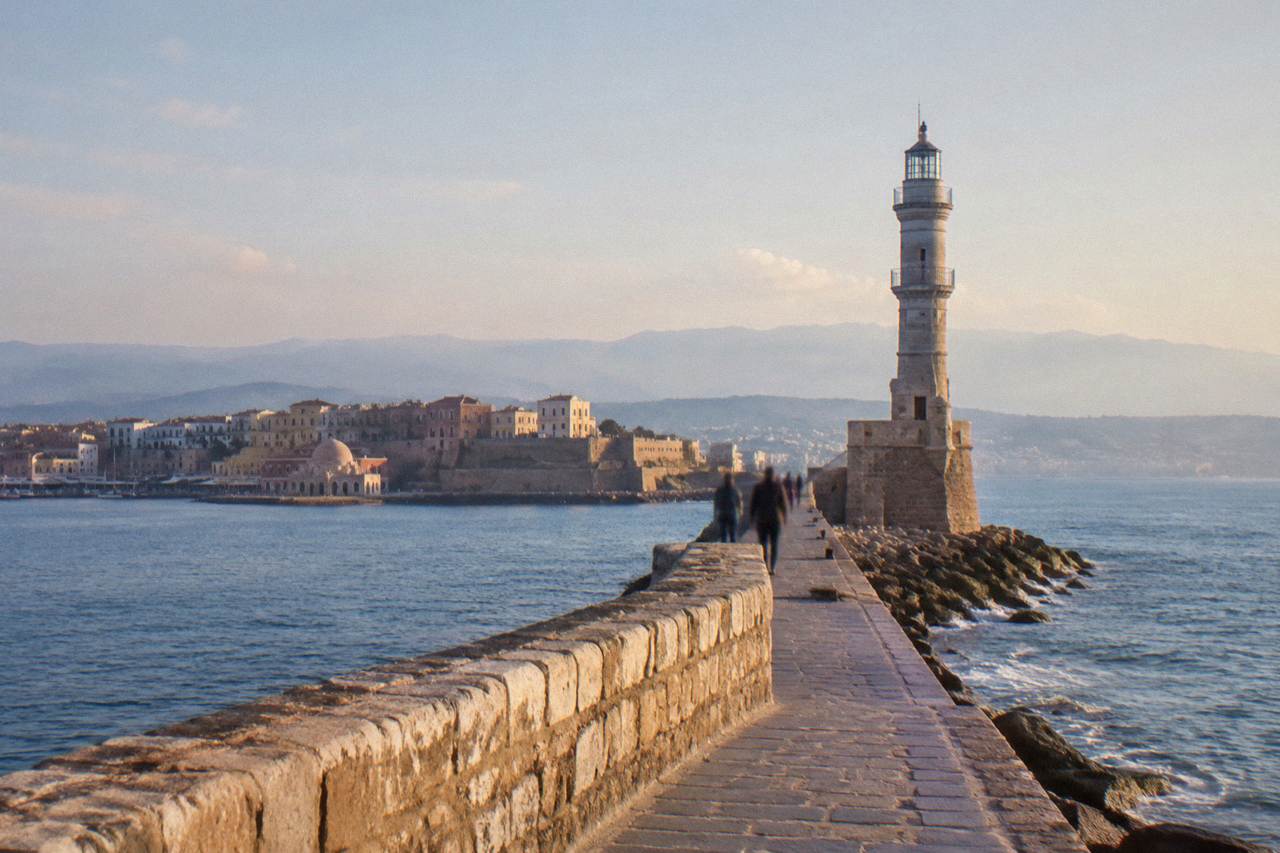
The Chania lighthouse stands at the end of the harbour mole protecting the Venetian Harbour of Chania, on the north-west coast of Crete. The Venetian base dates from about 1595 to 1601, and the tower took its present form during Egyptian rule, restored on that base between 1830 and 1840 and recorded as operating in 1839. The walk out along the mole is free and open to foot traffic.
Chania, a coastal city of about 111,375 permanent residents on the north-west coast of Crete, Greece, arranges itself around one body of water: the Venetian Harbour. At the mouth of that harbour, on the long stone mole that shields the inner basin from the open Cretan Sea, stands the lighthouse the city is photographed around. The base was laid by the Venetians, the tower above it took its present shape during the period of Egyptian rule in the 1830s, and the structure still closes the view down every street that runs toward the water in the Old Town.
The lighthouse is not a museum, a ticketed site, or a climbable tower. It is a piece of working harbour engineering that happens to be one of the most recognisable structures in Crete, and the walk out to it along the mole is free. This guide from the Chania Crete Travel Guide editorial desk sets out what the sources say about the tower, the walk, the light at different hours, and the sights that sit within a few minutes of its base.
What Is The Lighthouse Of Chania?
The lighthouse of Chania is a stone harbour tower standing at the end of the western mole that protects the Venetian Harbour of Chania, on the north-west coast of Crete. It rests on a base built by the Venetians between about 1595 and 1601, and the tower above that base took the form seen today during the period of Egyptian rule, with works recorded from 1830 to 1840 and the light recorded as operating in 1839.
The structure belongs to the harbour rather than to the city streets. The Venetian Harbour itself was first built between 1320 and 1356, with dredging works and a wall recorded in 1515, and the mole the lighthouse stands on is part of that same defensive logic: a protected inner basin for shipping, closed off from the open sea by stone arms. The lighthouse sits at the outer end of one of those arms, where it can mark the harbour mouth for boats approaching from the north.
What a visitor sees today is a tower with a small base structure, a slender shaft, and an open lantern gallery at the top, reached by an external stair. The tower is closed to the public, and there is no entrance fee because there is no entrance: the experience of the lighthouse is the walk along the mole toward it and the view back along the whole curve of the harbour. The listing details of the harbour and its buildings are covered in the Venetian Harbour of Chania guide, which pairs with this page.
The harbour around the tower has changed its work several times. Under the Venetians it was a naval station, with the Neoria shipyards, seven survivors of an original seventeen from the 15th to 16th century, still standing along the eastern shore. Ottoman rule began with the conquest of Chania in 1645, and Crete's union with Greece came in 1913. Through all of it the mole and its tower stayed at the harbour mouth, which is why the structure reads as a summary of the city's history in a single silhouette.
When Was The Chania Lighthouse Built, And Who Restored It?
The Venetian lighthouse on the Chania harbour mole was built in about 1595 to 1601, according to the dated history of the harbour works, and the tower was restored on its Venetian base during the period of Egyptian rule, with works from 1830 to 1840 and the light recorded as operating in 1839. The union of Crete with Greece in 1913 came long after, and the tower has been a fixed point of the harbour view through every change of rule since.
The layered history is worth reading in order, because the tower wears all of it at once: a Venetian base, an Egyptian-era restoration of the superstructure, and modern harbour use. The table below sets out the dated facts the sources give for the harbour and the lighthouse together, so the tower can be placed in its sequence rather than treated as a single undated monument.
| Period | Dated event for the harbour and tower |
|---|---|
| 1320 to 1356 | Venetian Harbour first built |
| 1336 to about 1356 | First Venetian city walls |
| 1515 | Dredging works and a wall recorded |
| About 1595 to 1601 | Venetian lighthouse built on the mole |
| 1536 onward | Second city walls to Michele Sanmicheli's design |
| 1645 | Ottoman conquest of Chania |
| 1830 to 1840 | Lighthouse restored on its Venetian base during Egyptian rule |
| 1839 | The light recorded as operating |
| 1913 | Union of Crete with Greece |
Two cautions follow from that table. First, the tower is often described in passing as simply "Venetian", which is true of the base and the siting but not of the whole tower seen today; the restoration of the 1830s gave the lighthouse its present profile. Second, no source in the site's files gives the exact height of the tower or the technical range of its light, so this page states neither. What can be said with dates attached is said above; what cannot, is left to the harbour authority rather than guessed.
The walk to the tower itself costs nothing and needs no booking, which makes it one of the free anchors of any day in the Old Town, covered further in the Old Town of Chania area guide. For the hours when the lighthouse is not the plan, the desk suggests pairing the morning at the harbour with a guided day out, and the picks below are the three the site's roster backs for that.
The Elafonisi day trip with tastings, the four-product tasting tour, and the Balos catamaran all start from Chania and return to it, which means the lighthouse remains the evening landmark at the end of any of those days. Each listing carries its own price, rating and duration, rendered on the card rather than typed here, and each has a live availability view before payment.
How Do You Get To The Lighthouse From Chania Old Town?
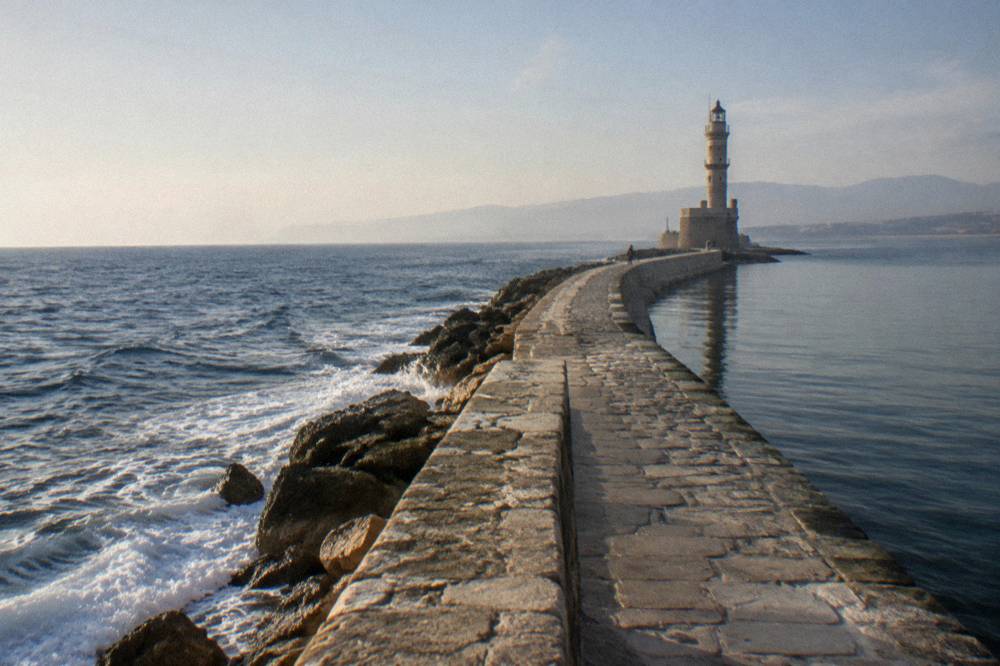
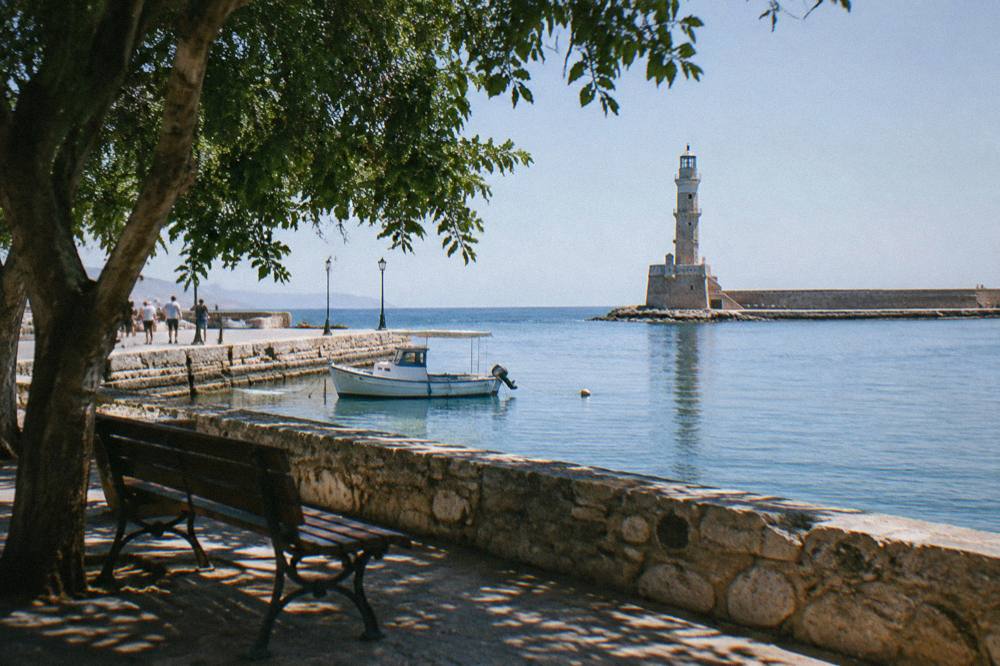
The lighthouse is reached on foot from the Old Town of Chania by walking to the inner edge of the Venetian Harbour and out along the stone mole to the tower at its end. There is no ticket, no gate and no fee for the walk, and the tower itself is closed, so the mole path and the viewpoints along it are the visit. The whole route is flat, paved at the harbour end and rougher stone toward the outer stretch of the mole.
The practical starting points are the two ends of the inner harbour. From the western side, the path drops from the Firka Fortress, built in 1620, whose grounds are free to enter, and the mole begins almost at its foot. From the eastern side, the route runs past the Neoria shipyards and the Mosque of the Janissaries before crossing the inner basin to the same point. Either way, the lighthouse closes the view ahead, and the walk out takes the visitor past small boats moored in the channel between the two harbour arms.
Three things shape the walk. The mole is exposed: there is no shade and no railing along parts of the outer stretch, so the same sun that lights the tower at golden hour lands on the walker at midday. Wind matters too, and the HNMS Chania Souda station table gives the prevailing wind as west, turning north-west in July and August, which is the direction the outer mole faces. And the surface underfoot is uneven stone in places, which matters for anyone walking in smooth-soled shoes.
For cruise passengers, the harbour layout is covered in detail in the Chania cruise port day itinerary; the lighthouse walk is short enough to slot into even a half-day ashore. For visitors staying longer, the Chania one day itinerary places the mole walk at the end of the day, when the light comes from behind the White Mountains to the south.
A morning or an evening at the harbour leaves the middle of the day open, and that is the gap a guided trip fills.
The Elafonisi trip is the one the desk would point a first-time visitor toward from this page, because it pairs a beach day with stops at Elos and a honey and wine tasting on the way, and the listing shows free cancellation before the cut-off. Availability and the current price sit on the operator's live listing, and the site never types a product figure into prose.
What Can You See From The Harbour Mole At The Lighthouse?
From the mole at the lighthouse the whole Venetian Harbour of Chania is visible in one frame: the inner basin with its excursion boats, the Neoria shipyards along the eastern shore, the Firka Fortress at the western entrance, and the minaret and roofline of the Old Town rising behind the quays. Looking outward, the view opens to the Cretan Sea, with the Akrotiri peninsula closing the horizon to the east.
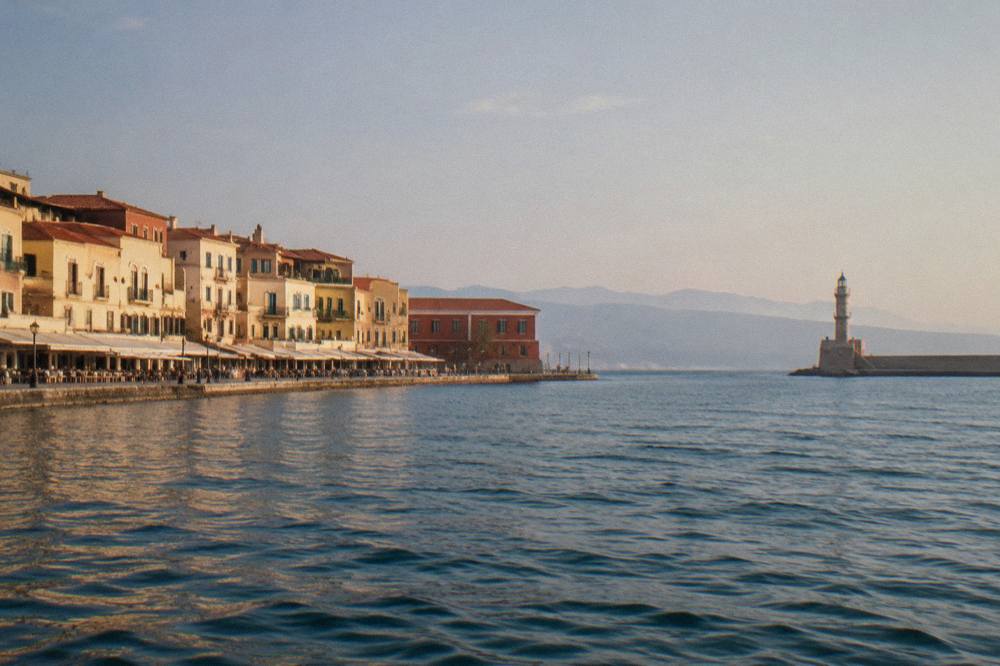
The return view is the reason the walk exists. From the outer stretch of the mole, the harbour arranges itself as a single curve: pastel buildings along the western quay, the glassed arcades of the Neoria, and the tower of the lighthouse framing one edge of the picture. Photographers get a compressed panorama that no street in the Old Town can produce, because the mole is the only place that stands far enough out into the basin to see both shores at once.
The named landmarks each carry their own story, and each has a fuller page on this site. The table below lists what is visible from the mole and the dated fact attached to each, so the view can be read rather than just admired.
| Landmark visible from the mole | Dated fact from the sources |
|---|---|
| Venetian Harbour basin | First built 1320 to 1356 |
| Neoria shipyards | Seven survivors of an original seventeen, 15th to 16th century |
| Firka Fortress | Built 1620, grounds free to enter |
| Mosque of the Janissaries | Standing on the eastern quay; no construction date is stated in the sources |
| Old Town rooftops | First Venetian walls from 1336, second walls from 1536 |
| Akrotiri peninsula | The airport sits on it, about 14 km from the city centre |
Beyond the harbour mouth, boats come and go through the channel the mole protects. Excursion boats to Lazaretta Island and Agioi Theodoroi leave from the inner quays, and the wider boat options from the city are collected in the site's boat-trip material; from the mole the departure point for all of them is visible at once. The scheduled ferries, by contrast, do not use this harbour at all: the overnight Blue Star Ferries service to Piraeus leaves from Souda port, about 7 km east of the Old Town, with a published departure around 21:30 and a crossing of about 9 hours 15 minutes, to be confirmed on the operator's timetable.
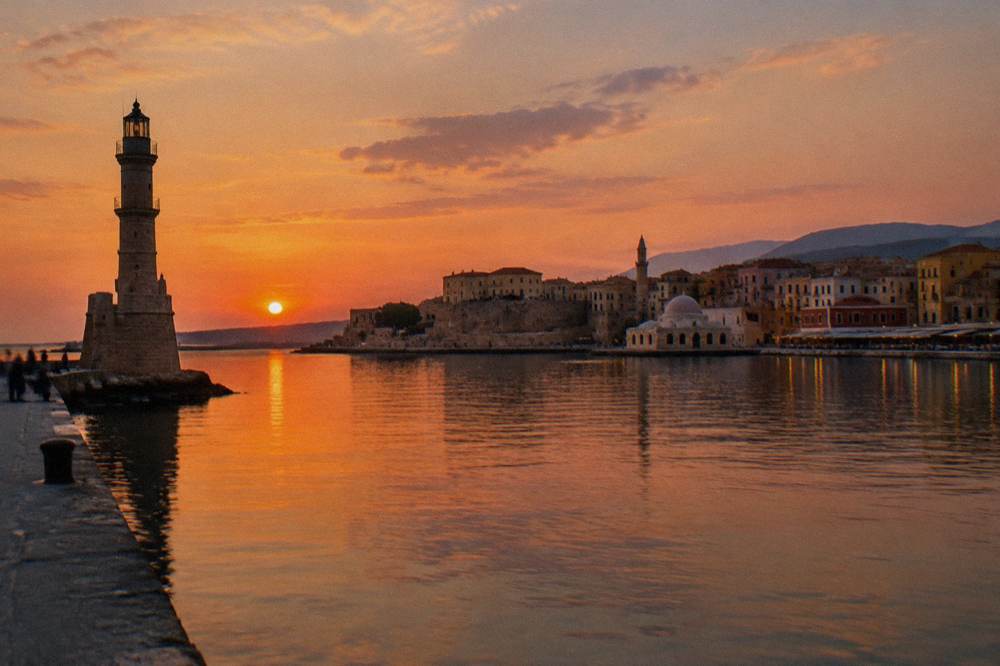
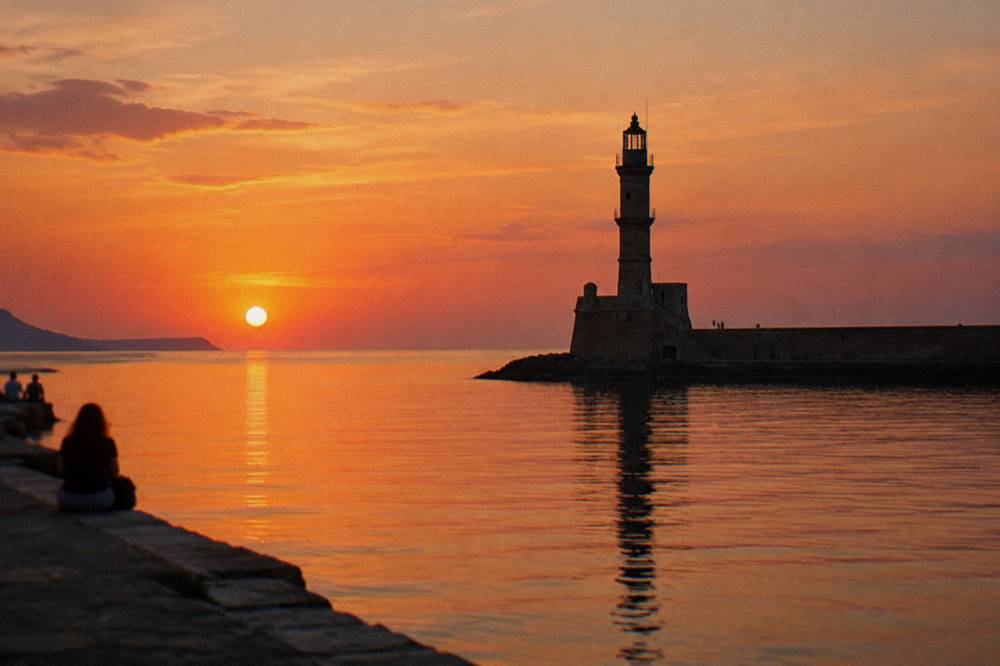
The evening view has a second act. Once the sun drops behind the White Mountains, the harbour front lights up and the lighthouse tower stands dark against the western sky. The site's files give no lighting schedule for the tower itself, so the desk states none; what is certain is the geometry, that the mole faces the sunset side of the harbour, and that the western quay is the foreground of that picture.
When Is The Best Light For Photographing The Chania Lighthouse?
The lighthouse of Chania is photographed to best effect in the last hour before sunset, when the low sun comes from the west over the White Mountains and lights the tower from the harbour side, and again in the first hour after sunrise, when the tower stands against the bright eastern sky over the Akrotiri peninsula. The HNMS Chania Souda station records, covering 1958 to 2010, show the dry and bright months run from May through September, with July rainfall at just 1.0 mm across 0.4 rain days on average.
The climate record matters to a photography plan more than to almost any other plan in Chania, because the shot depends entirely on sky. The station table gives the raw numbers, and they are worth reading in full before choosing a month.
| Month | Mean temperature C | Rainfall mm | Rain days |
|---|---|---|---|
| Jan | 11.0 | 129.5 | 16.3 |
| Feb | 11.0 | 104.0 | 14.5 |
| Mar | 12.7 | 76.0 | 11.5 |
| Apr | 15.9 | 31.5 | 7.7 |
| May | 20.2 | 13.5 | 4.2 |
| Jun | 24.7 | 3.4 | 1.2 |
| Jul | 26.7 | 1.0 | 0.4 |
| Aug | 26.3 | 1.4 | 0.6 |
| Sep | 23.2 | 15.4 | 3.2 |
| Oct | 19.4 | 67.7 | 9.3 |
| Nov | 15.8 | 77.0 | 11.2 |
| Dec | 12.7 | 101.9 | 16.1 |
January is the wettest month in that table at 129.5 mm, and July the driest at 1.0 mm; those statements belong to the station table for the period 1958 to 2010 and to no other claim. Rain starts to matter again from October, when the monthly mean rises to 67.7 mm, and the May to September window is dry, with 13.5 mm in May falling to 1.0 mm in July. Humidity across the year runs from 50 percent in July to 73 percent in January, and the prevailing wind is west, becoming north-west in July and August, which is the direction the outer mole faces: a July evening on the mole is usually a breezy one.
Winter photography has its own case. The mean temperature of 11.0 C in January and December's 12.7 C are mild by northern European standards, and the stormier sky of the wet months can give the tower a harder, darker background than the summer haze ever produces. The trade-off is the rain-day count, at 16.3 in January and 16.1 in December, so a winter visit plans for cover rather than betting on a clear evening. The fuller month-by-month picture, including what stays open, is in the site's material on the best time to visit Chania.
Can You Go Inside The Chania Lighthouse?
No, the lighthouse tower itself is closed to the public, and there is no ticket, queue or interior to visit: the experience is the open walk along the mole to the base of the structure and the views from the mole itself. No source in the site's files gives opening hours for the tower, because there are none to give, and no interior feature can be described for the same reason.
This is worth stating plainly because a good deal of competing copy implies otherwise. The tower is a working structure at the harbour mouth, not a museum with a stair and a viewing platform. Visitors who reach the outer mole sometimes expect a climb and a lantern room; what they get is the tower from below, the sea on two sides, and the whole harbour behind them. Framed that way, it is one of the free highlights of the city.
What the closed tower means for planning is that the lighthouse pairs naturally with the sights around it rather than filling time on its own. The Firka Fortress grounds at the head of the mole are free and date from 1620; the Maritime Museum of Crete sits by the Firka, with its hours and prices to be checked on its own page; and the Archaeological Museum of Chania at 15 Skra Street in Halepa lists a full ticket at EUR 15 and a concession at EUR 8, with hours to be confirmed on the museum's visit page since the published sources conflict on that point.
| Sight within walking reach of the mole | Entry per the sources |
|---|---|
| The mole walk to the lighthouse | Free, no ticket |
| Firka Fortress grounds | Free, fort built 1620 |
| Maritime Museum of Crete | Price and hours not stated; check the museum's own page |
| Archaeological Museum of Chania | EUR 15 full, EUR 8 concession, 15 Skra Street, Halepa |
| Neoria shipyards, exterior | Free to view from the quay |
What Is Near The Lighthouse For The Rest Of The Day?
The lighthouse sits at the edge of the Old Town of Chania, so the rest of the day fills itself within a short walk: the Firka Fortress and the Maritime Museum at the head of the mole, the Splantzia and Topanas quarters on either side of the harbour, the Municipal Market inland, and the Nea Chora beach to the west beyond the city walls. Every one of these is reached on foot from the mole without transport.
The desk suggests the sequence in the site's Chania two days itinerary, which places the harbour and the mole on the first morning and pushes outward on the second day. Nea Chora, the nearest swimmable beach to the Old Town, is covered on its own page, and the Municipal Market of Chania sits inland of the harbour for a midday stop. The question of what day the market runs is worth checking on its own page, because market days are a moving detail the desk does not state without a dated source.
After a first day built around the harbour, the second day belongs to the sea beyond it. The desk's featured pairing from this page is the Elafonisi pink beach trip with Elos and honey and wine tasting, which runs from Chania and returns in the evening, in time for a second sunset walk to the lighthouse if the legs allow.
That trip suits a visitor who wants the famous beach of the south-west without hiring a car or reading a bus timetable, and the tasting stops turn the transfer into part of the day. For a visitor who prefers to stay closer to food than to sand, the four-product tasting tour is the city-based alternative.
Both listings render their own price, rating and duration on the card, and both carry a live availability view. Neither price covers anything the listing does not name, and any separate entrance or fee at a stop is stated on the listing rather than guessed here.
How Does The Lighthouse Fit Into A Chania Harbour Evening?
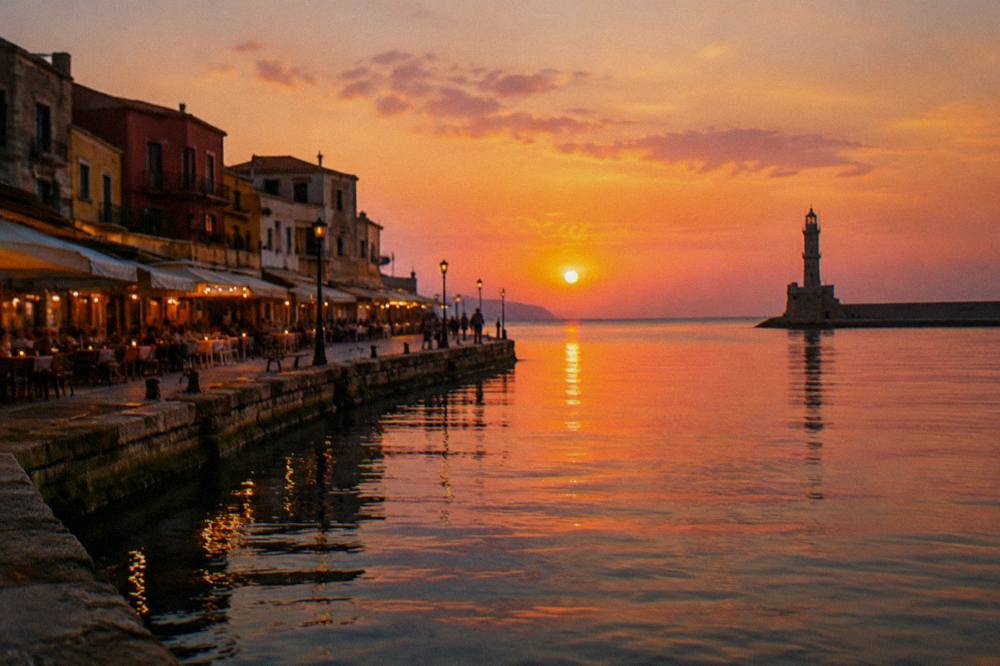
The lighthouse works best as the closing stop of a Chania evening: the mole walk after dinner along the harbour quays, with the tower silhouetted against the western sky and the Old Town lit behind, and the whole circuit flat, free and short enough for any level of fitness. Sunset is the hour the mole fills, and the July and August wind from the north-west is the one thing that moves people back along the path early.
The evening circuit is simple. The quays on both sides of the inner harbour hold restaurants and bars, the subject of the site's restaurant coverage, and the mole begins at the western corner below the Firka. Walking out as the light drops gives the harbour view twice, once in gold and once in blue, and the return passes the Firka and the western quay where the evening crowd sits. The Chania three days itinerary builds the same circuit into a longer stay, with the harbour evening repeated deliberately on the last night.
A harbour evening is also the moment the boat options show themselves. The sunset cruises from the Old Port run in the same hour the mole fills with photographers, and the waterside view of the lighthouse from a boat is the mirror image of the mole view of the boats. The picks below are the desk's three for pairing with a Chania evening, one beach day, one tasting day and one catamaran on the water.
The catamaran option among those three is the one that engages the lighthouse's own element, a run along the coast with meals and drinks included, and it suits a visitor who wants the sea day without the drive to Kissamos.
Is The Lighthouse Walk Suitable For Everyone?
The mole walk to the Chania lighthouse is flat and short, which suits nearly every level of mobility, but the outer stretch of the path is uneven stone with no railing in places and full exposure to sun and wind, so it asks for steady shoes, water in the warm months, and caution with small children and anyone unsteady on rough surfaces. The tower itself has no public interior, so no stairs or climb are involved at any point.
The exposure is the honest caveat. The HNMS Chania Souda table gives mean maximum temperatures of 30.7 C in July and 30.4 C in August, and the mole offers no shade anywhere along its length. In those months the walk is better made in the first or last two hours of daylight, and the middle of the day is better spent in the Old Town's shaded lanes or in the sea at Nea Chora. Families planning around children will find the pairing options in the site's coverage of Chania with kids, and beach alternatives near the Old Town have their own page.
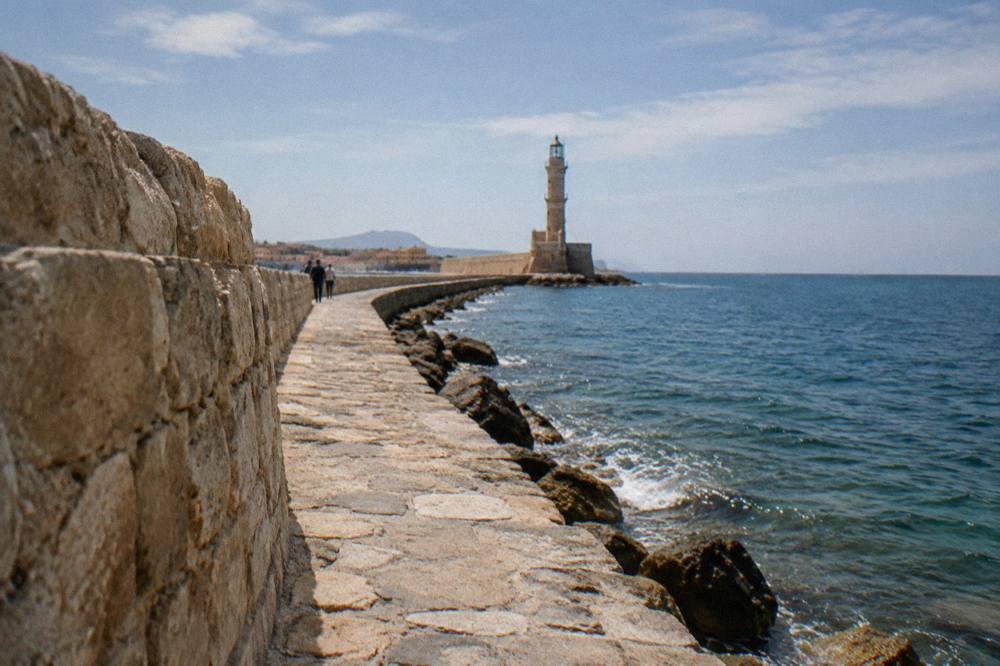
For visitors who cannot or would rather not walk the outer mole, the tower is fully visible from the inner harbour, from the Firka end and from the eastern quay by the Mosque of the Janissaries, and the classic photograph works from the head of the mole without taking the outer stretch at all. The view is generous that way: the lighthouse was built to be seen from the water, and the harbour gives every viewer a version of that sightline for the cost of a short stroll.
Common Questions About The Lighthouse Of Chania
How old is the lighthouse of Chania?
The Venetian base of the lighthouse dates from about 1595 to 1601, and the tower seen today took its present form during the period of Egyptian rule, with restoration works recorded from 1830 to 1840 and the light recorded as operating in 1839.
Can you walk to the lighthouse in Chania?
Yes, the mole is open to foot traffic and free. The path runs from the head of the harbour, below the Firka Fortress, out along the stone mole to the tower. The outer stretch is uneven stone with no shade, so steady shoes and water in summer are advised.
Can you climb the Chania lighthouse?
No, the tower is closed to the public and has no visiting interior. There is no ticket, because there is no entrance; the visit is the walk along the mole and the views from it.
When is the best time to photograph the Chania lighthouse?
The last hour before sunset, when the western sun lights the tower from the harbour side, and the first hour after sunrise. The HNMS Chania Souda station records for 1958 to 2010 show May to September as the dry window, with July averaging 1.0 mm of rain across 0.4 rain days.
Is the Chania lighthouse Venetian or Egyptian?
Both, in layers. The base was laid by the Venetians between about 1595 and 1601, and the tower above it was restored during the period of Egyptian rule, between 1830 and 1840, which is why its present form does not match the simpler profile of a purely Venetian tower.
What else is near the Chania lighthouse?
The Firka Fortress, built in 1620 with free grounds, stands at the head of the mole; the Maritime Museum of Crete sits beside it; the Neoria shipyards run along the eastern shore; and the Old Town, Splantzia and Topanas quarters wrap around the inner harbour, all within a short flat walk.