Firka Fortress Chania
Firka Fortress stands at the north-west corner of Chania's Venetian Harbour, built by the Venetians in 1620 to guard the harbour mouth opposite the lighthouse. Its grounds are free to walk.
Short answer
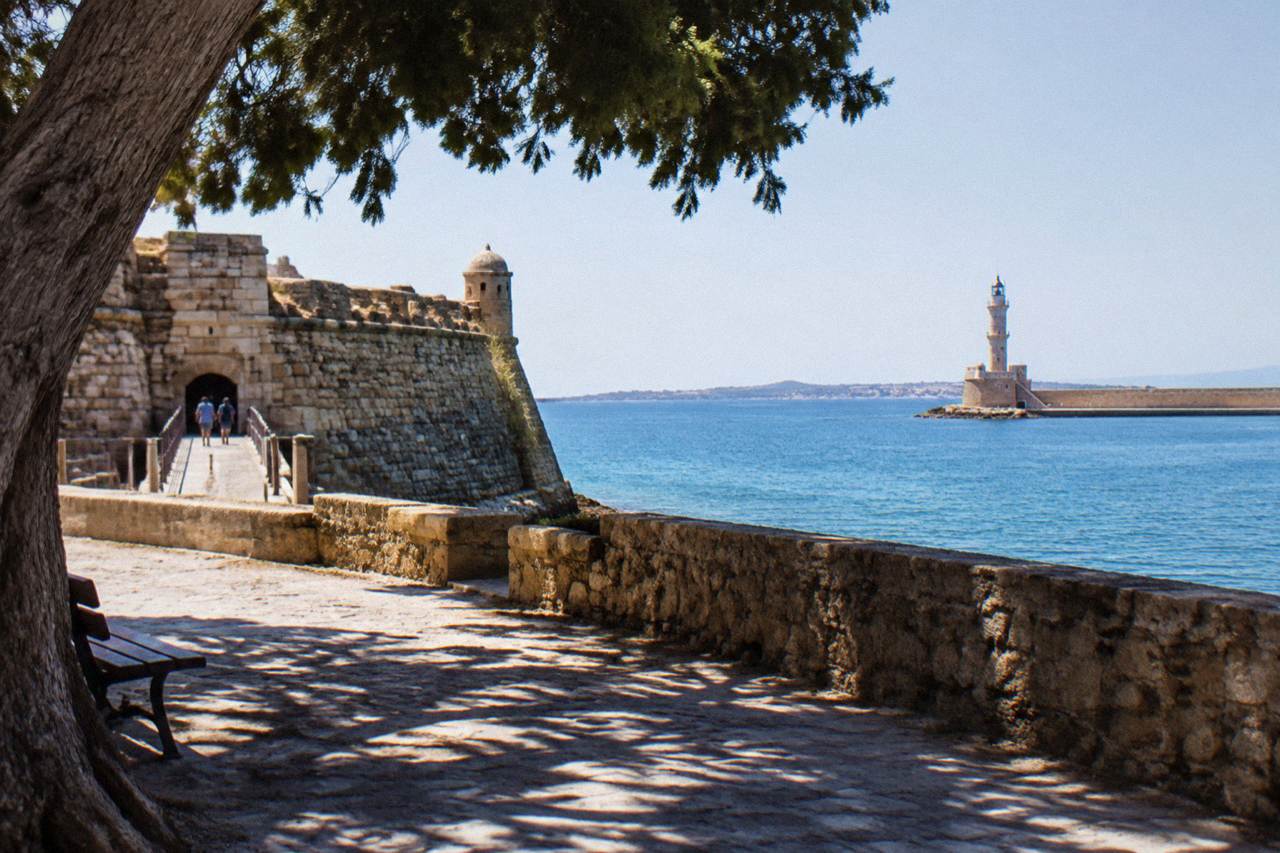
Firka Fortress is a Venetian fort built in 1620 at the entrance of Chania's Venetian Harbour, facing the lighthouse across the channel. The grounds are free to enter and the site shares its space with the Maritime Museum of Crete.
Firka Fortress guards the mouth of the Venetian Harbour in Chania, the coastal city on the north-west coast of Crete in Greece, and it has done the job in one form or another since the Venetians built it in 1620. The fort sits at the north-west corner of the harbour, directly across the channel from the lighthouse, and its stone walls are free to walk today. The Chania Crete Travel Guide desk covers it here as a primary landmark of the Old Town, alongside the harbour and the lighthouse it faces.
What Is Firka Fortress In Chania And Who Built It?
Firka Fortress is a military fort built by the Venetians in 1620 at the entrance of Chania's harbour, designed to control access to the port with guns positioned to command the narrow channel between the harbour mole and the fort's platform. The name refers to a military barracks, and the site kept a garrison role under later rulers before its grounds opened as a public landmark.
The Venetians built Firka late in their long hold on Chania. They had controlled the city since well before, and their harbour works spanned centuries: the Venetian Harbour itself was first constructed between 1320 and 1356, with dredging and a wall recorded in 1515, and the lighthouse across the channel was built around 1595 to 1601. Firka, dated 1620, was the last major piece of that defensive system, placed where cannon could cover any ship attempting the harbour mouth.
Ottoman rule began with the conquest of Chania in 1645, and the fort continued as a barracks and garrison site under the new administration, a role that ended only with the union of Crete with Greece in 1913. That layered history is visible in the fabric of the walls, which record both building campaigns and repairs across nearly four centuries of continuous use.
The site is best understood as one stop on a walk that takes in the whole harbour. The Venetian Harbour guide covers the arc from the shipyards to the mole, and the lighthouse of Chania covers the structure Firka was built to face.
For context on the wider city, Chania's municipality counted 111,375 permanent residents at the 2021 census and covers 356.12 square kilometres, yet the historic core that contains Firka, the harbour and the Old Town lanes is compact enough to cross on foot in well under an hour. That contrast between a large modern municipality and a small walkable centre is the practical reason a fortress built in 1620 still sits at the centre of daily life in the city rather than at its edge.
Where Exactly Does Firka Fortress Sit On The Harbour?
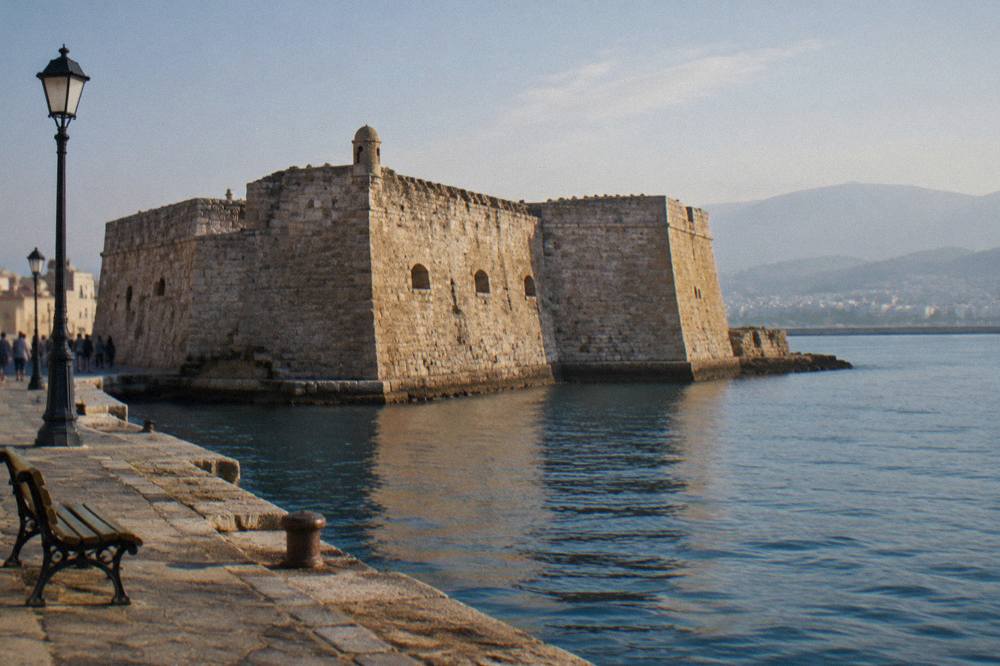
Firka Fortress occupies the north-west corner of the Venetian Harbour in Chania's Old Town, at the point where the old harbour meets the open sea, directly opposite the lighthouse on the mole. Every walking route along the western harbour front leads to it, and it marks the end of the quay before the seafront continues west.
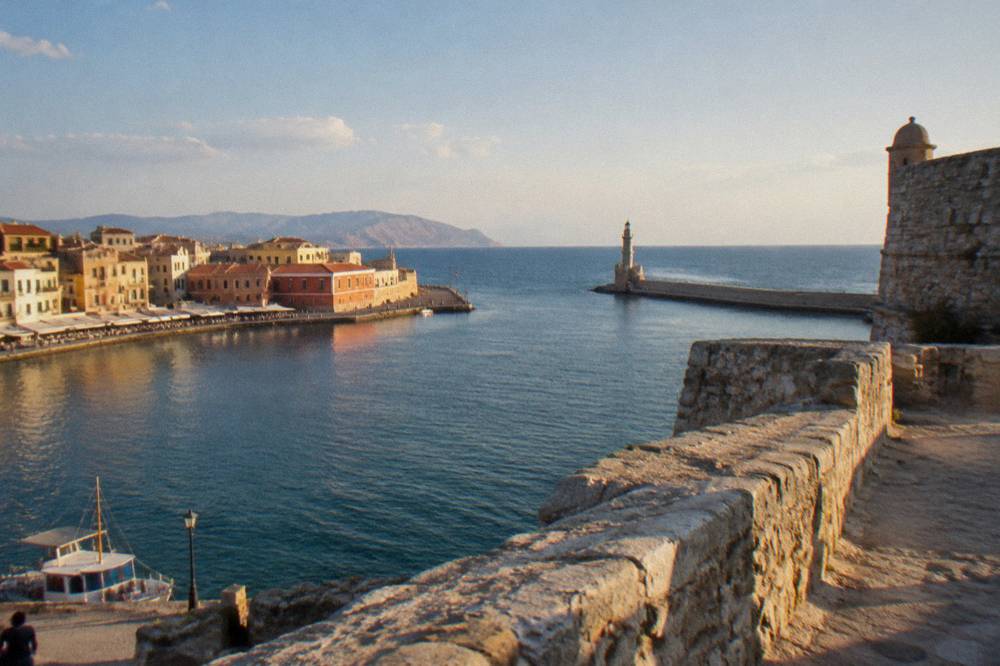
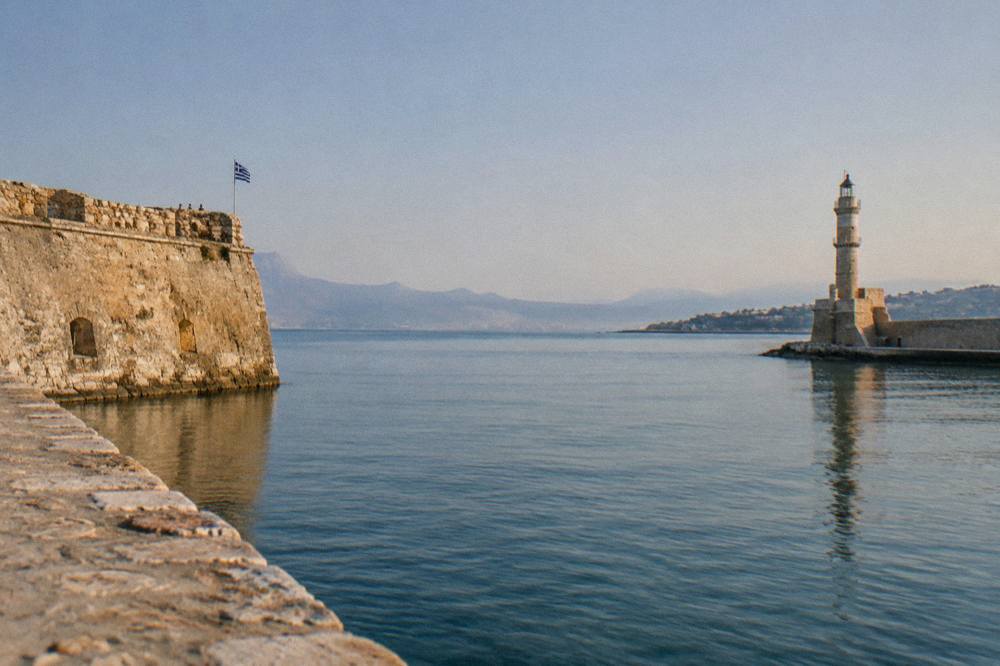
The position is the whole point of the building. The channel between the fort and the lighthouse is the historic harbour entrance, and the fort's platform was sited so guns could command it at short range. Standing on the walls today, the geometry is obvious: the lighthouse rises on its Venetian base a few hundred metres across the water, and the entrance channel between them is narrow enough to explain why both structures exist.
From the Old Town side, the approach runs along the harbour front past the restaurant terraces and the rows of former harbour buildings, with Firka's stone mass closing the view at the end. The walk is flat and short, and the fort connects naturally to the western seafront that continues toward Nea Chora. The Old Town area guide maps the full circuit, street by street, from the Topanas quarter where the fort stands through to Splantzia on the far side of the old city.
For visitors arriving on a cruise call with limited hours, the fort is one of the stops that fits a compressed day, as the Chania cruise port day itinerary sets out. The excursion boats that serve the harbour today, including the sunset and island cruises departing from the Old Port quays, use the same entrance channel Firka was built to command, which puts four centuries of harbour history into a single view from the walls.
What Can You See At Firka Fortress Today?
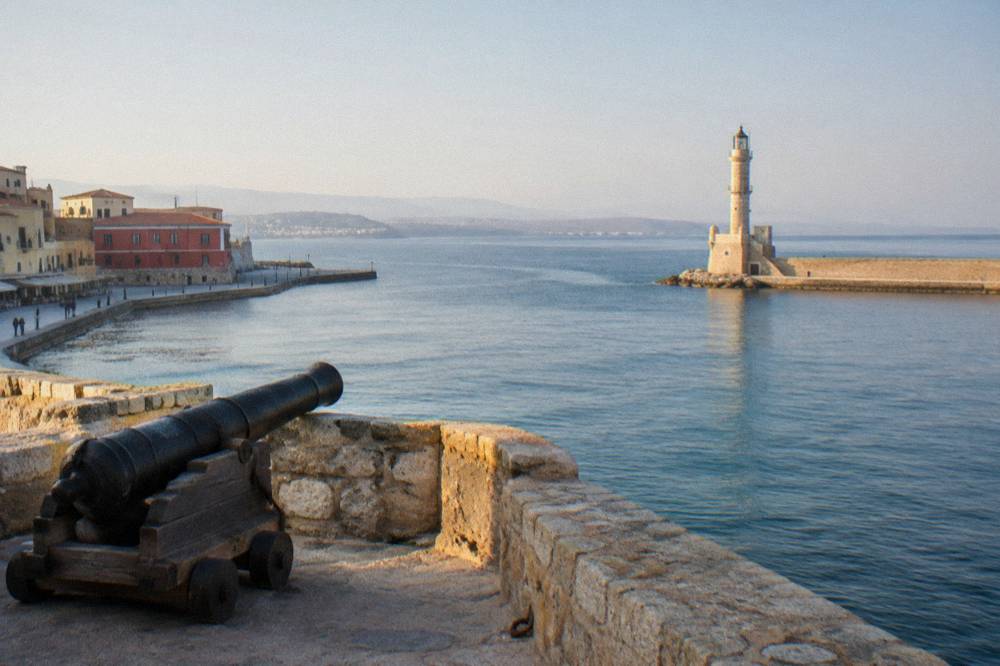
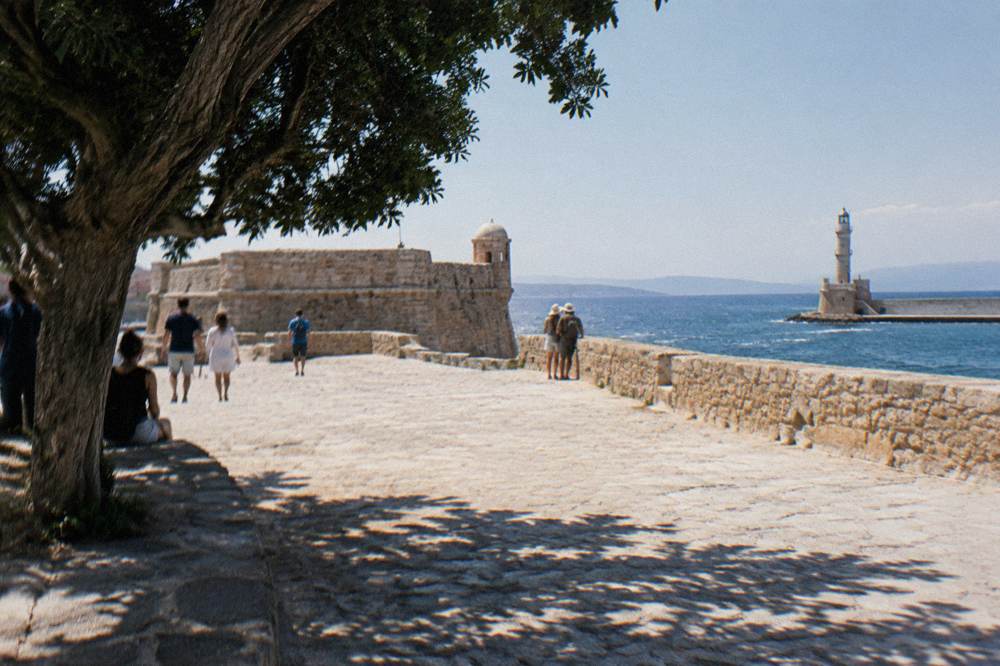
Today Firka Fortress offers free walkable grounds, thick bastion walls with views straight across the harbour entrance to the lighthouse, an open platform at the tip of the fort, and the Maritime Museum of Crete housed within the complex, which covers Greek naval history from antiquity to the modern era in its exhibition rooms.
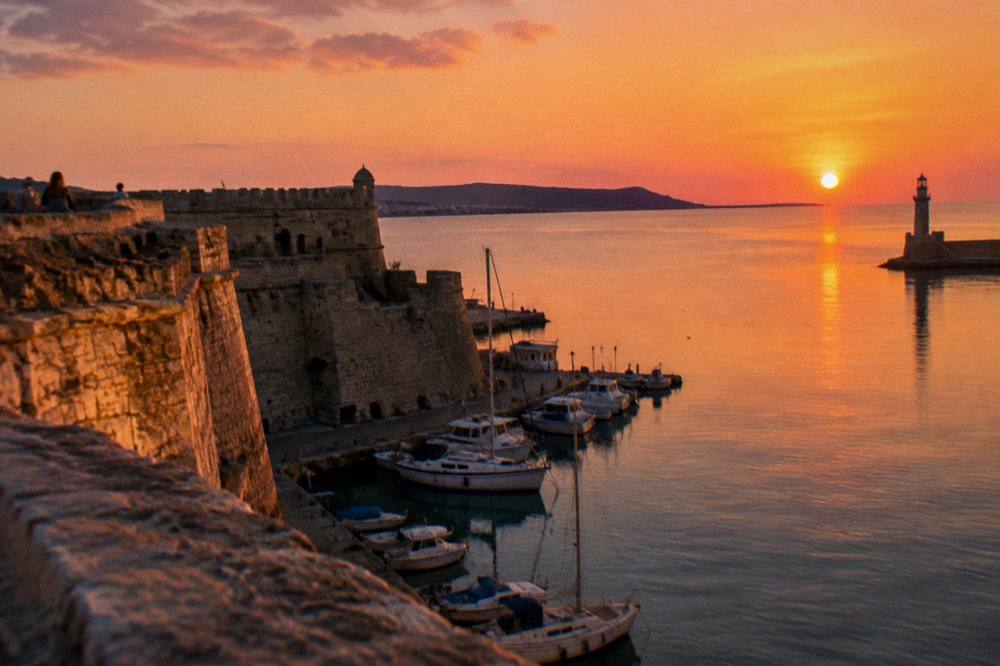
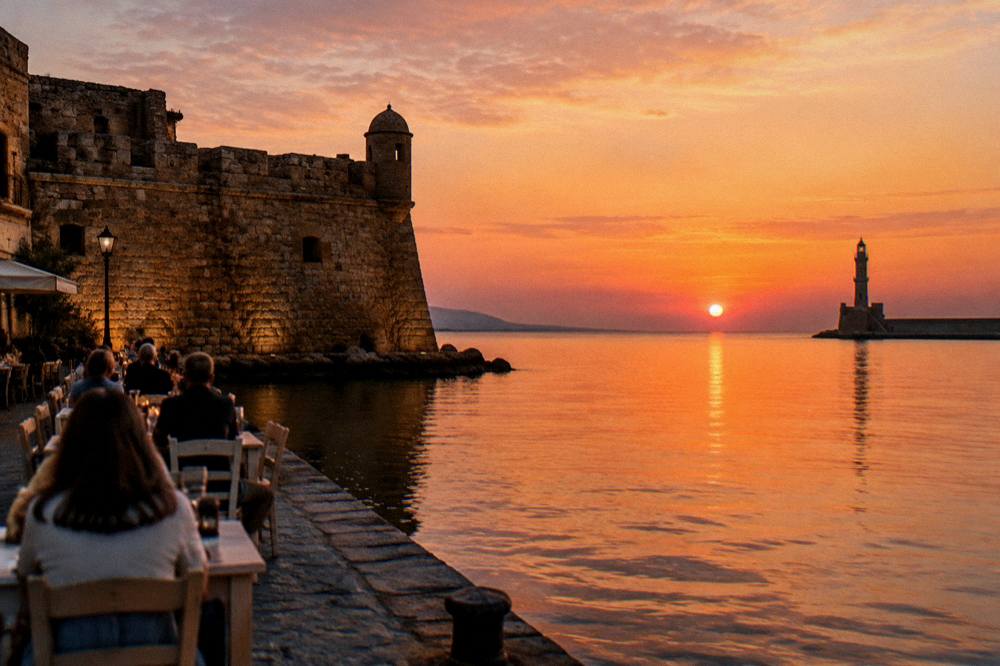
The grounds themselves are the main draw. The walls enclose a compact space, and the seaward edge gives one of the clearest sightlines on the whole harbour: the lighthouse opposite, the entrance channel below, and the open sea beyond. At sunset the platform faces west over the water, which is why the spot appears on so many evening walking routes through the Old Town.
The Maritime Museum of Crete occupies part of the fortress complex. Its collections cover the Greek naval tradition from ancient times through the modern period, and the museum's own rooms are the source for current ticketing and hours, which this desk does not state. The Maritime Museum guide covers what the museum holds in more detail.
Around the fort, the western harbour front continues to the Neoria, the Venetian shipyards, of which seven survive of an original seventeen built in the 15th to 16th century. Together with the municipal market inland and the Etz Hayyim synagogue on the old Jewish street, Firka anchors one end of a dense walkable core that rewards an unhurried loop rather than a point-to-point dash.
Photographically, the fort plays two roles. From the mole, it is the foreground mass that frames the western harbour, and from its own platform it is the viewpoint that turns the lighthouse, the mole and the entrance channel into a single composition. Visitors who want both pictures should walk the mole first, while the light is still on the fort's stone, and then cross back to the platform for the west-facing view as the sun drops.
Is Firka Fortress Free To Visit?
Yes, the fortress grounds at Firka in Chania are free to enter and open as a public space, with no ticket for the walls, the platform or the harbour views. The Maritime Museum of Crete inside the complex is separate, and its admission terms are confirmed on the museum's own channels, since this desk prints no price or hours for it.
That distinction matters for planning. A walk around the walls, the platform and the viewpoint costs nothing and takes as long as the view holds attention. The museum is a distinct visit with its own ticketing, and because its prices and schedule are not stated here, visitors should confirm them before planning a timed stop.
The free grounds make Firka one of the reliable no-cost landmarks in the city centre, alongside the harbour front itself, the lighthouse exterior and the lanes of the Old Town. For travellers watching a budget, it pairs naturally with a self-guided harbour walk and a swim stop, both covered in the wider things to do in Chania round-up.
For comparison with the paid sights in the same core, the table below sets out what is known about access terms at the major Old Town landmarks. Where a cell says to confirm locally, the access terms for that item remain unknown, and that is the honest position rather than a gap to fill with a guess.
| Sight | Access terms | Notes |
|---|---|---|
| Firka Fortress grounds | Free | Open public space |
| Maritime Museum of Crete | Confirm with the museum | Inside the fortress complex |
| Archaeological Museum of Chania | Full ticket EUR 15, concession EUR 8 | At 15 Skra Street, Halepa |
| Lighthouse of Chania | Exterior free | Walkable along the mole |
| Neoria shipyards | Exterior free | Seven survive of seventeen |
| Municipal market | Free to browse | Stalls priced individually |
How Does Firka Compare With Chania's Other Harbour Landmarks?
Firka Fortress is the military piece of Chania's harbour, built in 1620 to defend the entrance, while the lighthouse opposite is the navigation piece from about 1595 to 1601, and the Neoria shipyards are the industrial piece from the 15th to 16th century. Each answers a different Venetian problem, and all three stand within one walkable circuit.
| Landmark | Role | Built | Access |
|---|---|---|---|
| Firka Fortress | Harbour-defence fort and barracks | 1620 | Grounds free |
| Lighthouse of Chania | Navigation light on the mole | About 1595 to 1601, restored 1830 to 1840 | Exterior walkable on the mole |
| Neoria shipyards | Venetian boat sheds | 15th to 16th century, seven of seventeen survive | Exterior walkable |
| Venetian Harbour | The working port itself | First built 1320 to 1356 | Public quays |
| City walls (second circuit) | Land defences | From 1536, Sanmicheli's design | Remnants in the Old Town |
The comparison is worth making on the ground because the harbour reads as a system. The lighthouse guided ships in, Firka decided whether they could enter, and the Neoria built and housed the vessels that used the port. A visitor who walks only one of the three misses the logic of the other two.
The table above also frames the timeline. Firka is the youngest of the major harbour works, finished decades after the lighthouse and more than two centuries after the first harbour construction. Its 1620 date places it at the very end of Venetian confidence on Crete, a quarter century before the Ottoman conquest of Chania in 1645.
The lighthouse carries its own layered story: a Venetian structure of about 1595 to 1601, restored on its original base during the Egyptian-era administration of 1830 to 1840, and recorded as operating in 1839. Reading the two structures together, the fort on one side and the tower on the other, gives the clearest picture of how the harbour entrance was controlled across four distinct periods of rule, Venetian, Egyptian-era, Ottoman and Greek, without needing a single museum label to explain it.
What Is The Best Time Of Day To See Firka Fortress?
Late afternoon into sunset is the strongest time to stand on Firka Fortress, because the platform faces the harbour entrance and the open sea to the west, and the evening light crosses the lighthouse and the harbour front from that side. Morning visits suit photography of the fort itself, when the sun rises behind the Old Town.
The west-facing position does the work here. As the sun drops, the lighthouse opposite turns into a silhouette at the end of the mole, and the entrance channel catches the last light. The evening is also when the harbour restaurants fill and the quays get busier, so a visitor wanting quiet walls should arrive before that wave and one wanting atmosphere after it.
The seasons shift the timing without changing the logic. In July the mean temperature at the HNMS Chania Souda station is 26.7 C with a mean maximum of 30.7 C, so the late-afternoon slot doubles as the cooler part of the day for standing on exposed stone. In January the mean is 11.0 C with 129.5 mm of rain across 16.3 rain days, so a winter visit is a matter of picking a dry window rather than chasing light.
The same light show can be watched from the water. A guided sunset cruise from the Old Port passes the harbour entrance Firka was built to command, and the listing carries the current times and prices for the evening departures: Check availability. The internal page for the sunset boat cruise describes what the trip covers.
How Does Firka Fortress Fit Into One Day In Chania?
Firka Fortress sits at the natural western end of a one-day Chania circuit: start in the Old Town lanes, pass the municipal market, walk the harbour front past the Neoria and the lighthouse mole, and finish at Firka for the harbour-entrance view, ideally holding the fort until late afternoon so the day closes with the sunset from its platform.
The sequencing is flexible because everything is close. The Chania one day itinerary puts the fortress at the end of the harbour leg, while the Chania two days and Chania three days versions push it later, pairing the fort with an evening meal on the way back through the Old Town.
Visitors with a full week can go further afield on the days between harbour walks. The fortress view of the sea is a daily reminder of how close the island excursions are, from the gorges of the White Mountains to the beaches of the west coast, and the wider things to do in Chania page indexes those options.
A one-day plan also needs a realistic sense of what the harbour circuit demands. It is flat, it is short, and every stop on it, the market, the synagogue, the shipyards, the mole, the fort, is exterior-walkable without tickets. The only timed decisions are the museum inside Firka, which needs its hours confirmed, and any boat departure from the Old Port, which needs a booked slot. Everything else bends around the light and the appetite.
What Is The Weather Like Around Firka Fortress Through The Year?
The weather at Firka Fortress follows the coastal Chania pattern, with mean temperatures from 11.0 C in January to 26.7 C in July and rainfall concentrated between October and March, according to the HNMS Chania Souda station table for the period 1958 to 2010. May to September is the dry window, with 13.5 mm of rain in May falling to 1.0 mm in July.
The fortress is an outdoor site, so the rain months matter more here than for the museum interiors. The station table below gives the monthly detail, and it is labelled honestly: these are station records from 1958 to 2010, the period the Hellenic National Meteorological Service publishes for Chania Souda, not a newer normal.
| Month | Mean C | Rain mm | Rain days |
|---|---|---|---|
| Jan | 11.0 | 129.5 | 16.3 |
| Feb | 11.0 | 104.0 | 14.5 |
| Mar | 12.7 | 76.0 | 11.5 |
| Apr | 15.9 | 31.5 | 7.7 |
| May | 20.2 | 13.5 | 4.2 |
| Jun | 24.7 | 3.4 | 1.2 |
| Jul | 26.7 | 1.0 | 0.4 |
| Aug | 26.3 | 1.4 | 0.6 |
| Sep | 23.2 | 15.4 | 3.2 |
| Oct | 19.4 | 67.7 | 9.3 |
| Nov | 15.8 | 77.0 | 11.2 |
| Dec | 12.7 | 101.9 | 16.1 |
Within the table, January is the wettest month at 129.5 mm and July the driest at 1.0 mm. Rain starts to matter again from October, which records 67.7 mm, while the May to September stretch stays dry. Humidity in the same station table runs from 50 percent in July to 73 percent in January, and the prevailing wind is west, turning north-west in July and August, which is the wind a visitor standing on the seaward platform feels first.
The wind detail is more than trivia at this particular site. The fortress platform is exposed on its seaward face, and the north-westerly pattern of high summer means the freshest standing spot on a July evening is the one with the view. The table below translates the station record into what each season means for a visit here.
| Season | Station record, 1958 to 2010 | What it means at Firka |
|---|---|---|
| December to February | Means of 11.0 to 12.7 C, rain 101.9 to 129.5 mm a month | Pick a dry window, bring a layer for the exposed platform |
| March to April | Means of 12.7 to 15.9 C, rain falling to 31.5 mm | Comfortable walking weather, changeable skies |
| May to June | Means of 20.2 to 24.7 C, rain 3.4 to 13.5 mm | Dry, bright, warm stone by midday |
| July to August | Means of 26.3 to 26.7 C, rain about 1 mm | Evening visits suit the exposed walls |
| September to November | Means of 15.8 to 23.2 C, rain rising to 77.0 mm | Warm sea air, first wet days returning |
For a fuller reading of the seasons, including which months suit which trips, the Chania weather and best time to visit Chania guides carry the detail.
What Else Is Within Walking Distance Of Firka Fortress?
Within a short walk of Firka Fortress visitors reach the lighthouse mole, the Neoria shipyards, the Etz Hayyim synagogue, the municipal market and the lanes of the Old Town, all inside the historic core, while the seafront toward Nea Chora beach extends west from the fort's base for a longer shore walk.
The immediate circuit is compact enough that no transport is needed. The table below lists the walking-radius sights and what each one covers, with the in-depth page for each on this site.
| Sight | Direction from Firka | Coverage on this site |
|---|---|---|
| Lighthouse of Chania | Across the channel, via the mole | Lighthouse guide |
| Neoria shipyards | East along the harbour | Venetian Harbour guide |
| Etz Hayyim synagogue | South-east, in the Old Town | Etz Hayyim guide |
| Municipal market | South, at the edge of the Old Town | Municipal market guide |
| Nea Chora beach | West along the seafront | Nea Chora beach guide |
| Maritime Museum of Crete | Inside the fortress complex | Maritime Museum guide |
The western extension deserves its own mention. The seafront from the base of the fort runs toward Nea Chora, the city's working beach quarter, so a morning at the fortress can turn into an afternoon on sand without any transport at all. In the other direction, the harbour front east of the Neoria opens toward the Splantzia side of the old city, a quieter quarter with its own churches and tavernas, covered in the Old Town area guide.
Beyond the walking radius, the day-trip belt opens up. The Balos lagoon and Gramvousa cruises leave from Kissamos to the west, the gorge hikes run into the White Mountains to the south, and a 4x4 safari route to Balos uses the unpaved road from Kaliviani. The jeep option below is one way to reach that coast without a boat.
Common Questions About Firka Fortress Chania
Is Firka Fortress free to visit?
Yes, the fortress grounds are free to enter. The Maritime Museum of Crete inside the complex is a separate visit with its own admission terms, which visitors confirm before a timed stop.
How old is Firka Fortress in Chania?
The Venetians built the fort in 1620, making it the youngest of the major Venetian harbour works in the city. It stands close to the end of Venetian rule, which gave way to Ottoman control from the 1645 conquest of Chania.
Where is Firka Fortress located?
The fort occupies the north-west corner of the Venetian Harbour in Chania's Old Town, at the point where the historic harbour meets the open sea, directly across the entrance channel from the lighthouse.
Can you see the lighthouse from Firka Fortress?
Yes, the lighthouse stands opposite the fort on the harbour mole, and the platform gives a direct sightline across the narrow entrance channel. The view is one of the main reasons to walk out to the walls.
Is Firka Fortress good at sunset?
The platform faces west over the harbour entrance and the open sea, so the evening light crosses the lighthouse and the mole from that side. Late afternoon into sunset is the strongest window for the view from the walls.
How long does a visit to Firka Fortress take?
A walk of the free grounds, walls and platform takes as long as the view holds attention, and the site sits at the end of the harbour front, so it slots naturally into a harbour circuit rather than standing as a timed destination.
The fortress closes the harbour walk at its sea-facing end, and the same walls that covered the entrance in 1620 now frame the lighthouse, the mole and the evening sea for anyone who walks out to them.