Chania Bus
Chania is a compact coastal city on the north-west coast of Crete, and its bus network, port and airport connections cover the routes a visitor actually needs. This guide sets out what the operators themselves publish, route by route.
Short answer
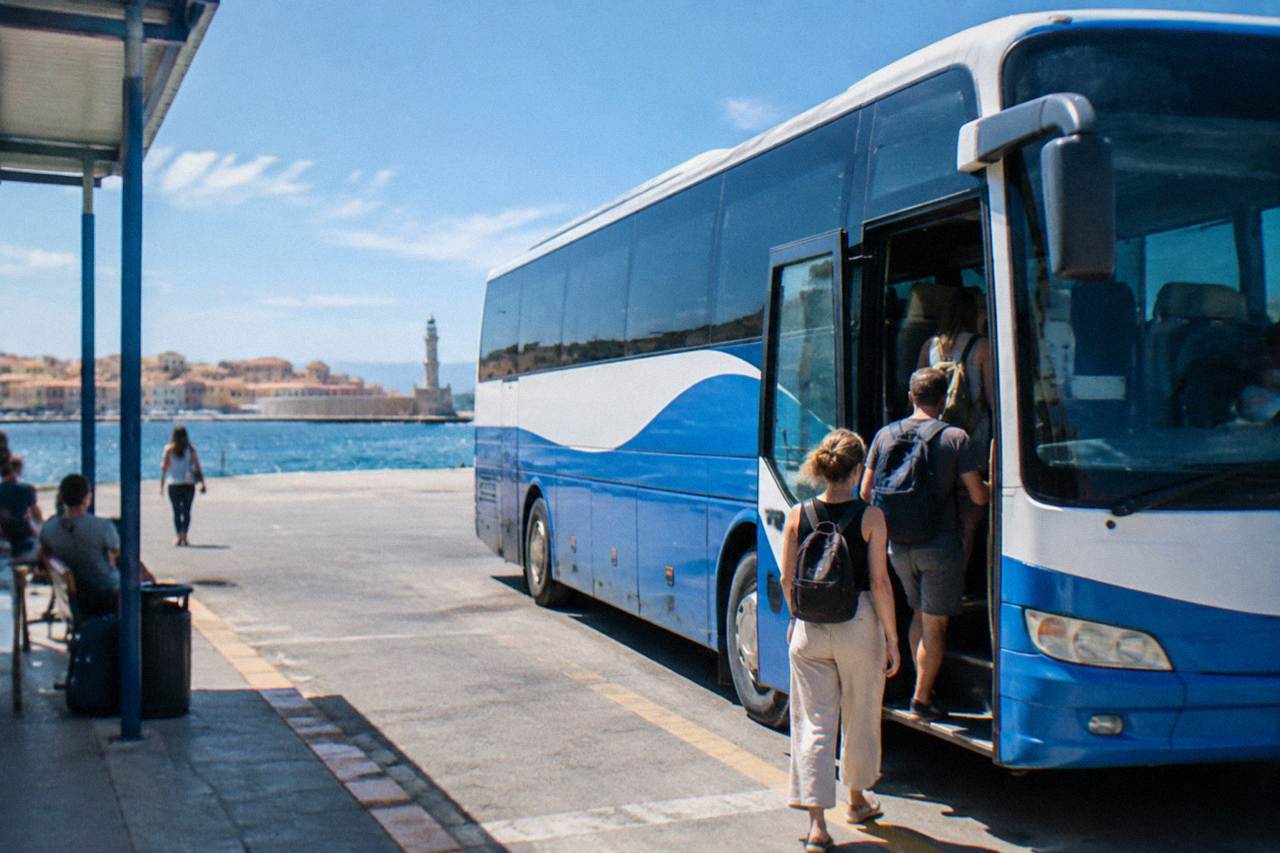
The KTEL Chanion bus station on Kydonias street runs long-distance routes to Heraklion, Rethymno, Kissamos, Paleochora, Omalos and, in summer, Elafonisi; tickets are booked at e-ktel.com. The airport is about 14 km from the centre, and the overnight Piraeus ferry leaves from Souda port, not the Venetian Harbour.
Chania is a compact coastal city on the north-west coast of Crete, Greece, with its Old Town wrapped around the Venetian Harbour, the White Mountains to the south and the airport on the Akrotiri peninsula to the east. Getting around does not demand a car for the city itself, and the regional bus network reaches the towns the day trips depend on. This guide reports what the operators publish: the KTEL Chanion network, the airport connection, the Souda port ferry, and the practical reality of driving, parking and walking in a city whose street plan predates the car by several centuries.
How Do You Get Around Chania Without A Car?
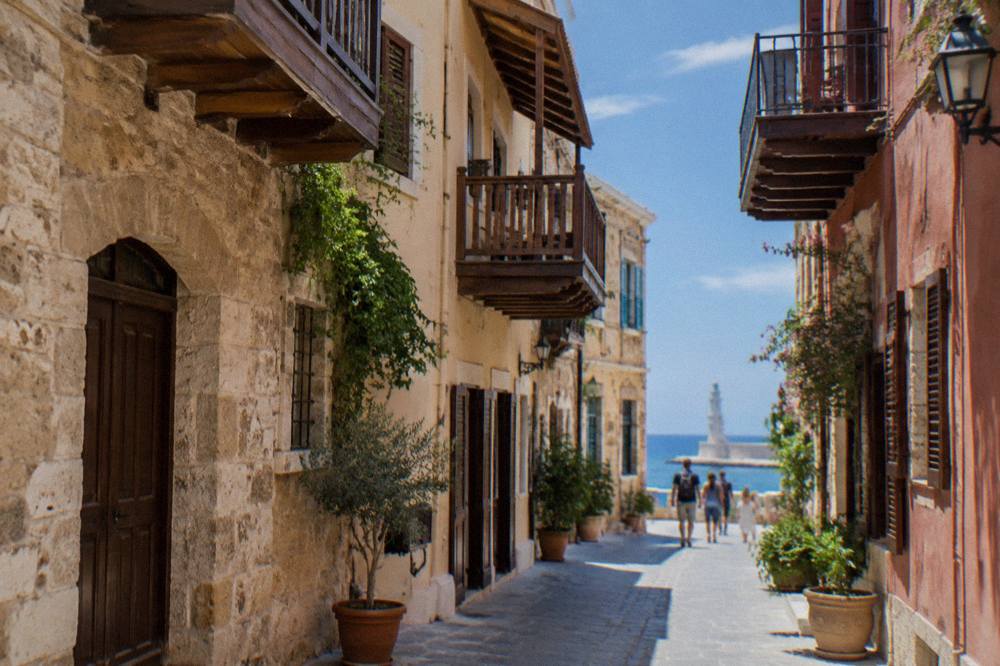
For the city itself, walking is the main transport, because the Old Town, the harbour and the beach districts sit close together, and the longer hops are covered by the KTEL regional buses that leave from the station on Kydonias street. Cars are useful for the far west coast and the mountain villages, not for moving inside Chania. The narrow lanes of the Old Town were laid out long before engines, parking in summer is tight, and the distances from the Venetian Harbour out to Nea Chora or the lighthouse are short. The bus station on Kydonias street is the hub for everywhere beyond the city.
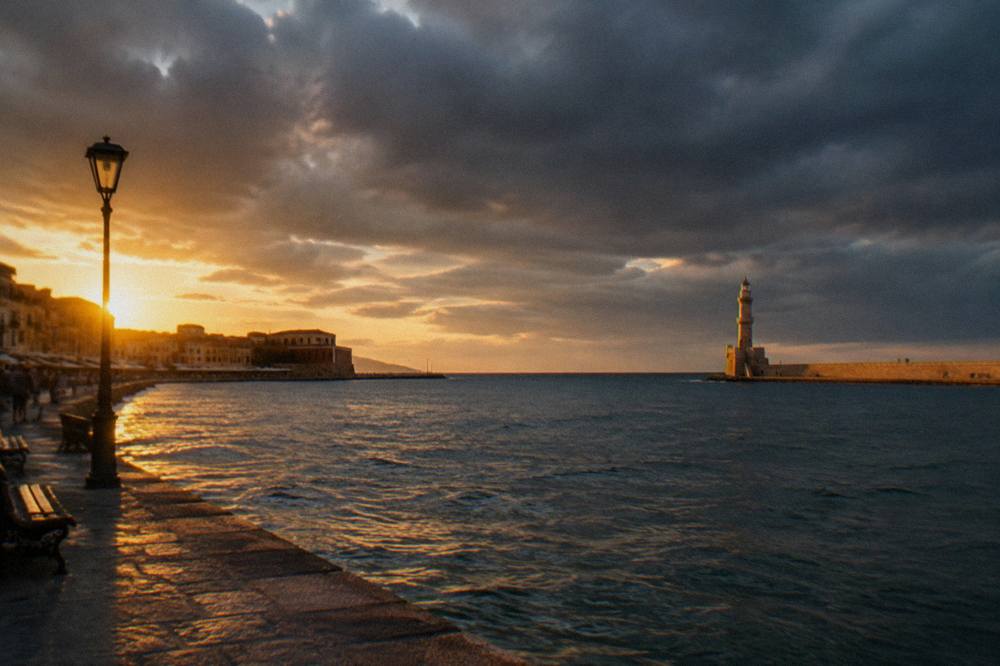
The municipality counted 111,375 permanent residents at the 2021 census across 356.12 km2, and much of that area is walkable districts strung along the coast. The Venetian Harbour was first built between 1320 and 1356, the lighthouse stands on the harbour mole on a Venetian base, and Firka Fortress, built in 1620, guards the harbour mouth. All of it is best seen on foot, and the guide to the Old Town lays out the walking routes street by street.
For a visitor deciding where to base themselves, this matters: staying inside or beside the Old Town removes the need for any daily transport at all. The where to stay in Chania guide covers the districts, from the harbour itself out to Nea Chora and Halepa, each with a different walk-to-everything profile.
What Does The Chania Bus Network Cover?
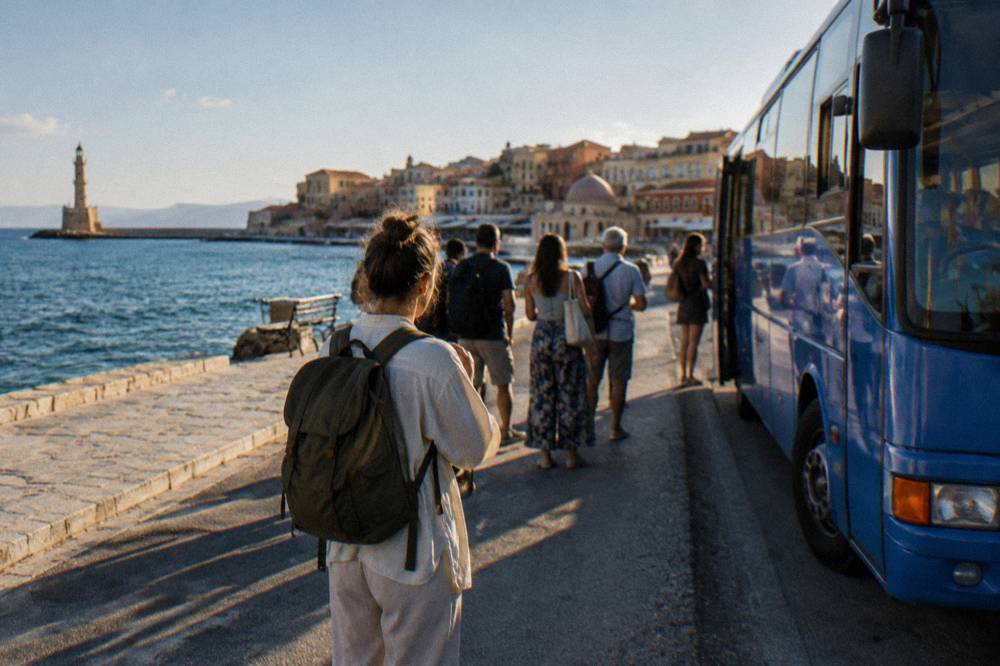
The KTEL Chanion long-distance bus station sits on Kydonias street in the city centre, and its published routes run to Heraklion, Rethymno, Kissamos, Paleochora, Omalos and, in the summer season only, Elafonisi, with tickets booked through the operator's own site at e-ktel.com. That single network connects Chania to the island's other two big cities, to the west-coast ports that serve Balos and Falassarna, to the south coast at Paleochora, and to the Omalos plateau where the Samaria Gorge route begins. It is the backbone of car-free travel in western Crete.
No fare is printed here, because KTEL's fares are not in the verified information for this page; the operator's own site carries current prices and timetables. What is verified is the network itself: those six destinations are the published long-distance routes, and the Elafonisi service runs in the summer season only. The KTEL Chania buses guide goes deeper on the station and how the routes fit a visit.
One point the timetable does not spell out: there is no railway anywhere on Crete, so the bus is the only scheduled land transport between the cities. That is worth internalising early, because a traveller who assumes a train connection exists, as it would in much of mainland Europe, will plan day trips that cannot be made.
The routes line up neatly with the day trips the region is known for. Kissamos is the departure port for the Balos and Gramvousa boats, which run daily to 31 October 2026 on the operator's published season. Omalos is the plateau where the Samaria walk starts at Xyloskalo. Rethymno and Heraklion are cities in their own right, and the Heraklion and Knossos guide covers what waits at the far end of that line.
How Do You Get From Chania Airport To The City?
Chania International Airport Ioannis Daskalogiannis, CHQ, is about 14 km from the city centre, on the Akrotiri peninsula near Souda, and the airport's own site lists the public bus and taxi options for the transfer; no fare is printed on the official page. The airport is operated by Fraport Greece and handled 3,992,149 passengers between January and October 2025, so the transfer options are built for volume, not for a sleepy provincial field.
The distance is the detail worth fixing in mind, because it is often misquoted. Fourteen kilometres from the centre means the transfer is a real journey, not a taxi hop from the terminal to the Old Town gates. The Chania airport to Chania town guide walks through the options in detail, and the Chania airport guide covers the terminal itself.
Car hire desks serve the airport, and the airport car rental guide explains when picking a car up at CHQ makes sense, versus taking the transfer into town and hiring from a city desk later. For anyone heading straight to a beach base west of the city, an airport car can save a transfer followed by a second pickup.
Where Does The Ferry To Piraeus Leave From?
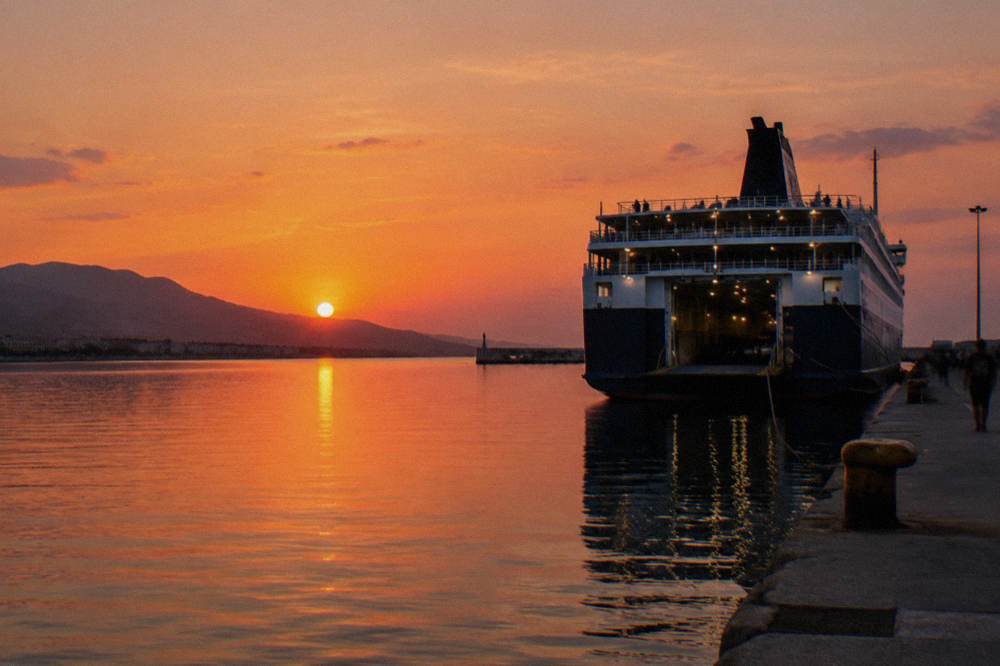
The overnight ferry to Piraeus leaves from Souda port, about 7 km east of the Old Town, never from the Venetian Harbour, which serves excursion boats only; Blue Star Ferries publishes a departure around 21:30 and a crossing of about 9 hours 15 minutes, to be confirmed against the operator's timetable. Getting this wrong is the classic Chania navigation error, because the Venetian Harbour looks like a port and is full of boats, but none of them goes to Athens.
Souda is also the bay the airport sits beside, on the opposite side from the city, so a ferry arrival and an airport arrival both begin with the same 7 km hop into the Old Town. The Piraeus to Chania ferry guide covers the crossing, and the Athens to Chania guide compares the ferry against the flight. No ferry fare appears anywhere on this page, because the operator's fares move and the verified pack does not license a number.
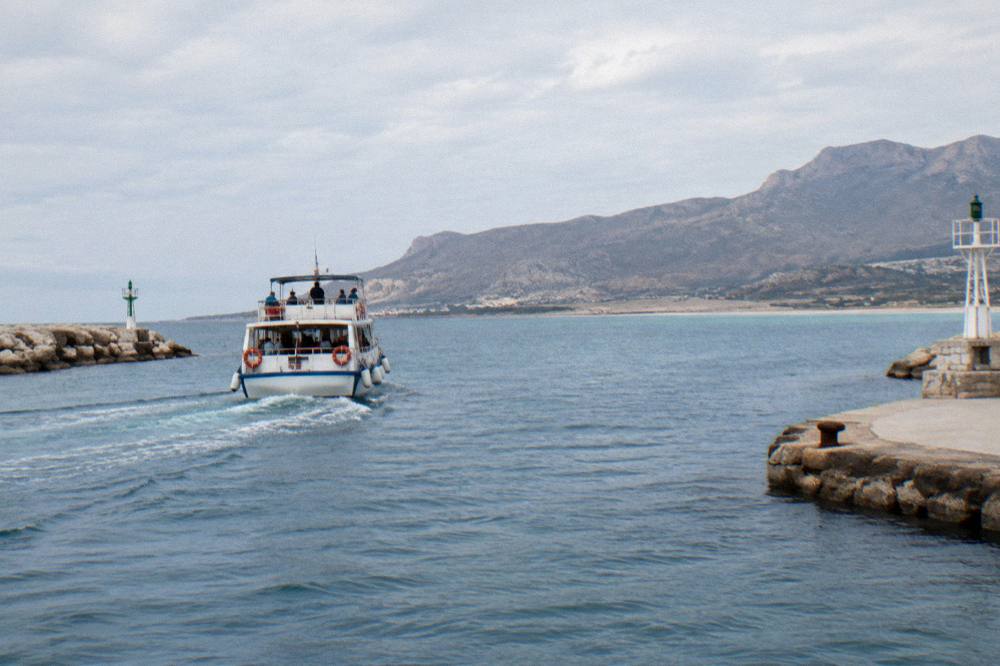
The Venetian Harbour's own boats are the sunset cruises, the snorkelling trips and the visits to Lazaretta and Agioi Theodoroi, and those are booked as tours rather than as transport. A short cruise from the Old Port is one of the easiest ways to see the lighthouse and the city walls from the water without organising anything beyond a departure time.
Is Driving In Chania And Crete A Good Idea?
Driving is the flexible option for the far west coast and the White Mountains, where bus frequency thins out, but inside Chania the car is a liability: the Old Town's lanes predate engines, summer parking is tight, and the island's roads reward preparation. A car earns its keep on the routes the buses serve thinly, the loop to Balos by road from Kaliviani, the beaches of Falassarna, the mountain villages above Omalos. The driving in Crete guide exists precisely because those roads need explaining before they are driven.
The Balos road is the case study. From Kaliviani at the top of the Kissamos bay, an unpaved road runs to a parking area, and from there the lagoon is reached on foot down a path. That is a drive many visitors are glad they made and many others regret, and the choice depends on comfort with rough surfaces rather than on driving skill. The Balos lagoon and Gramvousa guide lays out the boat alternative from Kissamos port, which skips the road entirely.
Within the city, the parking guide covers where a car can actually be left, and the car rental guide covers the hire itself. Between them they answer the question most drivers arrive with, which is not whether to hire but where the car goes once the day trips are done and the Old Town is the destination.
A middle path exists, and it is the one many visitors settle into: stay car-free in the city, and take guided day tours for the routes where a driver adds value. A wine and olive oil tour into the hinterland, for instance, removes both the driving and the question of who tastes and who steers, and the tasting rooms are inland where the bus network is thin.
What About Walking And Cycling In The City?
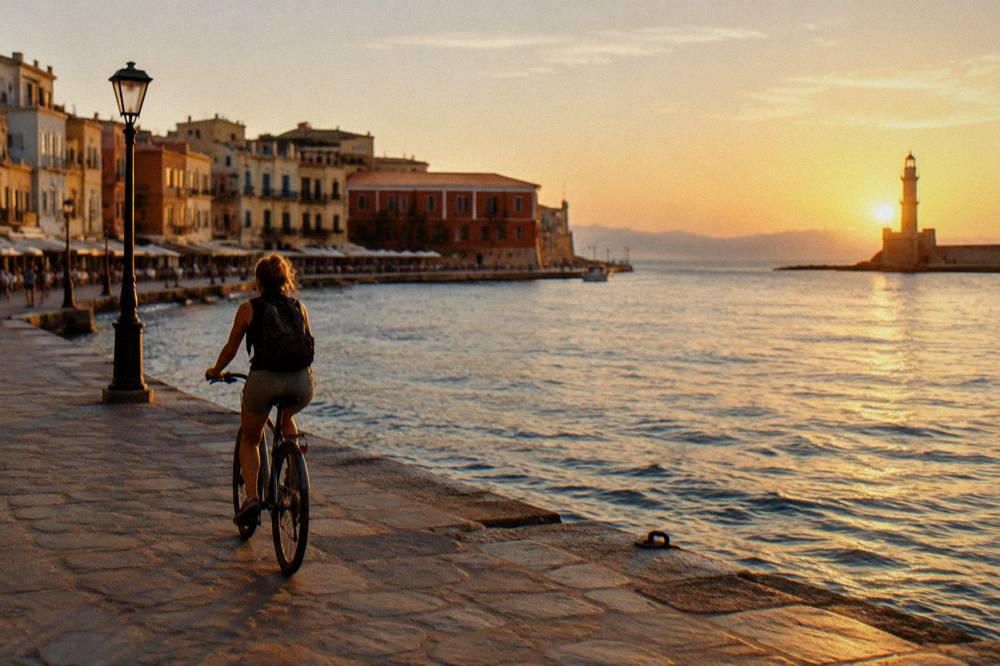
Walking covers Chania's core entirely, from the Venetian Harbour to Nea Chora beach and through Splantzia to the east, and the city's flat coastal geography makes a bicycle a genuine alternative, with small-group bike tours operating from the centre. The distances that matter are short: harbour to lighthouse, harbour to the Municipal Market, market to the Koum Kapi district. None of them justifies waiting for a bus.
The strolling is not just practical, it is the point. Seven Neoria shipyards, survivors of an original seventeen from the 15th to 16th century, line the harbour's eastern mole. The city's second walls, built from 1536 to Michele Sanmicheli's design, still shape the street pattern. Ottoman rule began with the 1645 conquest of Chania and the union of Crete with Greece came in 1913, and every one of those layers is visible at walking pace. The walking tours guide covers the organised versions.
Cycling suits the flat seafront and the long stretch west through Nea Chora toward Agia Marina, and the Agia Marina and Platanias guide covers that coast. The Akrotiri peninsula to the east is hillier, and the Akrotiri peninsula guide is the reference for its monasteries and coves.
How Do Day Trips From Chania Work Without A Car?
Day trips from Chania run on three systems: the KTEL buses to Kissamos, Omalos, Paleochora and the cities; the excursion boats from Kissamos port to Balos and Gramvousa, and from the Venetian Harbour along the immediate coast; and guided tours with hotel pickup, which cover the routes where a bus connection does not exist or does not fit a single day. A visitor can mix all three in one week without ever holding a car key.
The pieces have conditions worth stating plainly. Samaria Gorge is a managed national park run by NECCA, the Natural Environment and Climate Change Agency, which normally opens 1 May to 31 October; storms in late September and early October 2026 destroyed sections of the path, staff describe a 2026 reopening as extremely difficult, and works are aimed at readiness in May 2027, so the NECCA status has to be checked before any plan is made. The individual ticket is EUR 10 through the NECCA e-ticket portal, free for EU residents under 18 and over 65. The walk is one-way from Xyloskalo on the Omalos plateau down to Agia Roumeli, where boats leave around 17:30 for Sougia or Chora Sfakion to meet a KTEL bus back, and the tour price excludes the separate entrance and ferry charges.
Balos carries its own small print. The only confirmed charge is a EUR 1 Kissamos municipal fee collected on the boat ticket for over-13s; a proposed time-slot cap of roughly 1,200 visitors per three hours was announced in August 2026 but is not in force, so no cap should be assumed. Boats run daily from Kissamos to 31 October 2026 on the operator's season. Elafonisi, a Natura 2000 protected area, is free to enter and taking sand, shells or plants is prohibited, with a summer KTEL bus as the car-free route. The best tours from Chania guide sorts the full menu.
The guided option removes the timetable puzzle entirely, and for the long hauls it is often the only single-day shape that works. Knossos and Heraklion, for instance, sit at the end of a bus route that consumes the day before the site is even reached, and a guided tour compresses the logistics into one booking. The same logic applies to the sea: a guided snorkelling trip with pickup handles the drive to the bay, the gear and the boat in one product.
For the pages behind each decision, the site carries dedicated guides: Samaria Gorge, Elafonisi beach, Falassarna beach, and the comparison piece Elafonisi vs Balos for travellers torn between the two.
What Does The Weather Mean For Getting Around?
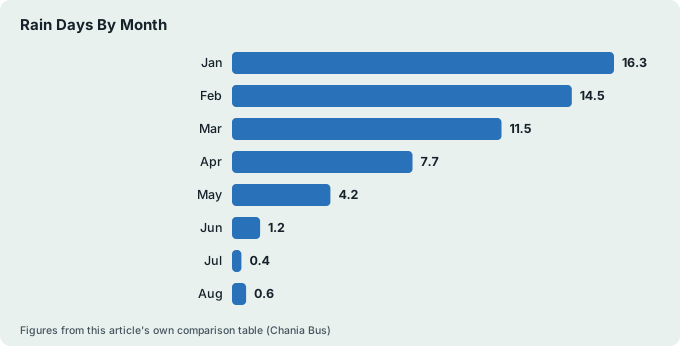
The HNMS Chania Souda station table, covering the period 1958 to 2010, shows why transport planning in Chania is seasonal: May to September is dry, with 13.5 mm of rain in May and 1.0 mm in July, while October jumps to 67.7 mm and January carries 129.5 mm across 16.3 rain days. Buses, boats and mountain roads all run against that curve.
The practical consequences are concrete. Rain matters from October onward, and the summer bus to Elafonisi runs precisely in the dry months. Storm damage closed Samaria Gorge in the 2026 season, which is exactly the failure mode the autumn rainfall numbers describe. Prevailing winds blow from the west, turning north-west in July and August, and that is the pattern boat operators work around on the open crossings to Gramvousa.
| Month | Mean Temp C | Rain mm | Rain Days |
|---|---|---|---|
| Jan | 11.0 | 129.5 | 16.3 |
| Feb | 11.0 | 104.0 | 14.5 |
| Mar | 12.7 | 76.0 | 11.5 |
| Apr | 15.9 | 31.5 | 7.7 |
| May | 20.2 | 13.5 | 4.2 |
| Jun | 24.7 | 3.4 | 1.2 |
| Jul | 26.7 | 1.0 | 0.4 |
| Aug | 26.3 | 1.4 | 0.6 |
| Sep | 23.2 | 15.4 | 3.2 |
| Oct | 19.4 | 67.7 | 9.3 |
| Nov | 15.8 | 77.0 | 11.2 |
| Dec | 12.7 | 101.9 | 16.1 |
The figures are station records from the HNMS Chania Souda station, at 148 m inland of Souda Bay, covering 1958 to 2010, which is the period the service publishes. The Chania weather and best time to visit guides build on the same table for the wider planning picture.
What Are The Key Transport Facts To Keep Straight?
Four facts prevent the classic Chania transport errors: the airport is about 14 km out at Akrotiri, the Piraeus ferry leaves from Souda port rather than the Venetian Harbour, the long-distance buses leave from Kydonias street, and there is no railway anywhere on Crete. Every other decision, car or no car, bus or tour, follows from those four.
| Transport Fact | Verified Detail |
|---|---|
| Airport | CHQ, Ioannis Daskalogiannis, about 14 km from the centre, Akrotiri peninsula, Fraport Greece operator |
| Airport traffic | 3,992,149 passengers, January to October 2025 |
| Ferry port | Souda, about 7 km east of the Old Town |
| Ferry to Piraeus | Blue Star Ferries, overnight, departure about 21:30, crossing about 9 h 15 min |
| Bus station | KTEL Chanion, Kydonias street |
| Bus routes | Heraklion, Rethymno, Kissamos, Paleochora, Omalos, Elafonisi in summer |
| Railway | None on Crete |
Two further tables settle the access questions that come up around the big day trips, using only the charges the operators themselves publish. The first is the verified fee picture at the headline destinations; the second is the dated history of the transport landmarks a visitor walks past while waiting for any of it.
| Destination | Access Detail |
|---|---|
| Samaria Gorge | EUR 10 ticket via the NECCA e-ticket portal, free for EU under-18 and over-65; normally 1 May to 31 October, check NECCA status after storm damage |
| Balos and Gramvousa | Boats from Kissamos port, EUR 1 municipal fee on the ticket for over-13s, daily to 31 October 2026 |
| Elafonisi | Natura 2000 area, free entry, sand, shells and plants protected, summer KTEL bus |
| Archaeological Museum | 15 Skra Street, Halepa, EUR 15 full ticket, EUR 8 concession, check the museum's visit page for hours |
| Firka Fortress | Grounds free, fort built 1620 |
| Landmark | Date From The Record |
|---|---|
| Venetian Harbour first built | 1320 to 1356 |
| First city walls | 1336 to about 1356 |
| Lighthouse built | About 1595 to 1601 |
| Neoria shipyards | 15th to 16th century, seven of an original seventeen |
| Firka Fortress | 1620 |
| Second walls, Sanmicheli design | From 1536 |
| Ottoman conquest of Chania | 1645 |
| Union of Crete with Greece | 1913 |
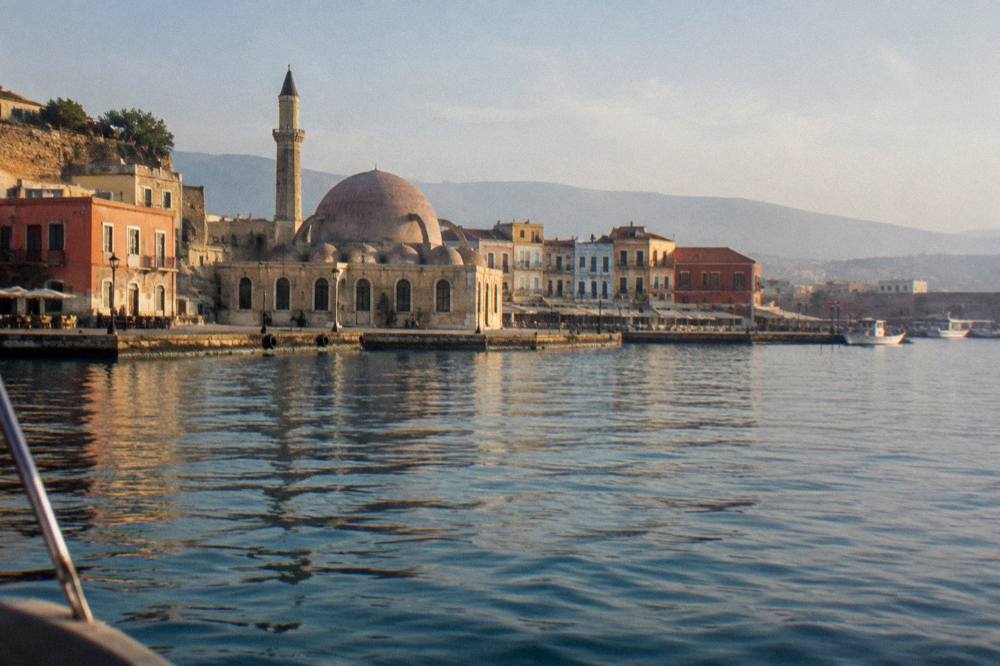
The longer itineraries tie all of this together. The Chania in three days and west Crete in one week guides sequence the buses, boats and tours into working plans, and the how many days in Chania guide sizes the stay. For the evenings that need no transport at all, the Chania restaurants guide stays inside walking distance of the harbour.
Common Questions About Getting Around Chania
Is There A Train In Chania?
No. There is no railway anywhere on Crete, so the KTEL buses and the roads carry all land travel between the cities. Any plan that assumes a rail connection cannot be made.
Where Does The Ferry To Athens Leave From?
From Souda port, about 7 km east of the Old Town. The Venetian Harbour in the city centre serves excursion boats only. Blue Star Ferries publishes an overnight departure around 21:30 with a crossing of about 9 hours 15 minutes, which should be confirmed against the operator's timetable.
Can You Get To Balos Without A Car?
Yes. Excursion boats run from Kissamos port, which the KTEL bus network reaches, with daily departures to 31 October 2026 on the operator's published season. A EUR 1 Kissamos municipal fee is collected on the boat ticket for over-13s. Driving is also possible via an unpaved road from Kaliviani to a parking area, followed by a walk down.
How Far Is Chania Airport From The City Centre?
About 14 km. The airport, officially Chania International Airport Ioannis Daskalogiannis, sits on the Akrotiri peninsula near Souda and is operated by Fraport Greece. Public bus and taxi information is listed on the airport's own site.
Can You Visit Elafonisi By Bus?
In summer, yes. KTEL Chanion runs a seasonal Elafonisi route from the Kydonias street station. Elafonisi is a Natura 2000 protected area with free entry, and taking sand, shells or plants is prohibited.
Is The Old Town Of Chania Walkable?
Yes, entirely. The Old Town, the Venetian Harbour, the Municipal Market and the seafront districts sit within a compact area, and the walking tours guide on this site covers the routes and the landmarks along them.
Getting around Chania comes down to a short list of anchors: the Kydonias street bus station for the region, Souda for the ferry, the Akrotiri peninsula for the flight, and your own feet for the city. Everything beyond that is a day-trip decision, and this Chania Crete Travel Guide carries a dedicated page for each one of them.