Chania Airport
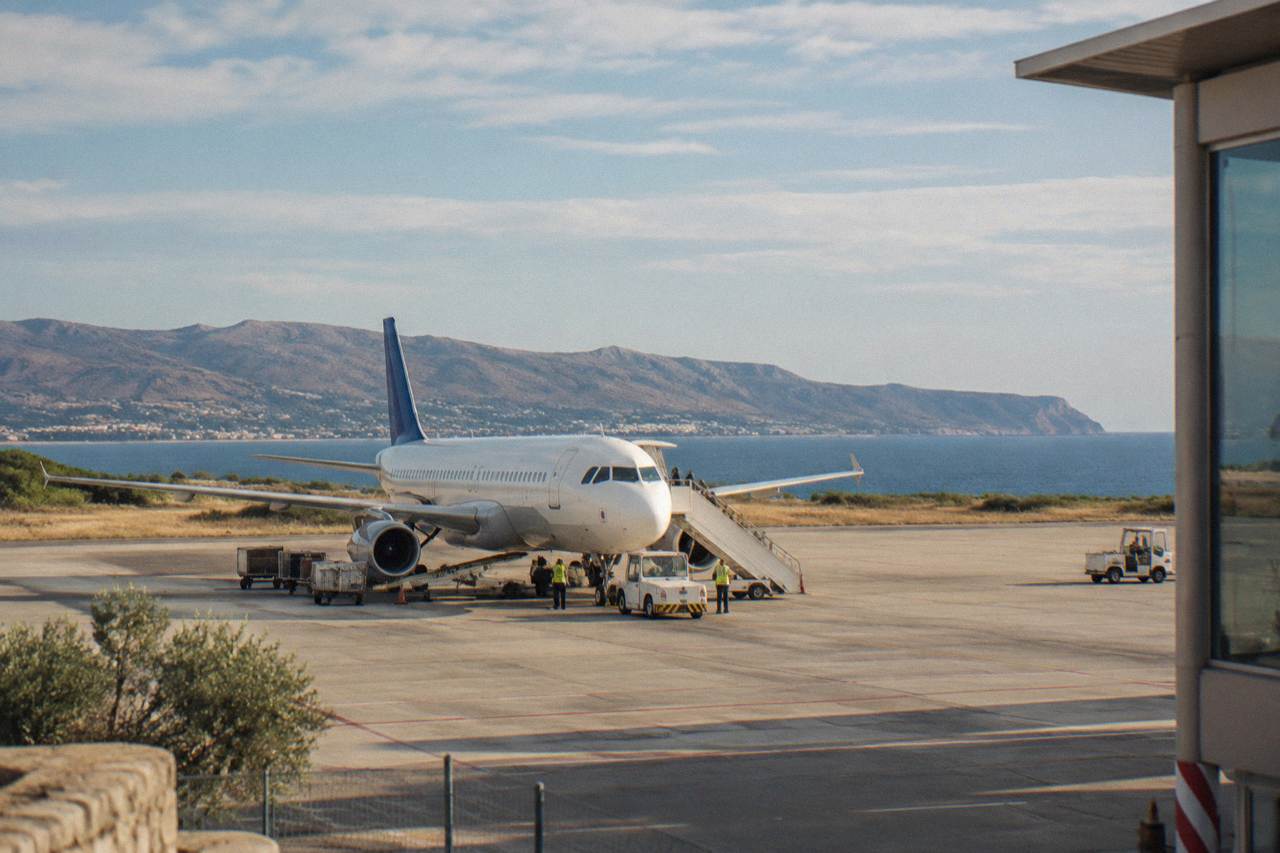
Chania International Airport Ioannis Daskalogiannis (CHQ), operated by Fraport Greece, sits on the Akrotiri peninsula near Souda, about 14 km from the centre of Chania on the north-west coast of Crete. Here is what the airport's own information and the published timetables actually say about getting in, out and onwards.
Short answer
Chania Airport (CHQ) is about 14 km from Chania city centre on the Akrotiri peninsula, near Souda. Public KTEL buses and taxis serve it, with current information on the airport's own site, and the overnight Blue Star Ferries service to Piraeus leaves from Souda port, about 7 km east of the Old Town.
Chania International Airport "Ioannis Daskalogiannis" (CHQ) is the air gateway to Chania, the coastal city on the north-west coast of Crete, Greece, that sits on the Cretan Sea with the White Mountains rising behind it. The airport is operated by Fraport Greece and handled 3,992,149 passengers between January and October 2025, which makes it the second-busiest way into West Crete after Heraklion. It sits on the Akrotiri peninsula near Souda, about 14 km from the city centre, and despite a persistent rumour that it is minutes from the Old Town, the transfer is a real journey that deserves a little planning. This guide sets out what the airport's own pages and the published timetables say, and nothing they do not.
Where Is Chania Airport And How Far Is It From The City Centre?
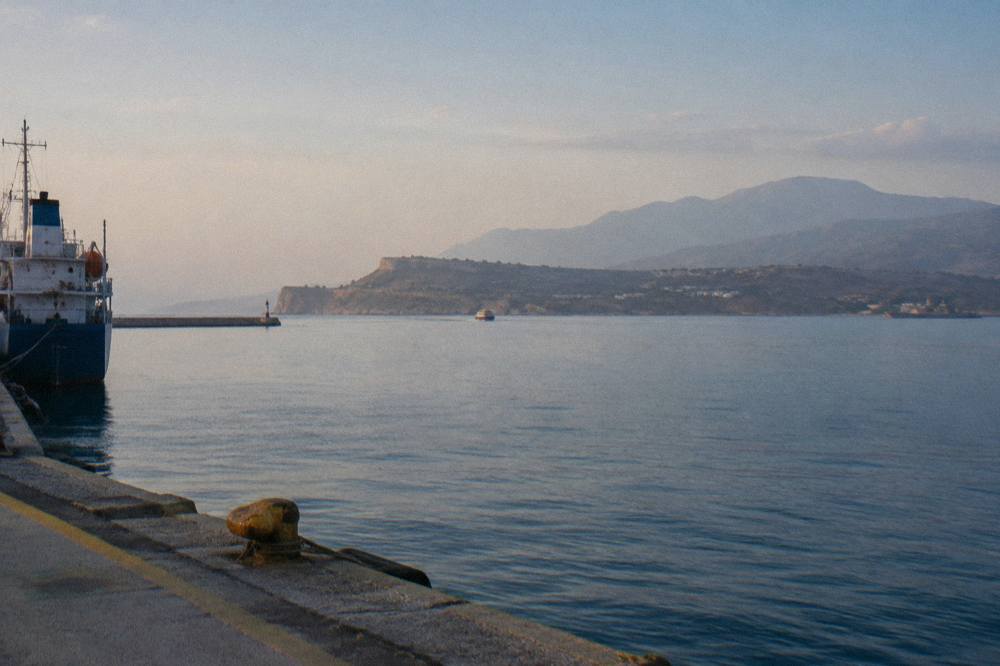
Chania Airport sits on the Akrotiri peninsula, near Souda, roughly 14 km from the centre of Chania, a distance repeated in every official description of the facility. The terminal lies east and slightly north of the city, on the road out towards the peninsula's beaches and monasteries, so the transfer into the Old Town passes Souda rather than dropping straight into the harbour.
The geography matters more than at a compact city airport. Akrotiri is the blunt headland that forms the northern arm of the Bay of Souda, and the airport occupies its western side. To reach the city a vehicle runs along the shore of the bay, past the port area of Souda, and then into the western side of Chania where the Venetian Harbour and the Old Town sit. The route is simple, a single main corridor for nearly all of it, but the distance is genuine: allow for a real transfer rather than a five-minute hop, and treat anything promising arrival "in the harbour in no time" with caution.
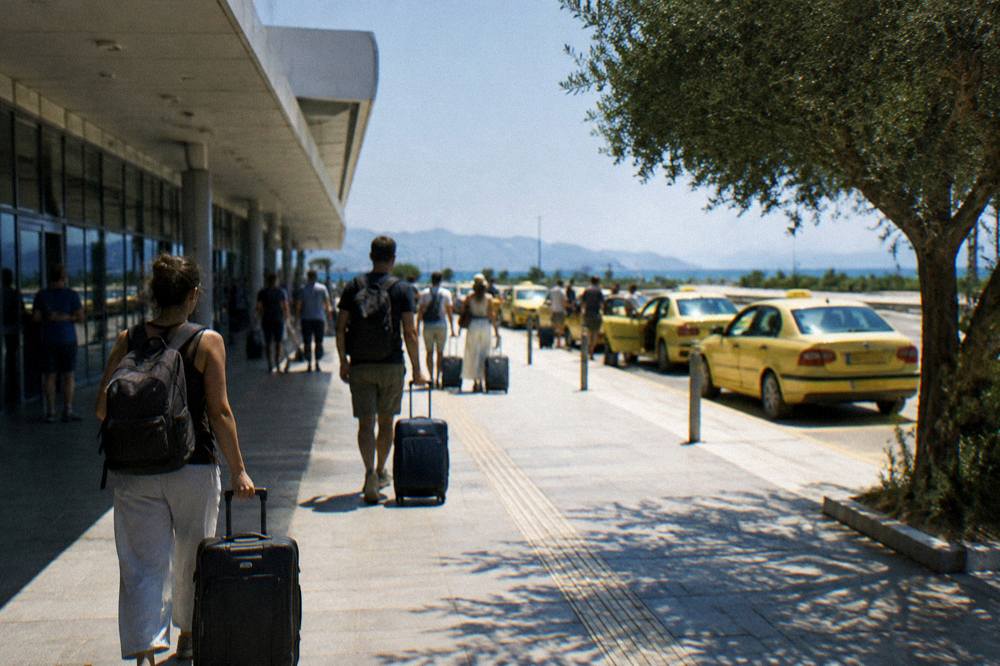
The airport's own site carries the current public bus and taxi information for the transfer, and that is where schedules should be checked, because the desk does not print bus fares, taxi fares or shuttle prices that the official pages do not state. What can be said is structural: the KTEL bus network connects the airport with the city, taxis operate from the terminal, and hire-car desks cluster at the airport for travellers who prefer to drive from the runway. Each of those options has its own page in this guide, and the practical detail on all three sits further down.
| Fact | Detail |
|---|---|
| Official name | Chania International Airport "Ioannis Daskalogiannis" |
| IATA code | CHQ |
| Operator | Fraport Greece |
| Location | Akrotiri peninsula, near Souda |
| Distance to Chania city centre | About 14 km |
| Passengers January to October 2025 | 3,992,149 |
| Currency on arrival | Euro, since 1 January 2001 |
| Border system | Schengen, with EES fully deployed from 10 April 2026 |
For travellers landing from outside Greece, two country-level facts are settled and need no hedging. Greece has been in the euro area since 1 January 2001, and it is a Schengen member with internal checks abolished since 26 March 2000. The Entry/Exit System (EES) was fully deployed across Schengen on 10 April 2026, so non-EU arrivals should expect electronic registration at the border. ETIAS, the travel authorisation often mentioned alongside it, is not in operation and no applications are being collected as of October 2026, so no start date or fee belongs in any plan yet.
How Do You Get From Chania Airport To Chania Town?
The airport is linked to Chania town by the public KTEL bus network and by taxis, with the current schedules and pickup points published on the airport's own site, which is where transfer times and arrangements should be confirmed before landing. There is no rail connection of any kind on Crete, so the choice is road transport: bus, taxi, a pre-booked transfer or a hire car driven from the terminal. The desk prints no fare for any of these, because the official pages do not state one.
The KTEL bus is the shared-option backbone. Chania's long-distance bus station sits on Kydonias street in the city, and the network's routes fan out from there to Heraklion, Rethymno, Kissamos, Paleochora, Omalos and, in summer, Elafonisi. The airport link is part of the same system, and the practical detail, where the stop is and how the timetable shifts between winter and the summer season, lives on the airport's site and the operator's booking channels. Anyone planning the first evening in the Old Town around a bus should check the day's timetable rather than a remembered one, because seasonal services in Crete move with the tourist calendar.
Taxis and pre-booked transfers run the same 14 km corridor. The airport's own pages carry the taxi information, and the sensible habit at the rank is the habit anywhere in Greece: confirm the destination and agree on the meter or the arrangement before the car moves. The desk does not quote fares because the official sources do not. A full comparison of the road options, including where each one drops you relative to the Old Town's car-free lanes, sits in the dedicated Chania airport to Chania town guide.
| Transport option | Where it starts | Where to confirm details | Notes from the official pages |
|---|---|---|---|
| KTEL public bus | Airport stop, terminal side | Airport's own site and KTEL channels | Connects into the network hub on Kydonias street in Chania |
| Taxi | Airport rank | Airport's own taxi page | About 14 km to the city centre along the Souda Bay road |
| Hire car | Airport hire-car desks | Booking confirmation and airport car hire guide | Driving is on the right; the driving in Crete guide covers local road reality |
| Ferry to Piraeus | Souda port, not the airport | Blue Star Ferries timetable | Overnight service, departs about 21:30, crossing about 9 h 15 min |
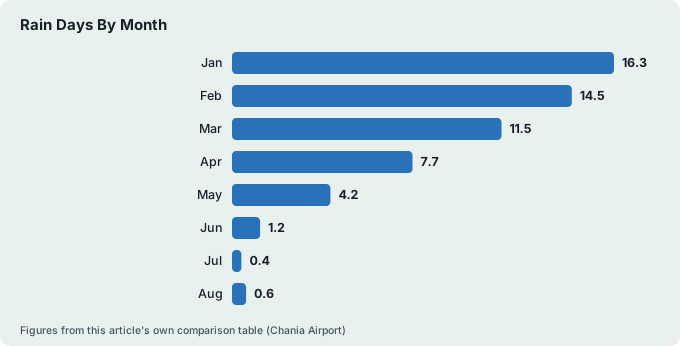
One structural point saves confusion more than any other: the ferry to Athens has nothing to do with the Venetian Harbour. The overnight Blue Star Ferries service to Piraeus leaves from Souda port, about 7 km east of the Old Town, and its published timetable showed departures about 21:30 with a crossing of about 9 h 15 min at the time of check. The Venetian Harbour, by contrast, serves excursion boats, the small craft that run sunset trips and swims to Lazaretta. A traveller who books a ferry and heads for the postcard harbour will miss the boat in both senses. The full sea route is covered in the Piraeus to Chania ferry guide.
Flights themselves have a dedicated page too: the flights to Chania guide covers how the airport fits into wider routes, and the Athens to Chania guide compares the short hop against the overnight ferry for anyone starting in the capital.
Should You Rent A Car At Chania Airport?
Renting a car at Chania Airport makes sense for itineraries built on West Crete's scattered beaches and gorges, because the airports of Crete are the one place where every major hire desk sits within reach of the arrivals hall, but the decision depends on where the trip is based. A stay inside the Old Town with day trips by bus and booked tours can skip the car entirely, while a plan that strings together Balos, Elafonisi, Falassarna and the south coast usually runs better on four wheels.
If that is the shape of your trip, book a rental car here.
The honest framing is geographic rather than numerical. The famous destinations of the region, Balos Lagoon and Gramvousa, Elafonisi, Falassarna, the gorges of Samaria and Imbros, are not suburbs of Chania; they are hours of road away, some of it winding and, on the Kaliviani approach to Balos, unpaved beyond a certain point. The KTEL network reaches a good share of them, with summer-only service to Elafonisi and standard routes to Omalos for the Samaria trailhead, but frequency drops outside the high season and the last buses home do not wait for a late sunset.
The car decision also interacts with parking, which in central Chania is its own subject. The Old Town's lanes are largely walkable and largely closed to through traffic, and the city's parking arrangements deserve a look before any booking, as the Chania parking guide lays out. Travellers who book a car for the whole trip sometimes find it sitting in a lot for the middle days, which is money at rest. A common pattern reported in itineraries is a split: a walkable base in town for the harbour days, and either a car for a defined block of days or booked day trips that include travel, like the guided Elafonisi and Falassarna tour this site features, Check availability, which pairs two of the west's famous beaches in one day with snacks along the way. The full local detail, desk locations and the paperwork, sits in the Chania airport car rental guide.
Is Chania Airport A Military Base?
Chania Airport shares its ground with military aviation, a legacy of the Akrotiri peninsula's history, but it functions as a civilian international airport operated by Fraport Greece, and scheduled passenger flights are its daily business, with nearly four million passengers passing through between January and October 2025. The military presence is real, which is why photography restrictions around certain areas exist, but civilian arrivals use the normal terminal, normal airlines and normal Schengen procedures.
The question comes up often enough to have its own answer page on this site, is Chania airport a military base, and the short version is that the facility is dual-use, with the civilian terminal run by Fraport Greece under the arrangement that covers several Greek airports. For a visitor the practical effects are modest: the airport is a working passenger hub, the EES border registration that applied across Schengen from 10 April 2026 applies here like anywhere else in Greece, and the arrivals process is the standard one for the zone.
The passenger figure gives the scale. Fraport's count of 3,992,149 passengers from January to October 2025 puts CHQ firmly in the ranks of serious seasonal airports, and the seasonality is visible in the terminal's rhythm: the summer months fill the schedule with flights from across Europe, and the winter schedule contracts. Anyone flying in the shoulder months should expect a quieter terminal and, on the ground, a calmer version of Chania itself, which the best time to visit Chania guide treats in full.
What Is The Weather Like When You Land At Chania?
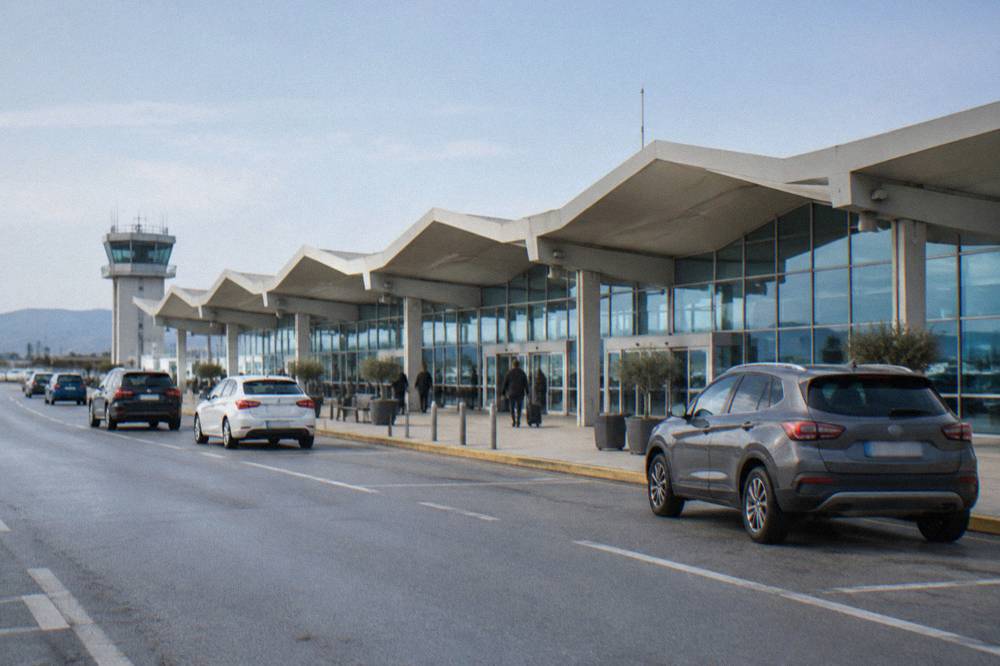
Chania's climate is Mediterranean and coastal, with the Hellenic National Meteorological Service's Chania Souda station, recording 1958 to 2010, showing a July mean of 26.7 C and a January mean of 11.0 C, and rainfall concentrated in winter: 129.5 mm in January against 1.0 mm in July. May to September is the dry stretch, with just 13.5 mm in May and 3.4 mm in June. For arrivals that means heat and dryness in high summer, and mild, wetter conditions from late October through March.
Those figures deserve their labels. The station sits at Chania Souda, 148 m up and inland of Souda Bay, and the table is the service's own monthly means for the period 1958 to 2010, which the HNMS publishes as its station record; it is not a newer normal and the desk does not dress it up as one. In practice the numbers translate simply: July and August are hot and nearly rain-free, with mean maximums of 30.7 C and 30.4 C and 0.4 and 0.6 rain days respectively, while January, at 11.0 C mean with 16.3 rain days, is the month for museums, food and the harbour without a crowd. Humidity in the table runs from 50 percent in July to 73 percent in January, and the prevailing wind is from the west, swinging north-west in July and August.
| Month | Mean C | Mean max C | Mean min C | Rain mm | Rain days |
|---|---|---|---|---|---|
| Jan | 11.0 | 14.4 | 7.9 | 129.5 | 16.3 |
| Feb | 11.0 | 14.7 | 7.8 | 104.0 | 14.5 |
| Mar | 12.7 | 16.6 | 9.0 | 76.0 | 11.5 |
| Apr | 15.9 | 20.0 | 11.4 | 31.5 | 7.7 |
| May | 20.2 | 24.5 | 15.0 | 13.5 | 4.2 |
| Jun | 24.7 | 28.9 | 19.0 | 3.4 | 1.2 |
| Jul | 26.7 | 30.7 | 21.2 | 1.0 | 0.4 |
| Aug | 26.3 | 30.4 | 21.2 | 1.4 | 0.6 |
| Sep | 23.2 | 27.4 | 18.7 | 15.4 | 3.2 |
| Oct | 19.4 | 23.5 | 15.7 | 67.7 | 9.3 |
| Nov | 15.8 | 19.6 | 12.4 | 77.0 | 11.2 |
| Dec | 12.7 | 16.2 | 9.7 | 101.9 | 16.1 |
Rain starts to matter again from October, which carries 67.7 mm in the table, and within the table January is the wettest month and July the driest. What the table does not contain is a monthly sea-temperature normal, because no official one exists for Chania; a live reading is a live reading, and the desk prints no indicative series dressed up as a normal. The month-by-month implications for the whole trip, not just the landing, sit in the Chania weather guide.
Where Should You Stay After Landing At Chania Airport?
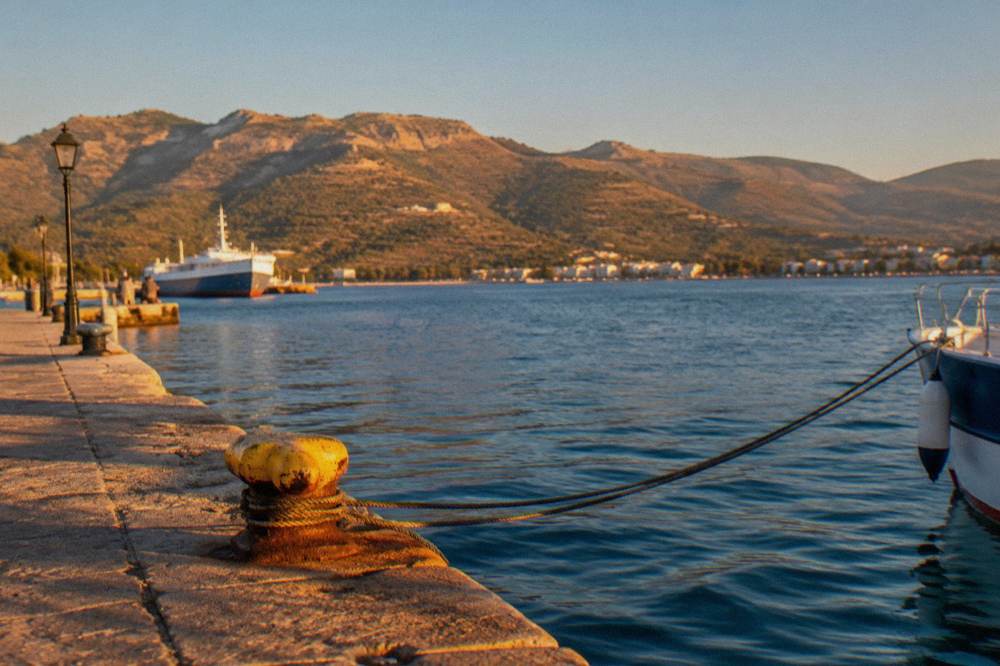
The stay decision after landing at Chania Airport comes down to the Old Town against the beach suburbs, because the 14 km transfer puts every option within a single road corridor: the Old Town around the Venetian Harbour for walkable harbour evenings, Nea Chora for a sandy beach within reach of the centre, and Agia Marina and Platanias further west for sand-and-sunbed family bases. The airport itself sits east of all of them, so no base adds airport distance to speak of.
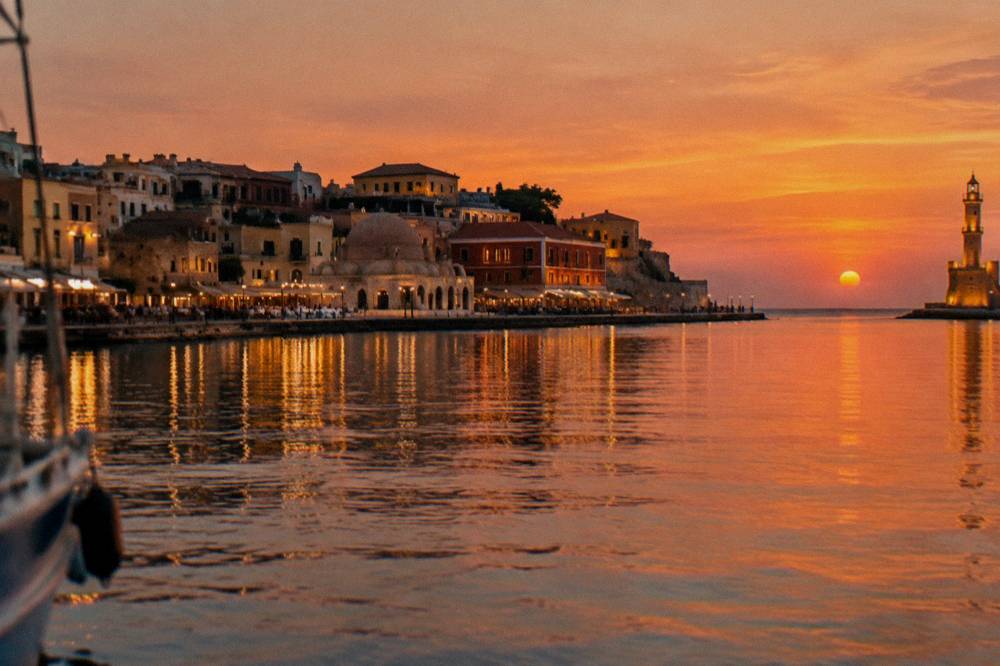
The desk reports the trade-offs the way the city lays them out. The Old Town puts the harbour, the lighthouse, the Splantzia and Topanas quarters and a dense run of restaurants underfoot, with the trade-off of car-free lanes and paid parking at the edges. Nea Chora wraps a working beach into a short walk of the western edge of town. Agia Marina and Platanias stretch west along the sand, better for a car and a beach-first plan. The comparative detail, area by area, including Halepa's quieter streets east toward Souda, sits in the where to stay in Chania guide, with hotel-level breakdowns in the best hotels in Chania and boutique hotels in Chania pages.
One item to confirm at booking rather than on arrival: the climate crisis resilience fee. It is collected by accommodation per room or apartment per night, with seasonal rates by category, and the exact amount is something to confirm when booking, because the desk prints no figure for it. It appears on the accommodation's paperwork, not at the airport, but travellers budgeting a Chania trip should know it exists before the bill does.
What Can You Do Near Chania Airport On Your First Day?
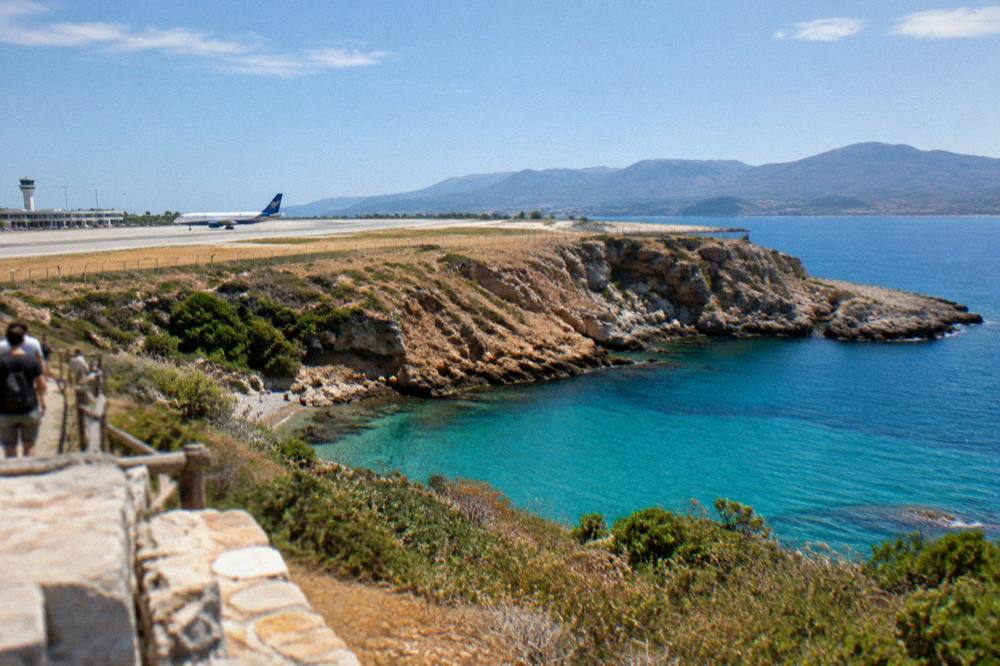
The country closest to Chania Airport rewards a first day with the Akrotiri peninsula's own sights: the monasteries of Agia Triada and Gouverneto, the beaches of Marathi, Stavros and Kalathas, and the dramatic cove of Seitan Limania, all within the headland the airport shares, with the beaches of the peninsula reached in well under an hour of driving in normal conditions. The peninsula is the airport's own backyard, and it means a landing day does not have to be lost to transfers.
The desk describes what sits where, from the verified geography. Agia Triada is a working monastery on the peninsula, Gouverneto an older fortified house a rough road beyond it, and each has its own page on this site. Marathi is the sheltered family beach on the bay side, Stavros sits at the peninsula's north tip with its ring of cliffs, and Kalathas offers a compact bay with a small island offshore. Seitan Limania is the steep, narrow cove whose descent demands proper shoes and honest self-assessment; its access path is rough, and the Seitan Limania guide covers what the walk involves. The whole peninsula is mapped in the Akrotiri peninsula guide, and the wider beach shortlist, including Nea Chora and the western sands, sits in the best beaches in Chania page.
For travellers who would rather not drive on day one, booked tours take the roadwork out of the equation, and a landing-day plan can even stay in town: a street food walk through the Old Town, or a short boat trip from the Venetian Harbour to Lazaretta island for a swim, both leave from the centre and return there. The tour options that start from Chania itself, rather than the airport, are gathered in the best tours from Chania page.
How Does Chania Airport Compare With Arriving At Heraklion?
Chania Airport serves the west of Crete and Heraklion Airport serves the centre and east, so the comparison is really a question of itinerary: for Balos, Elafonisi, Falassarna, the gorges and the White Mountains, Chania is the closer gateway at about 14 km from its city centre, while for Knossos, Heraklion city and the east of the island, Heraklion airport is the practical choice. Flying into one and out of the other is a recognised way to see the island without doubling back.
The two cities get a full head-to-head on this site, in the Chania vs Heraklion comparison and the is it better to fly into Chania or Heraklion answer page, and the desk does not re-litigate it here. What belongs on an airport page is the road reality: Heraklion is a long drive east along the northern highway, reachable by KTEL bus from the station on Kydonias street in Chania, and the same bus line links the two cities in the other direction. A split ticket, into CHQ and out of Heraklion or the reverse, trades the backtrack for a one-way drive past Rethymno, which itself makes a stop, as the Rethymno guide shows.
For Americans and other long-haul travellers, there is no direct flight from the United States to Chania; the connection runs through a European hub or through Athens, and the can you fly directly to Crete from the US page treats the routing in detail. The Athens link itself is short by air and overnight by sea, the Blue Star Ferries service from Souda departing about 21:30 with a crossing of about 9 h 15 min as published, and the Athens to Chania page compares the two properly.
What Should You Know About Buses Once You Have Landed?
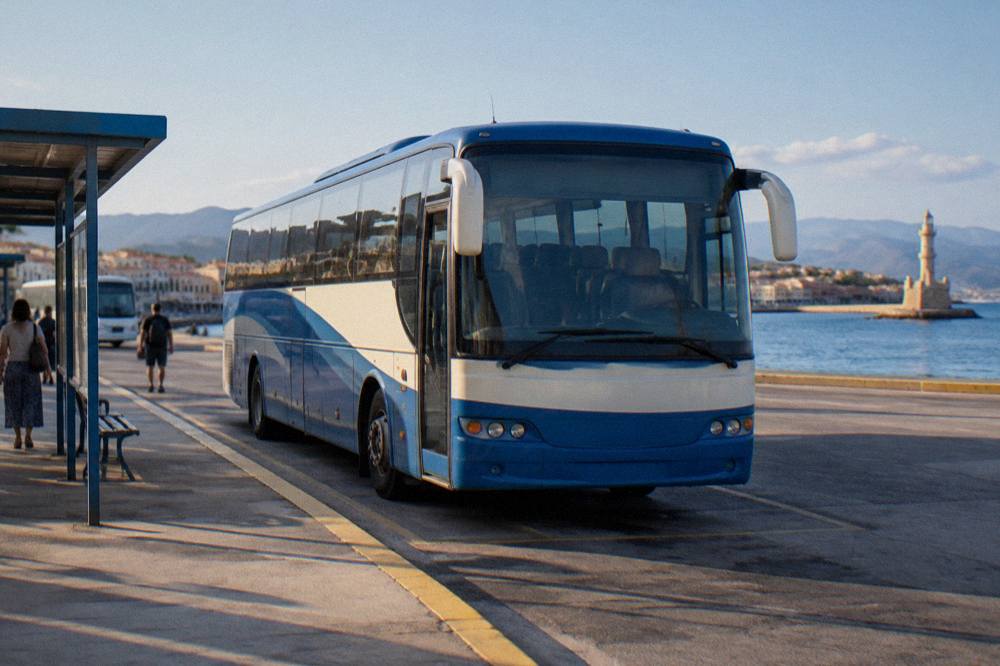
The KTEL bus network is Crete's public backbone, with Chania's long-distance station on Kydonias street running routes to Heraklion, Rethymno, Kissamos, Paleochora, Omalos and, in summer, Elafonisi, and the airport connected into the same system for the run into town. Schedules are seasonal, the summer-only Elafonisi line exists precisely because beach season is bus season, and the desk prints no fare and no timetable, because both live on the operator's own channels and change with the year.
The structural fact worth knowing is where the hub sits. Kydonias street is the origin point for the long-distance lines, so a bus-based trip does not orbit the airport at all: it orbits the city station, with the airport link feeding into it and the day-trip lines leaving from it. Omalos is the plateau where the Samaria Gorge walk begins at Xyloskalo, and the gorge has its own entry regime: a EUR 10 individual ticket through the NECCA e-ticket portal, free for EU residents under 18 and over 65, with the normal season 1 May to 31 October and the path closed or delayed when storms damage it, so the NECCA status must be checked before any plan is made. Boats from the walk's end at Agia Roumeli leave for Sougia or Chora Sfakion about 17:30, connecting back to the KTEL network, all as reported by the sources this site carries.
| KTEL route from Chania (Kydonias street) | Where it serves | Season note |
|---|---|---|
| Heraklion | Northern highway east, via Rethymno | Year-round long-distance line |
| Rethymno | Coastal city east of Chania | Year-round |
| Kissamos | North-west coast, boats to Balos and Gramvousa | Balos boats run daily to 31 October 2026, operator-reported |
| Paleochora | South coast, boats to Gavdos in season | Year-round, boats seasonal |
| Omalos | Samaria Gorge trailhead at Xyloskalo | Gorge season 1 May to 31 October, storm closures possible, check NECCA |
| Elafonisi | Natura 2000 beach area, west | Summer-only service |
The bus-plus-boot pattern covers a surprising share of the region, but it is not universal, and the two decisions it cannot make for a traveller are the airport transfer timing and the trade between bus days, hire-car days and booked tours. The full framework, including the getting-around options in one place, sits in the getting around Chania and KTEL Chania buses pages.
How Many Days Should You Plan Around A Chania Flight?
A Chania flight supports anything from a one-day harbour stop to a full week of West Crete, and the honest floor for the classic combination of Old Town, one famous beach and one gorge is three days, with five comfortable and a week only starting to feel long once the south coast and Rethymno or Knossos join the list. The airport's position at the edge of the region means every extra day buys distance: day one stays in town, and each day after pushes further west or south.
The itineraries on this site are built exactly on that ladder. The one day in Chania plan keeps to the Old Town, the harbour and a nearby beach. Two days adds a boat trip or a peninsula drive, three days brings in a gorge or a far beach, and the three days in Chania and five days in Chania pages sequence the options. A full week is the scale at which the West Crete one week itinerary operates, stringing Balos, Elafonisi, Falassarna, a gorge and the south coast into one arc, with the things to do in Chania page as the master list.
The day-trip distances are the reason the ladder works. Balos and Gramvousa boats leave from Kissamos on the north-west coast, running daily to 31 October 2026 as the operator reports, with the only confirmed charge a EUR 1 Kissamos municipal fee collected on the boat ticket for over-13s. Elafonisi is a Natura 2000 protected area with reported free entry and a strict ban on taking sand, shells or plants, and Samaria's regime is the NECCA one described above. None of these is an afternoon stroll from the harbour, which is precisely why the day count matters, and why this Chania Crete Travel Guide keeps a dedicated page for each of them.
Common Questions About Chania Airport
How far is Chania Airport from the city centre?
About 14 km. The airport sits on the Akrotiri peninsula near Souda. Current bus and taxi information for the transfer is on the airport's own site.
Do ferries to Athens leave from Chania Airport?
No. Ferries to Piraeus leave from Souda port, about 7 km east of the Old Town, on an overnight Blue Star Ferries service that departs about 21:30 with a crossing of about 9 h 15 min as published. The Venetian Harbour in Chania serves excursion boats only.
Is Chania Airport a military base?
It is a dual-use facility with a civilian international terminal operated by Fraport Greece, which handled 3,992,149 passengers between January and October 2025. Scheduled passenger flights run normal Schengen procedures, with the EES border system fully deployed since 10 April 2026.
Can you take a bus from Chania Airport to Chania town?
Yes, the public KTEL bus network links the airport with the city, whose long-distance station sits on Kydonias street. Schedules are seasonal and should be confirmed on the airport's own site or the operator's channels; the desk prints no fare because the official pages do not state one.
Do I need ETIAS to fly to Chania?
No system of that kind is collecting applications as of October 2026. Greece is a Schengen member, the Entry/Exit System has been fully deployed since 10 April 2026, and no travel authorisation fee or start date has been announced, so plan on standard passport procedures.
Is Chania Airport close to Balos and Elafonisi?
Not on foot, and not quickly. Balos boats leave from Kissamos on the north-west coast, and Elafonisi sits at the island's western edge in a Natura 2000 protected area; both are day trips by car, bus or booked tour, which is why the number of days in Chania matters when booking flights.
A flight into CHQ is the start of a region that rewards a plan: a 14 km transfer into a walkable harbour city, a bus hub for the long lines, a ferry port for Athens in the other direction, and a peninsula of monasteries and coves already in view from the runway. Land with the distance respected and the season checked, and the airport does its job quietly while Chania gets on with being the reason you came.