Chania Walking Tour
Chania is a coastal city on the north-west coast of Crete, Greece, and its Old Town is compact enough that a walking tour is the natural way to see it. This guide sets out what guided walks cover, where they go, and how to plan one.
Short answer
A Chania walking tour covers the Old Town around the Venetian Harbour, usually in a small group with a guide, sometimes with food tastings added. Walks run from short Old Town circuits to street-food routes, and the city is flat enough on the harbour side for almost anyone.
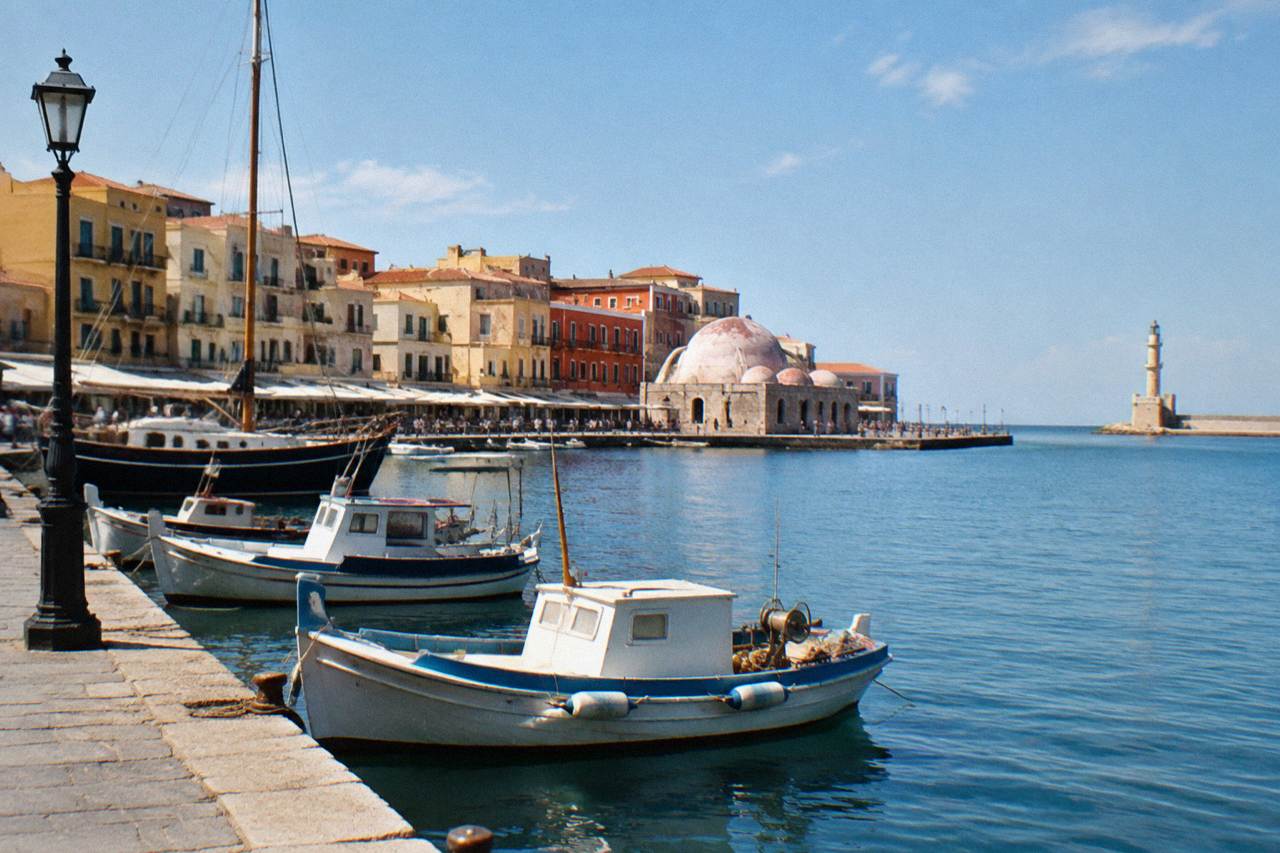
Chania is a coastal city on the north-west coast of Crete, Greece, facing the Cretan Sea, and its Old Town wraps so tightly around the Venetian Harbour that walking is not just an option here, it is the default. The harbour itself was first built between 1320 and 1356, the lighthouse at its mouth dates from about 1595 to 1601 on a Venetian base restored during Egyptian rule, and the whole layered history sits within an area a visitor can cross on foot. That density is why a Chania walking tour works so well: the sights that other cities spread across a metro map here stand a few lanes apart.
This guide from the Chania Crete Travel Guide editorial desk covers what guided walks include, the routes they follow, the food-led options, self-guided alternatives, and the practical questions of timing, footwear and weather. One honest note up front: there is no free or tip-based walking tour product in Chania that this site can verify, so everything below is about booked guided walks and the routes you can walk yourself.
What Is A Chania Walking Tour, And What Does One Cover?
A Chania walking tour is a guided walk through the Old Town and harbour area of Chania, Crete, usually in a small group, focusing on the layered Venetian, Ottoman and Greek history of a city whose harbour was first built between 1320 and 1356. Typical walks combine the harbour front, the back lanes, Splantzia and Topanas, and sometimes street food or market stops along the way.
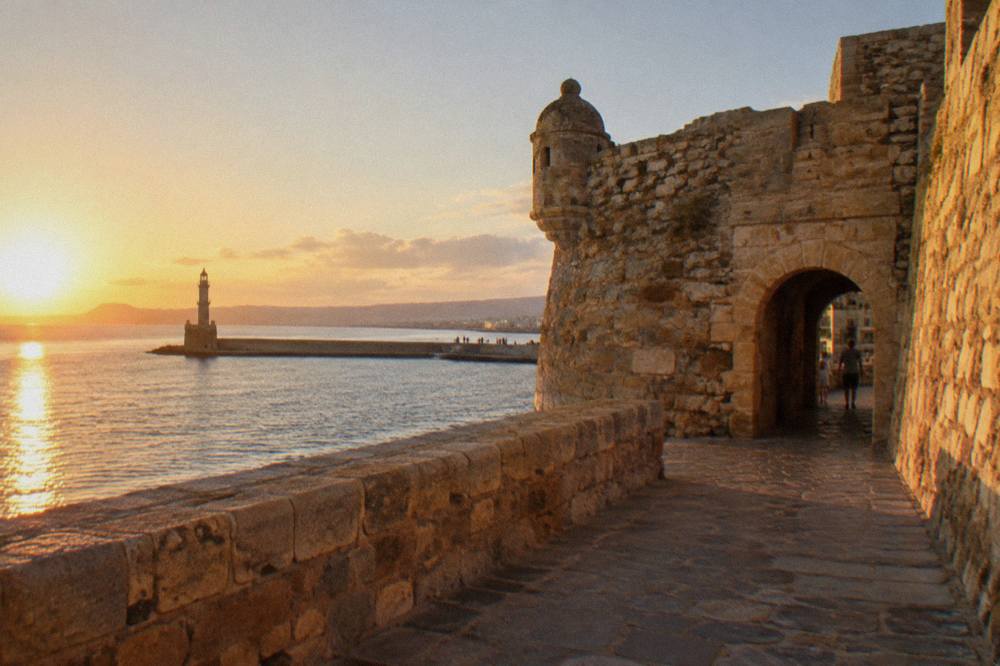
The core product is simple: a guide meets a group, walks the Old Town, and explains what the buildings are. What varies is what gets folded in. Some walks stay purely historical, moving from the Firka Fortress at the harbour mouth, built in 1620, along the mole toward the lighthouse, then back through the lane network. Others add food, stopping at bakeries, markets and tavernas, and these are covered in their own section below. A third shape pairs the walk with a puzzle or treasure-hunt format, which suits families.
The bookable options on this site that fit the walking-tour idea include an Old Town highlights walk with street food, a street-food walk, a sightseeing-and-tastings combination, a food-tasting town walk, and a mythological scavenger hunt with puzzles and clues. There is also a small-group city bike tour, which covers the same highlights at a faster pace and is worth knowing about even on a page about walking, because it shows what the city looks like when the distances between sights start to add up.
Where Do Walking Tours In Chania Actually Go?
Most walking tours in Chania follow a loop from the Venetian Harbour through the Old Town: the Firka Fortress at the harbour mouth, the Neoria shipyards of which seven survive from an original seventeen, the lighthouse mole, the Municipal Market, and the districts of Splantzia and Topanas on either side of the old city. The exact order varies by guide, but the geography rarely does.
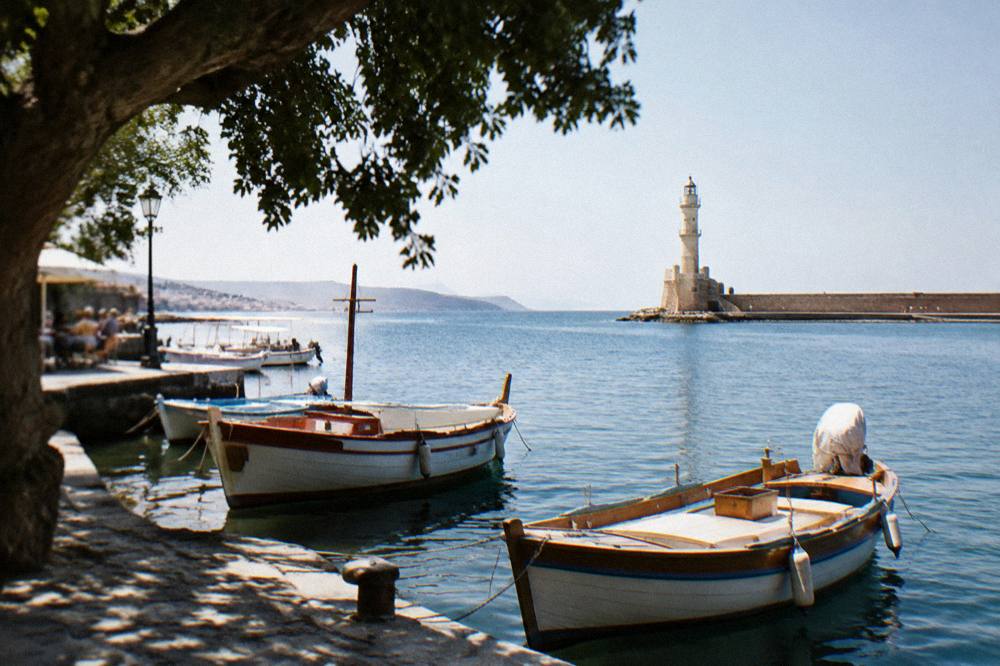
The harbour front is the spine. The Venetian Harbour was first constructed between 1320 and 1356, with dredging and a wall recorded in 1515, and the long quay still defines how the city presents itself. At the western end stands Firka Fortress, built in 1620, whose grounds are free to enter and which usually marks either the start or the end of a walk. At the seaward end the lighthouse, built about 1595 to 1601 and restored on its Venetian base during the period of Egyptian rule from 1830 to 1840, sits on the mole. Guides typically walk part of the mole for the view back over the harbour.
Behind the quay the Old Town splits into recognisable quarters. Splantzia, east of the harbour, grew around the Orthodox and Ottoman presence after the 1645 Ottoman conquest of Chania. Topanas, to the west, was the Venetian arsenal quarter. Between them run the lanes where the second city walls, begun in 1536 to Michele Sanmicheli's design, once enclosed everything. The Neoria, the Venetian shipyards of the 15th to 16th century, line the eastern harbour edge: seven survivors of an original seventeen, and a frequent walk stop because they explain what the harbour was for.
The Municipal Market hall is another regular waypoint, sitting at the junction where the old town meets the newer commercial streets. Beyond it, some walks extend east to the KTEL long-distance bus station area on Kydonias street, though a guided Old Town walk rarely goes that far: the product is concentrated on the lanes, not the modern city. For a fuller picture of the district geography, the Splantzia and Topanas guide sets out how the two quarters differ.
Is The Old Town Flat Enough For An Easy Chania Walking Tour?
Yes, the walking surface of a Chania Old Town tour is essentially flat: the harbour, the market and the lanes of Splantzia and Topanas all sit at sea level, and there are no serious climbs on the standard route. The only gradient most walks touch is the harbour mole out to the lighthouse, which is a gentle, paved walk, not a hike.
This matters more than visitors expect, because Crete as a whole is a mountainous island and several of the famous day trips from Chania are genuine mountain walks. The Samaria Gorge route, for example, runs one-way from Xyloskalo on the Omalos plateau down to Agia Roumeli, with the gorge normally open 1 May to 31 October and closed or delayed when storms damage the path, so the NECCA status must be checked before any gorge plan is made. None of that applies to an Old Town walk. The city product and the gorge product are different kinds of day.
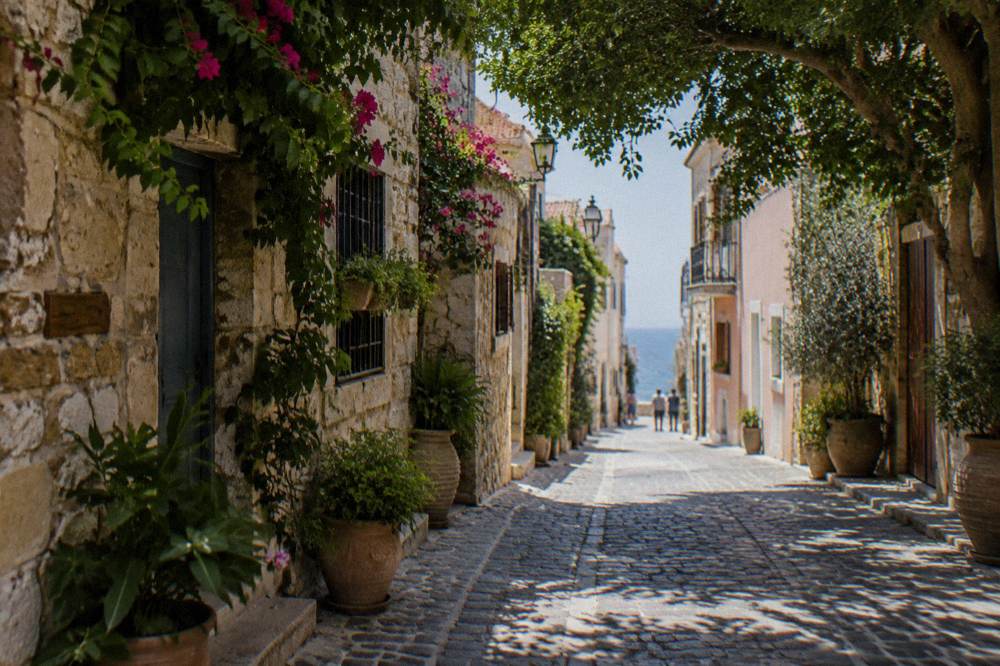
The one caveat is surface, not slope. Old Town lanes are paved with worn stone and cobbles, sometimes uneven, occasionally slick after rain. Footwear with grip matters more than fitness. For anyone who finds cobbles difficult, the quay itself is smooth and flat, and a self-guided harbour-front loop on foot or a short boat trip from the harbour are comfortable alternatives. The getting around guide has more on how the city's districts connect.
Do Chania Walking Tours Include Food And Wine Tastings?
Several Chania walking tours are built around food rather than pure sightseeing: a street-food walk, an Old Town highlights walk with street food stops, a sightseeing-and-tastings combination, and a dedicated food-tasting town walk all operate in the city, pairing the lanes with bakeries, market stalls and taverna tastings. Wine and olive-oil tasting tours also run from Chania, but those leave town by vehicle rather than staying on foot.
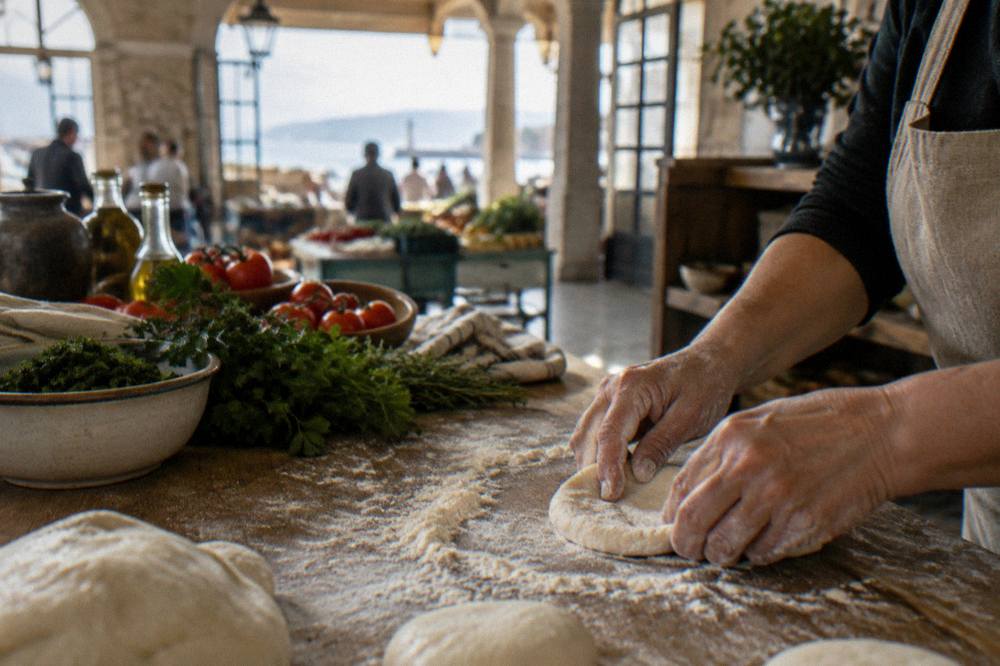
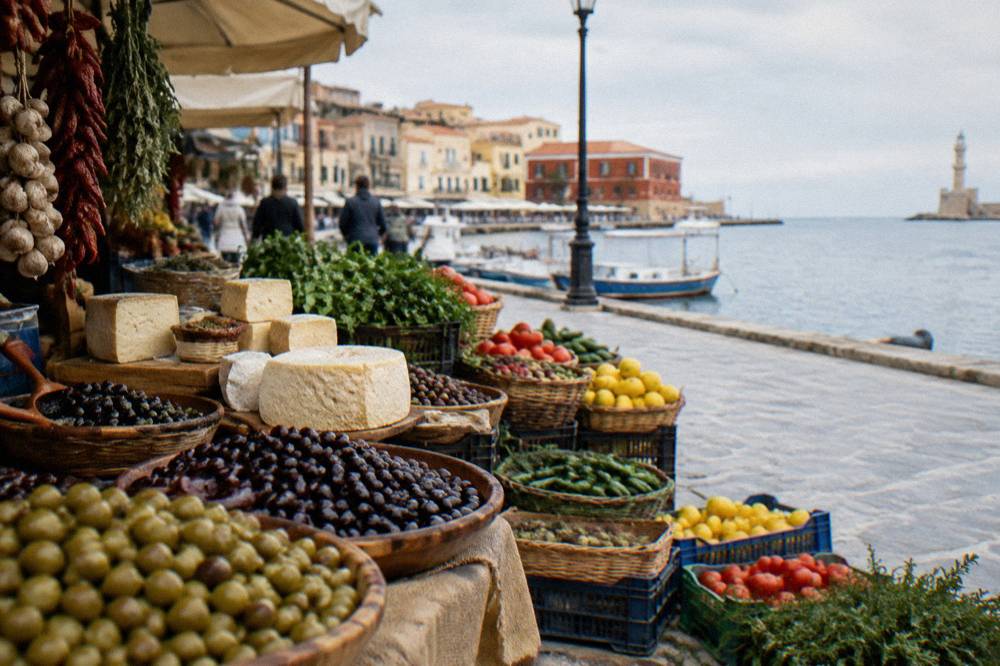
The food-led city walks are the clearest crossover between walking and eating. They move through the Old Town with a guide and stop at food businesses along the route: bougatsa bakeries, the market hall, cheese and honey producers' counters, tavernas. What each walk includes is on its own listing, and tastings vary by operator and season. For the food background, the Cretan food in Chania guide explains the dishes these walks usually build around, and the Chania restaurants guide covers where to eat when the walk is over.
The separate category is the vehicle-based tasting day. Olive oil, wine, cheese and honey tasting tours run from Chania into the countryside and the foothills of the White Mountains, and a cooking class in a mountain village is another food product that starts with a drive. These are excellent days, but they are not walking tours of the city, and booking one when a walk was intended is a common mismatch. The distinction to check on any listing is whether the itinerary is on foot in the Old Town or driven out of it.
A useful way to compare the city options is by what each one actually walks past and stops at:
| Walk type | Base district | Food element | Suits |
|---|---|---|---|
| Old Town highlights walk with street food | Harbour and Old Town loop | Street food stops en route | First-time visitors wanting history plus tastes |
| Dedicated street-food walk | Old Town lanes | Multiple food businesses | Visitors whose main interest is the food |
| Sightseeing and tastings combination | Harbour and city sights | Tasting stops mixed with sightseeing | Visitors wanting both in balance |
| Food-tasting town walk | Central Chania | Tastings as the core content | Return visitors who know the sights |
| Mythological scavenger hunt | Old Town, puzzle-led | None | Families and groups with children |
Prices, ratings, durations and review counts for each of these are on the operators' live listings, and this site renders them through its tour pages rather than typing figures into prose.
Can You Walk Chania Old Town Without A Guide?
Yes, Chania Old Town is entirely walkable without a guide, and a self-guided loop from Firka Fortress along the harbour to the Neoria, back through the market and around Splantzia and Topanas, covers the same ground a guided walk covers. The trade-off is interpretation: the buildings are self-explanatory in outline but not in detail, and a guide supplies the dates, names and stories the stones do not carry.
A sensible self-guided route starts at Firka Fortress, built in 1620, whose grounds are free. Walk the quay east past the harbour front, detour out along the mole toward the lighthouse for the view back, then continue to the Neoria shipyards. Turn inland to the Municipal Market, loop through the lanes of Splantzia, and finish in Topanas on the west side. The whole circuit is flat, and at a steady pace it is a comfortable half-day with stops.
What a self-guided walk loses is context with dates attached. The facts on this page give a skeleton: harbour first built 1320 to 1356, first walls from 1336, second walls from 1536 to Sanmicheli's design, Ottoman rule from the 1645 conquest, union with Greece in 1913. A guide's value is turning that skeleton into a story on the spot, and knowing which unmarked doorway matters. For visitors who prefer to walk alone, the itineraries on this site, from how many days in Chania to the day-trip roundups in best tours from Chania, supply the same structure a guide would.
One practical note: there is no free or tip-based walking tour product in Chania that this site can verify, and it names no walking-tour platform. The guided options that exist are booked products, and the honest comparison is between a booked walk and a self-guided one, not between a booked walk and a free one.
How Far Can You Walk Beyond The Old Town In Chania?
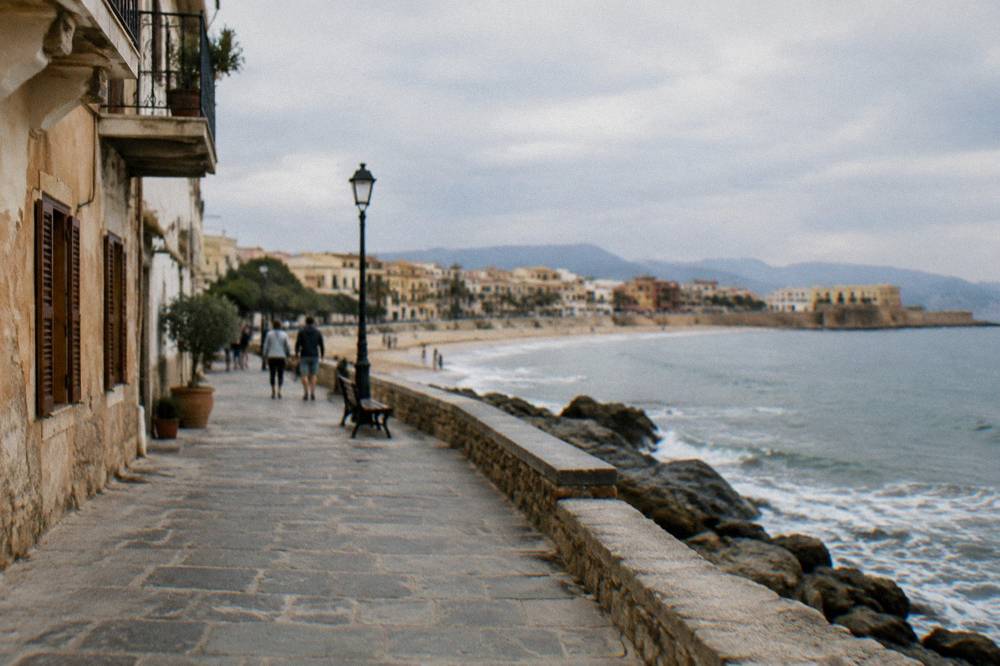
Beyond the Old Town, Chania extends on foot west along the seafront to Nea Chora beach, a walkable continuation of the harbour front on a flat promenade, and east toward Halepa, where the Archaeological Museum sits at 15 Skra Street. Both extensions are flat, urban and self-guided; the dramatic coastal walks of the region, like the gorges, are day trips, not city strolls.
Nea Chora is the nearest sandy beach to the centre and the promenade that links it to the harbour makes an easy extension to any Old Town loop. Halepa, east of the centre, is a quieter district of consular-era houses, and it holds the Archaeological Museum of Chania at 15 Skra Street, with a full ticket at EUR 15 and a concession at EUR 8; the museum's own visit page is the place to confirm current opening arrangements before walking out there, and visitors are asked to leave 20 minutes before closing.
The rule that keeps plans honest is the one repeated throughout this site: a figure or an operational detail that is not in the verified facts does not get stated. Walking distances around the city are short and visible on any map, and no invented walking time appears here. What can be said firmly is the geography: the Old Town and its extensions sit on flat coastal ground, and the mountains, the gorges and the south coast are all vehicle or boat territory.
For the days when walking the city is not the plan, the regional options are covered elsewhere on this site: the best beaches in Chania guide for the coast, and the day-trip pages for the gorges and lagoons.
When Is The Best Time Of Day For A Walking Tour In Chania?
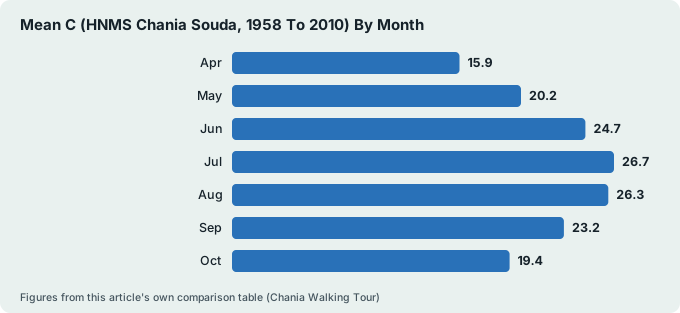
The best time of day for a walking tour in Chania is the morning, because the HNMS Chania Souda station table shows the summer months of June to August averaging 24.7 to 26.7 degrees C overall, with mean maximum temperatures of 28.9 to 30.7 degrees C, and the lanes hold heat through the midday and early-afternoon hours. Early evening is the second-good window, and many food walks deliberately run late.
The climate context is worth having precisely because it comes from a named station record rather than a travel brochure. The HNMS Chania Souda station, inland of Souda Bay, publishes monthly means for the period 1958 to 2010, and that table shows a dry summer: 1.0 mm of rain in July on 0.4 rain days, 1.4 mm in August on 0.6 rain days. Rain only starts to matter again from October, at 67.7 mm, and January is the wettest month in the table at 129.5 mm. For a walking tour, that means the planning question is heat and sun, not rain, from May through September.
| Month | Mean C (HNMS Chania Souda, 1958 to 2010) | Mean max C | Rain mm | Rain days |
|---|---|---|---|---|
| Apr | 15.9 | 20.0 | 31.5 | 7.7 |
| May | 20.2 | 24.5 | 13.5 | 4.2 |
| Jun | 24.7 | 28.9 | 3.4 | 1.2 |
| Jul | 26.7 | 30.7 | 1.0 | 0.4 |
| Aug | 26.3 | 30.4 | 1.4 | 0.6 |
| Sep | 23.2 | 27.4 | 15.4 | 3.2 |
| Oct | 19.4 | 23.5 | 67.7 | 9.3 |
The prevailing wind table is also relevant to a harbour walk: the station record shows prevailing winds from the west, and from the north-west in July and August, which is the meltemi pattern in its general form. No wind speeds are published in the verified data, so none are claimed here, but the direction explains why the harbour mole feels breezy on summer afternoons. The fuller picture, including the winter months, is in the Chania weather guide and the best time to visit Chania guide.
Practically: book the earliest start a listing offers in July and August, carry water, and keep the mole and the unshaded quay for morning or late afternoon. In April, May, October and November the whole day is walkable.
What Should You Wear And Bring On A Chania Walking Tour?
For a Chania walking tour, wear closed shoes with grip rather than sandals, because the Old Town lanes are worn stone and cobbles that can be uneven and slick, and bring sun protection and water, because the summer station means run at 26.7 degrees C in July with mean maxima of 30.7 degrees C and effectively no rain. Layers matter from October to March, when means fall back to 11.0 to 19.4 degrees C.
Footwear is the item that actually decides comfort. The surfaces are historic and were never designed for smooth soles. A shoe with a real sole also matters on the harbour mole, where the paving is exposed and, in the north-westerly summer winds, spray can reach the walkway. Everything else in the kit is ordinary hot-weather travel gear: a hat, water, sunscreen, and something to cover shoulders for any walk that enters a church or the mosque building on the harbour, which functions as an exhibition space rather than an active mosque.
Season by season, the station table drives the packing list:
| Season | Station means (HNMS Chania Souda, 1958 to 2010) | What to carry |
|---|---|---|
| May to June | 20.2 to 24.7 C, 3.4 to 13.5 mm rain | Sun protection, water, light layers |
| July to August | 26.3 to 26.7 C, 1.0 to 1.4 mm rain | Serious sun protection, water, early start |
| September to October | 19.4 to 23.2 C, 15.4 to 67.7 mm rain | Water, a light layer, a compact rain layer from October |
| November to April | 11.0 to 15.9 C, 31.5 to 129.5 mm rain | Warm layer, rain jacket, shoes with wet-weather grip |
One caution for any walk in the warmer months: the harbour front is a working quay with boats, water edges and mooring lines, and the lanes have traffic at their edges. None of this is unusual for a Mediterranean port city, and no safety statistic is claimed here, but the ordinary rules of a port apply: watch the edge on the mole, and keep children close where the lanes meet the busier roads.
How Does A Walking Tour Fit Into A Longer Chania Stay?
A walking tour fits best on the first full day of a Chania stay, because the Old Town loop doubles as an orientation to the whole city: after one guided walk, the harbour geography, the quarters of Splantzia and Topanas, the market and the museum locations are all fixed in memory, and every later decision, from restaurants to day-trip departures, gets easier. Most itineraries then hand the second and third days to the beaches and gorges.
The pattern this site recommends in its itinerary guides is consistent: day one for the Old Town and harbour, on foot or with a guide; day two for a beach or boat trip; day three and beyond for the big regional days. The regional options are significant journeys. Balos and Gramvousa cruises leave from Kissamos port to the west, with daily departures through to 31 October 2026 in the operator's published season and a EUR 1 Kissamos municipal fee collected on the boat ticket for over-13s. Elafonisi sits at the south-west corner, a Natura 2000 protected area where entry is reported free and taking sand, shells or plants is prohibited. The Samaria Gorge is the mountain day, subject to the storm-damage caveat above and the NECCA status check.
Two of those regional days pair naturally with a city walk in a first-week plan:
| Day plan | Where it starts | What the walk or trip covers | Booking note |
|---|---|---|---|
| Old Town guided walk | Chania Old Town | Harbour, lanes, market, Splantzia and Topanas | City product, all year in principle |
| Elafonisi and Falassarna guided day | Chania, by coach | Two beaches of the far south-west, with snacks | Long day; check the listing for pickup points |
| Balos and Gramvousa cruise | Kissamos port | Boat to the lagoon and island, walk down from the parking area if driven | EUR 1 municipal fee on the ticket; boat ticket prices are on the operator's listing |
The Elafonisi and Falassarna guided tour with snacks, the street-food walk and the small-group bike tour between them cover a workable first three days, and the trio below shows all three together. Beyond that, the best tours from Chania guide and the itinerary pages take over, and the where to stay in Chania guide settles the base.
Are There Family-Friendly Walking Options In Chania?
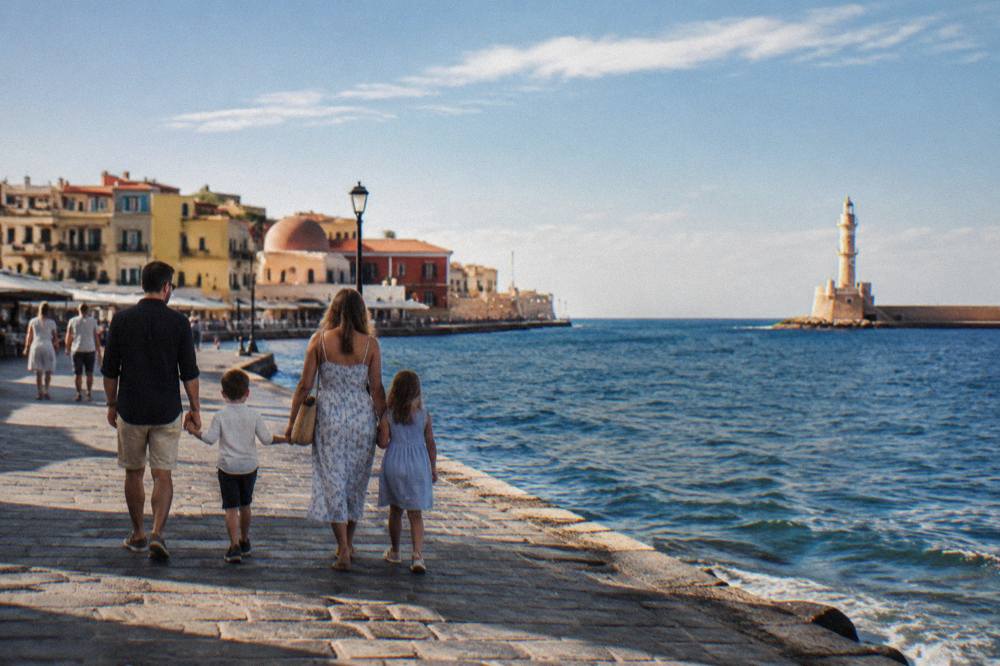
Yes, Chania has genuinely family-friendly walking options, chief among them a mythological scavenger hunt with puzzles and clues that turns the Old Town into a game, plus the flat, compact geography that makes self-guided family walks easy: the harbour loop is short, the mole is a contained objective, and the market and Nea Chora beach extension give children visible rewards along the way.
The scavenger-hunt product is the clearest designed-for-families option in the roster: it is a puzzle-led walk through the Old Town built around Greek mythology, which reframes the same lanes a historical walk covers as a clue trail. Its price, rating and duration render on its tour page rather than being typed here. The other family-friendly truth about Chania is structural rather than commercial. Because the Old Town is flat and small, a family can walk it in segments: the quay in the morning, the market at lunch, the beach promenade to Nea Chora in the afternoon, with nothing more demanding than cobbles underfoot.
The boat alternatives from the harbour also work as walking-adjacent family time: short cruises to Lazaretta Island with a swim stop, and a sunset cruise, both depart from the Old Port and both are covered in the site's boat-trip pages. On the planning side, the things to do in Chania roundup collects the full range of city and day-trip options in one place.
What Mistakes Do People Make When Booking A Chania Walking Tour?
The common mistakes when booking a Chania walking tour are mismatching the product to the day, expecting a city walk to reach the beaches and gorges it cannot reach, and ignoring the surface and the sun: an Old Town walk is a cobbled, sun-exposed, flat loop, not a shade walk, and the big sights outside the Old Town, from Nea Chora to the Archaeological Museum in Halepa, sit at the edges of a standard guided route rather than inside it.
The mismatch problem is real because Chania's tour roster mixes city products with regional ones. A visitor who books a gorge trek expecting a stroll, or a stroll expecting a lagoon, has bought the wrong day. The fix is reading what the listing says the itinerary covers: if the listing says Kissamos port, it is a Balos boat day; if it says Xyloskalo or Agia Roumeli, it is Samaria, and the separate EUR 10 entrance via the NECCA e-ticket portal and the boat from Agia Roumeli at about 17:30 are outside the tour price; if it says Old Town, it is the walk this page is about.
The second mistake is assuming a guide's presence changes the geography. Chania's headline Venetian and Ottoman sights are concentrated because the historic city was small, and a walk covers them precisely because they sit within the old walls. The Archaeological Museum in Halepa, the airport at about 14 km out on the Akrotiri peninsula, and the Souda port ferry terminal about 7 km east of the Old Town are all outside walking-product territory, and planning them as if they were walkable wastes a morning. The Chania airport guide and the getting around pages cover those edges of the city.
The third mistake is timing. Booking the only afternoon slot in July and walking the unshaded quay at the day's peak is avoidable: the station table above shows why mornings are the premium window, and listings that offer multiple start times make the choice easy.
Common Questions About Chania Walking Tours
Is Chania Old Town walkable?
Yes. Chania Old Town is compact and flat, wrapping around the Venetian Harbour, and a loop covering Firka Fortress, the harbour front, the Neoria, the Municipal Market and the lanes of Splantzia and Topanas is a comfortable half-day on foot. The surfaces are worn stone and cobbles, so shoes with grip matter more than fitness.
How long does a walking tour in Chania last?
Durations vary by product and are printed on each tour's live listing rather than stated here. The city walks range from short Old Town circuits to longer food-led routes, and the regional walking days, such as gorge hikes, are full-day trips by vehicle to the trailhead.
Do walking tours in Chania include food?
Several do. An Old Town highlights walk with street food stops, a dedicated street-food walk, a sightseeing-and-tastings combination and a food-tasting town walk all pair the lanes with tastings. What each includes is itemised on its own listing.
Is there a free walking tour in Chania?
No free or tip-based walking tour product in Chania is verified by this site, and it names no walking-tour platform. The guided walks that exist are booked products; the honest alternative to booking one is a self-guided loop, which the route section above lays out.
What is the best month for a walking tour in Chania?
Per the HNMS Chania Souda station table for 1958 to 2010, May, June, September and October combine mean temperatures of 19.4 to 24.7 degrees C with low rainfall, from 13.5 mm down to 1.0 mm in the dry months. July and August are hotter, with mean maxima above 30 degrees C, so early starts are the practical answer then.
Can you walk from Chania Old Town to a beach?
Yes. Nea Chora, the nearest sandy beach to the centre, links to the harbour front by a flat seafront promenade, and the walk is a natural extension of any Old Town loop. The famous west-coast beaches, Balos, Falassarna and Elafonisi, are day trips by boat or vehicle, not walks.
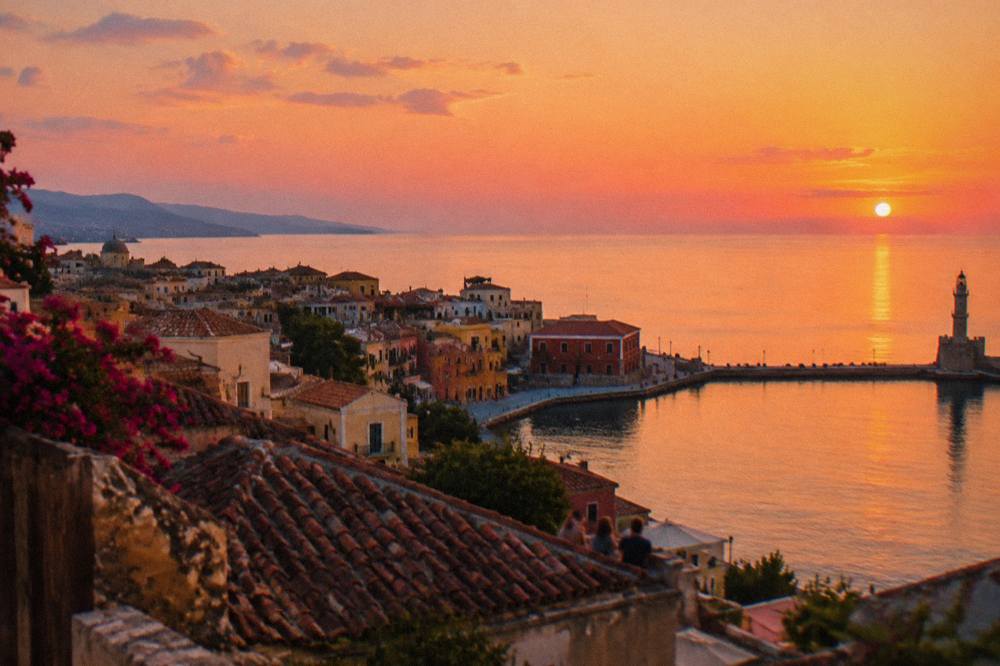
The short version: a Chania walking tour works because the city's history sits in one flat, walkable pocket around the Venetian Harbour, and whether the day is guided, food-led, puzzle-led or self-directed, the loop from Firka Fortress past the Neoria and through Splantzia and Topanas is the walk that carries it. Book the morning slot, wear real shoes, and keep the gorge and lagoon days for the vehicles and boats they actually need.