Chania Nightlife
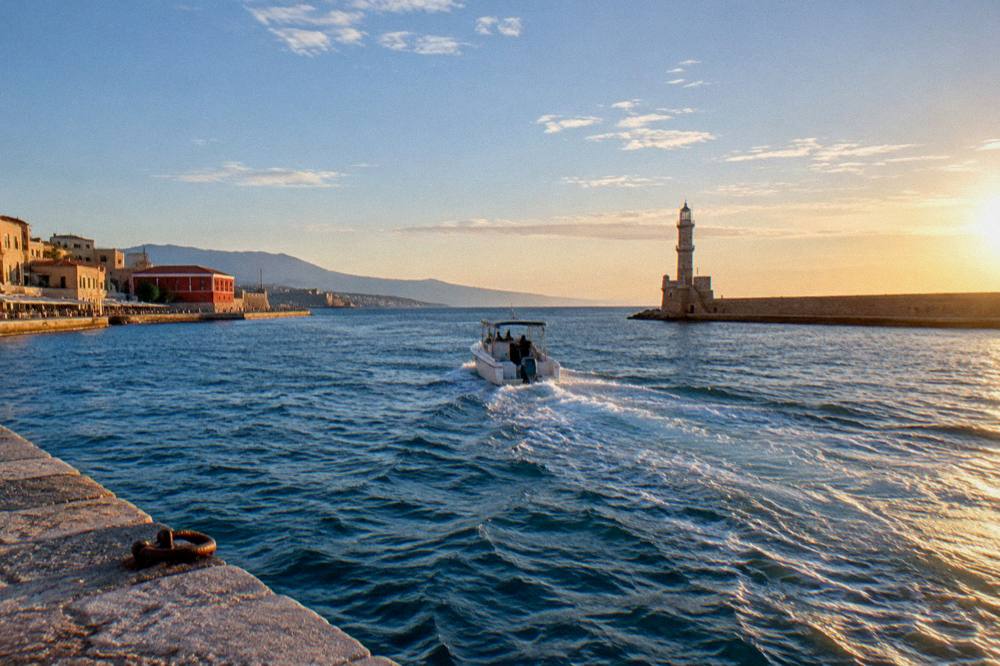
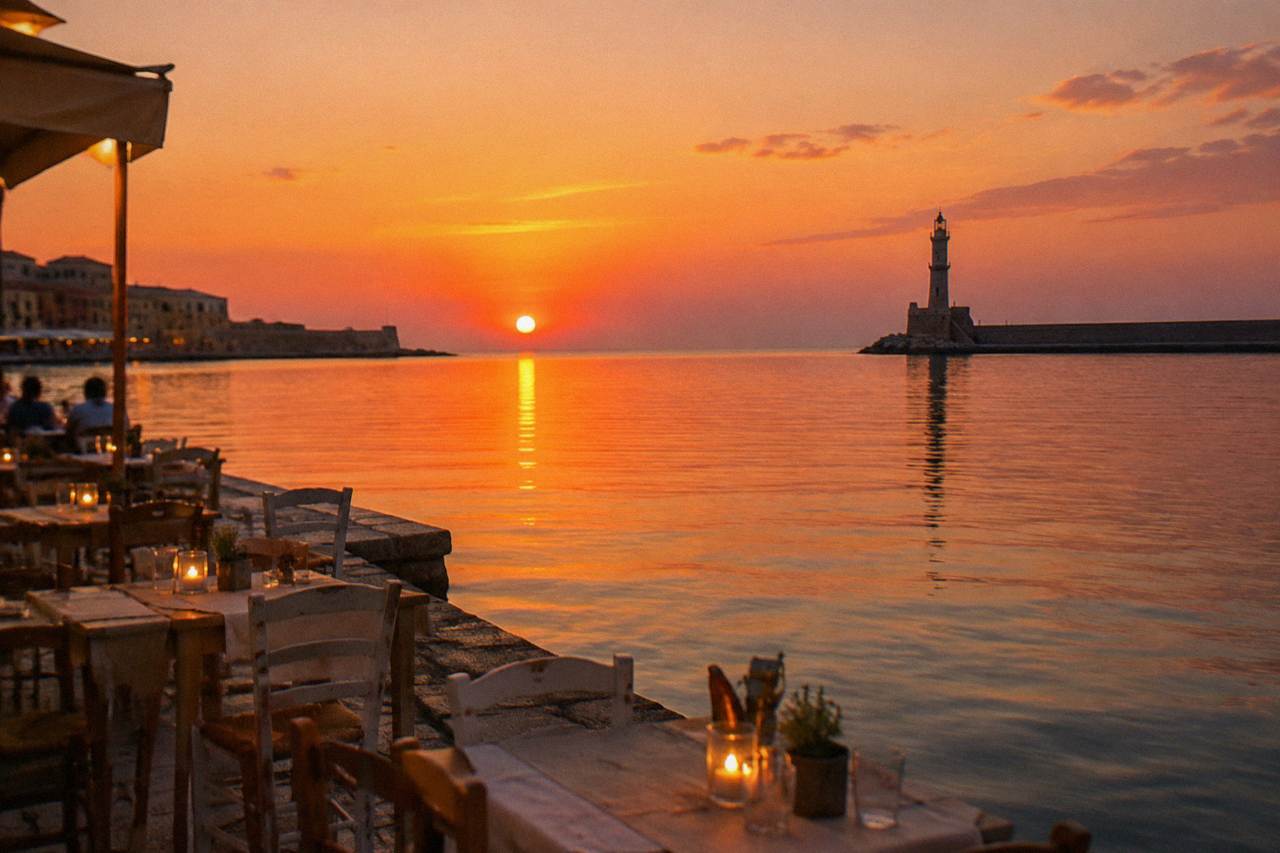
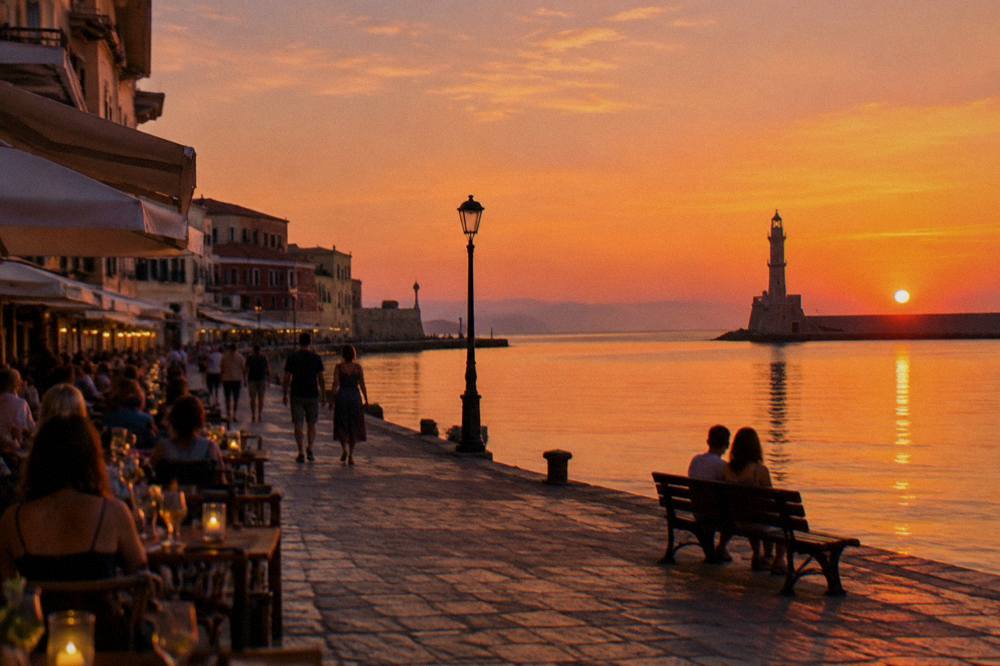
Chania at night moves to the Venetian Harbour: lit waterfront tables, the lighthouse on its mole, late kitchens in the Old Town lanes and a short, walkable circuit between them all.
Short answer
Chania nightlife centres on the Old Town and the Venetian Harbour, where bars and kitchens stay open late into the summer night. It is a compact, walkable scene of waterfront tables, lantern-lit lanes and small squares rather than large clubs, with sunset boat trips and food tours as the evening bookends.
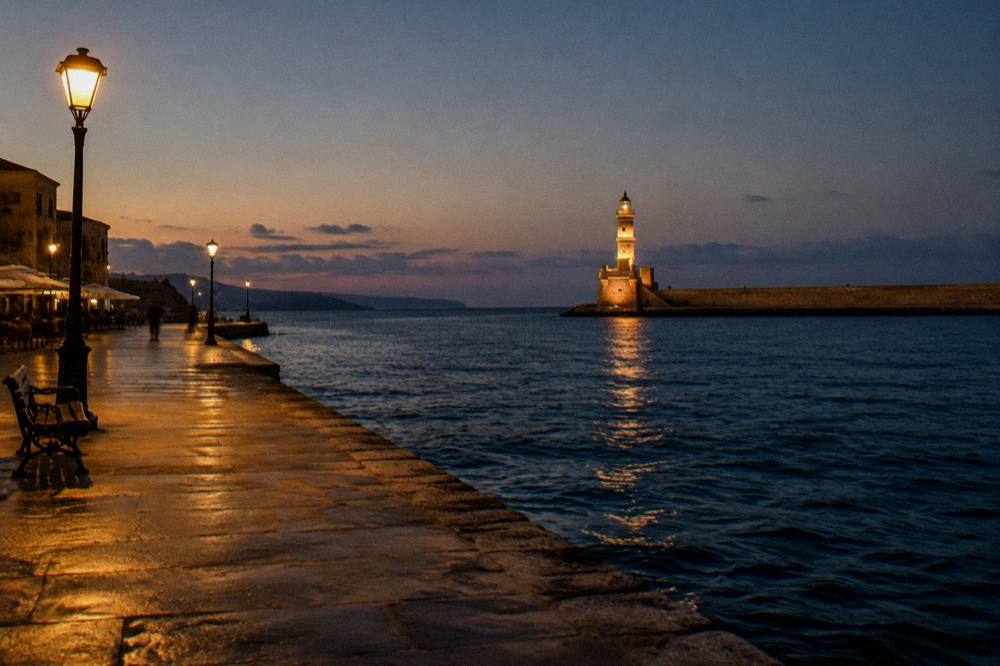
Chania is a coastal city on the north-west coast of Crete, Greece, facing the Cretan Sea, and when the sun goes down its centre of gravity shifts to one small, walkable place: the Venetian Harbour and the Old Town lanes behind it. The harbour itself is old in a way few nightlife districts anywhere can claim, first built between 1320 and 1356, with the lighthouse at the end of its mole constructed about 1595 to 1601 and restored on its Venetian base during the Egyptian-era years of 1830 to 1840. Tonight that same mole is the walk that closes the evening for nearly everyone in town.
The scene is not a club city. It is a harbour city. Tables spill onto the quays, the lanes off the harbour hold small bars and mezedopolia, and the whole circuit from the Firka Fortress, built in 1620, to the Mosque of the Janissaries at the inner harbour takes ten minutes or so at a strolling pace. This page from the Chania Crete Travel Guide desk lays out where the night happens, what it costs to plan around, which verified sights and fees touch an evening out, and how to time the whole thing against the weather table the Hellenic National Meteorological Service publishes.
What Is Chania Nightlife Really Like?
Chania nightlife is a compact, late-starting, food-led evening scene spread around the Venetian Harbour and the Old Town lanes rather than a big-club destination: streets fill from around nine onward, kitchens serve well past ten in season, a bar is as likely to be a mezedopolio with wine and small plates, and everything sits within one short walking circuit. The city, with 111,375 permanent residents in the wider municipality at the 2021 census, supports a dense strip of harbourfront bars, back-lane tavernas and small squares, all reachable on foot, and in summer the evening runs late because the daylight does: July mean temperatures of 26.7 C at the HNMS Chania Souda station only begin to feel comfortable after sundown, so the streets fill from around nine onward and the tables stay out until well past midnight.
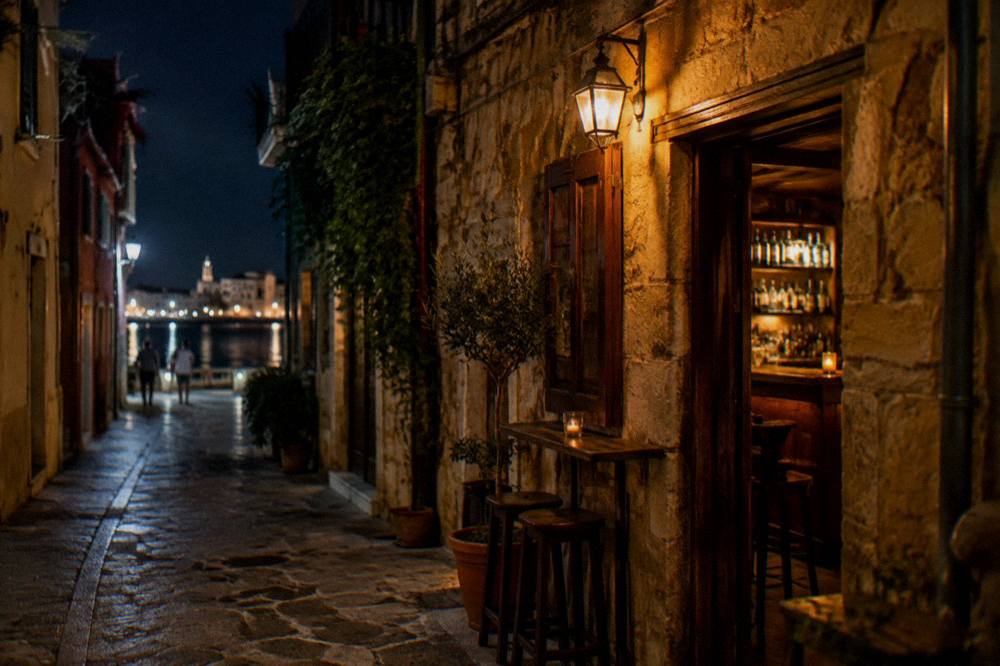
The shape of the night is set by geography. The harbour front is the promenade: lit tables along the water, the lighthouse a bright point at the end of the mole, excursion boats moored for the night. One street back, the Topanas district on the west side and Splantzia on the east side hold the smaller rooms where locals and staying visitors end up. The Neoria, the Venetian shipyards, seven survivors of an original seventeen from the 15th to 16th century, run along the east side of the harbour and give that stretch its long stone wall. Nothing here needs a car between venues.
Two habits shape the evening more than any venue list. First, eating is late: kitchens in the Old Town serve well past ten in season, and a bar is as likely to be a mezedopolio with wine and small plates as a counter with stools. Second, the walk itself is the main event. The desk's own view is that anyone planning a first night should simply do the harbour loop, from the Firka Fortress, whose grounds are free to enter by day, along the mole toward the lighthouse and back through the lanes, before deciding where to sit.
For the food side of the evening in detail, the site's Chania restaurants guide and the guide to Cretan food in Chania cover the kitchens; this page covers the hours around them.
Where Does Chania Nightlife Happen After Dark?
The night divides into four walkable zones: the Venetian Harbour front, the Old Town lanes of Topanas and Splantzia, the waterfront strip running east from the Neoria, and the beach suburbs such as Agia Marina and Platanias further west along the coast. The first three are within one circuit of each other; the fourth is a bus or taxi ride and runs louder and later in high summer. Everything in the centre sits around a harbour first built 1320 to 1356, with dredging and a wall recorded in 1515, so the distances are short and the orientation is simple: water on one side, lanes on the other.
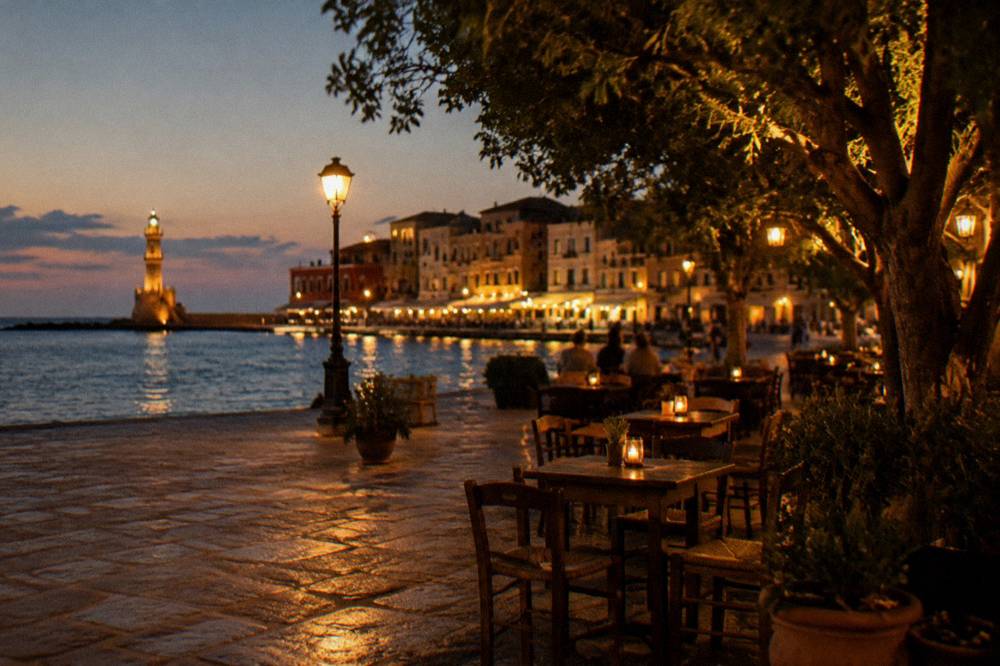
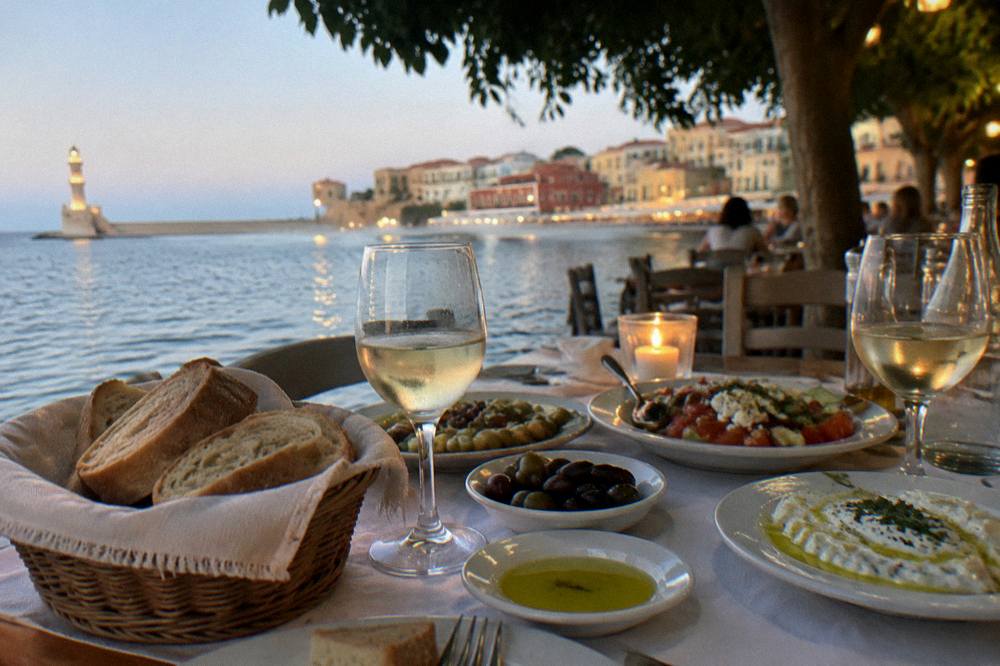
The harbour front is the postcard and the crowd. Tables face the water, the mosque building at the inner harbour glows at night, and the mole walk toward the lighthouse is the standard before-or-after-dinner stroll. Prices here sit at the top of the local range, as waterfront tables anywhere do, and the check arrives itemised, so the arithmetic is visible before paying.
Splantzia, east of the harbour around its plane-tree square, is the other pole: smaller bars, music rooms and late kitchens at gentler prices, in the district that sits between the harbour and the Neoria shipyard wall. Topanas, west of the harbour below the Firka Fortress, is quieter, all stone lanes and low doors. The desk suggests one honest planning rule: no district is a secret and none needs avoiding, but the harbour front sells the view and the lanes sell everything else, and the posted menu is the check anyone can do before sitting.
For where to sleep closest to all of it, the where to stay in Chania guide compares the Old Town against the beach areas, and the how many days in Chania guide helps size the trip the night belongs to.
To sleep a short walk from the harbour front, book a hotel room here.
Three evening plans from the roster pair naturally with a night out, and each can anchor a day that ends in town:
What Are The Best Evening Plans Beyond Bars In Chania?
The strongest non-bar evening plans in Chania are the guided sunset boat cruises from the Old Harbour, a food-and-wine tasting evening in or near the Old Town, and a late walk taking in the lit harbour monuments, all of which need booking only a day or two ahead in shoulder season. The water plans matter most: sunset trips depart from the Venetian Harbour itself, which is the harbour for excursion boats, unlike the Piraeus ferry, which leaves from Souda port about 7 km east of the Old Town. That distinction is the single most useful transport fact of any Chania evening on the water.
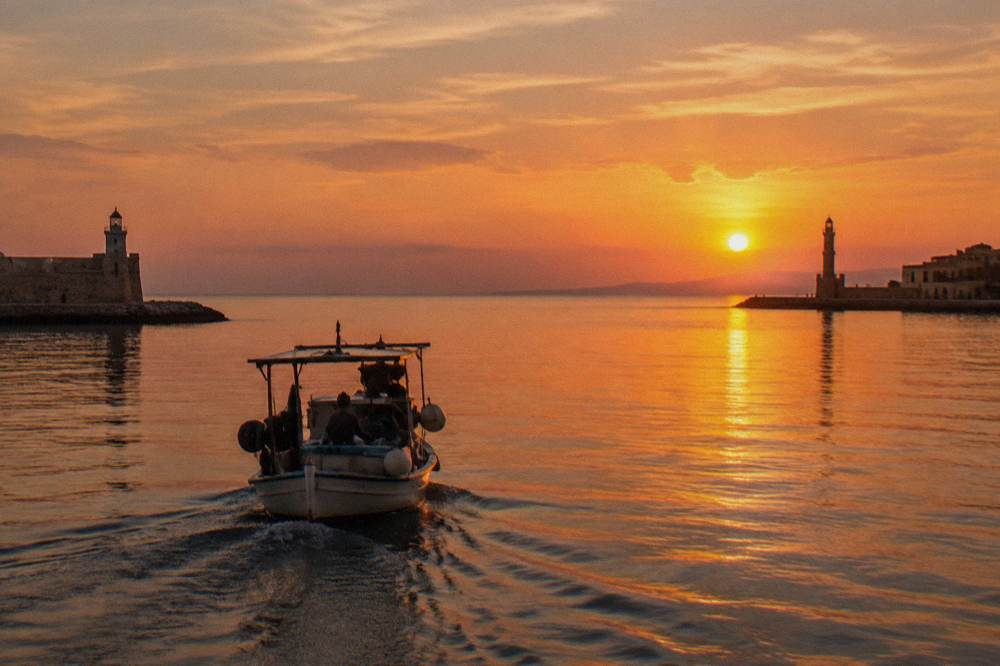
A short sunset cruise is the classic opener. One such trip, with a guide on board:
The food evenings are the other pillar. A guided tasting walk through the Old Town pairs the lanes with the kitchen culture, and the roster holds several, including one built around street food stops and another around a sit-down tasting circuit:
For a longer evening built around Cretan wine and oil, this guided tour runs from Chania with tastings and snacks:
The free monuments do the rest. The Firka Fortress grounds cost nothing, the fort dates from 1620, and the harbour loop past the Neoria and the mosque building needs no ticket at all. The one paid sight with published figures is the Archaeological Museum of Chania at 15 Skra Street in Halepa, a short ride east of the centre: the full ticket is EUR 15, the concession EUR 8, and the museum's own visit page is where opening hours should be checked, since the sources on hours contradict each other. The table below gathers the figures that touch an evening or a next-morning plan.
| Sight or service | Verified figure | Note |
|---|---|---|
| Archaeological Museum of Chania, 15 Skra Street, Halepa | EUR 15 full, EUR 8 concession | Check the museum's visit page for hours |
| Firka Fortress grounds | Free entry | Fort built 1620 |
| Venetian Harbour and mole walk | Free | Harbour first built 1320 to 1356 |
| Neoria shipyards, exterior | Free to walk past | Seven survivors of an original seventeen, 15th to 16th century |
| Samaria Gorge individual ticket | EUR 10 via the NECCA e-ticket portal | Free for EU under-18 and over-65; check NECCA status before planning |
| Kissamos municipal fee on Balos boat tickets | EUR 1, over-13s | The only confirmed Balos charge |
What Does An Evening On The Water Look Like In Chania?
An evening on the water in Chania means a sunset cruise, a short trip to Lazaretta Island for a swim stop, or a longer small-group sail to Agioi Theodoroi, all departing from the Venetian Harbour and returning the same night. The harbour is the base for excursion boats, and its night-lit basin is what makes these trips feel like part of the evening rather than a separate excursion: you board a few steps from where you will eat afterwards. July and August mean maxima of 30.7 C and 30.4 C respectively in the HNMS Chania Souda station table, so a boat deck at sunset is the comfortable version of a summer evening.
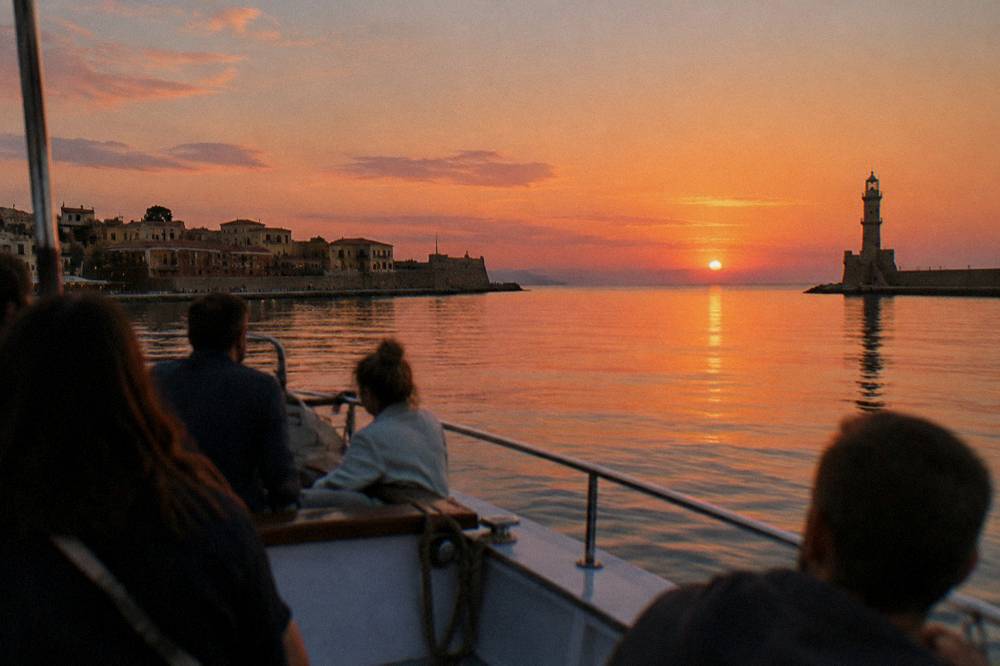
The roster gives the range. A Lazaretta trip with a swim stop is the shortest water plan of the evening; a small-group sail to Agioi Theodoroi with a meal on board stretches the same idea; and a luxury sunset catamaran rounds out the top end. None of these figures belongs in prose, so the desk's rule stands: the duration, price and rating render on the tour's own listing, not in an article. Two of the roster's evening-appropriate options:
One planning note that is often missed: the wind. The HNMS Chania Souda station table gives the prevailing wind as west overall, north-west in July and August, which is the meltemi pattern, a general summer north-westerly with no reliable speeds attached to it in the published data. Evening cruises are the calm-water version of the coast for exactly this reason, and if a departure is windy the operator makes the call, not the passenger.
For daytime water plans that end back in town for the night, the best tours from Chania guide collects the full day-trip roster, and the site's beaches coverage helps decide which shore day to pair with which harbour night.
How Late Do Things Run, And How Do You Get Home?
In high season, Old Town kitchens and bars in Chania commonly serve past midnight, the harbour promenade stays busy until the last tables empty, and the practical limit on the night is the return trip: the centre is walkable, but the beach suburbs to the west and the airport 14 km away on the Akrotiri peninsula are not. No published closing-time table exists for the bars, so the desk reports what is structural rather than what is scheduled: a city of this size supports a late, dinner-anchored night in the centre, and transport, not the venues, sets the curfew.
The transport facts that matter are few and verified. Chania International Airport "Ioannis Daskalogiannis" (CHQ), operated by Fraport Greece, sits about 14 km from the city centre on the Akrotiri peninsula near Souda; the airport's own site carries the public bus and taxi information, and no fare belongs in this page. The long-distance KTEL bus station is on Kydonias street, with routes to Heraklion, Rethymno, Kissamos, Paleochora, Omalos and, in summer, Elafonisi. The overnight Blue Star Ferries service to Piraeus leaves Souda port at about 21:30 with a crossing of about 9 h 15 min on the operator's published timetable, to be confirmed before travel. None of these run for the benefit of a bar crawl: a late night in the centre plus a walk home is the realistic shape.
| Journey or service | Verified fact | Where to confirm |
|---|---|---|
| Airport to city centre | About 14 km, Akrotiri peninsula | The airport's own site for bus and taxi options |
| Piraeus ferry | Blue Star Ferries, overnight from Souda port, about 21:30 departure, about 9 h 15 min crossing | The operator's timetable |
| Long-distance buses | Station on Kydonias street; routes to Heraklion, Rethymno, Kissamos, Paleochora, Omalos, Elafonisi in summer | e-ktel.com |
| Within the Old Town | On foot; the harbour circuit is short | No service needed |
| To beach suburbs west | KTEL or taxi; no fare published here | KTEL Chanion |
For the full arrival-to-door picture, the getting around Chania guide and the KTEL buses guide carry the detail, and the Chania airport guide covers the first leg of the trip.
When Is The Best Season For Chania Nights?
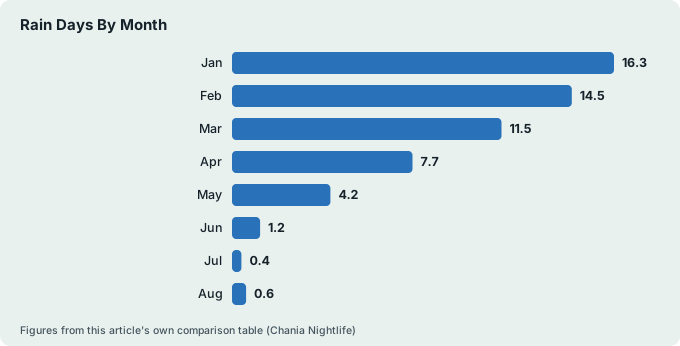
The best months for Chania evenings, judged on the HNMS Chania Souda station records for 1958 to 2010, are May through September, when monthly rainfall runs 13.5 mm in May down to 1.0 mm in July, with June, July and August the driest and warmest stretch, mean temperatures of 24.7 C, 26.7 C and 26.3 C respectively. From October the rain returns, 67.7 mm across 9.3 rain days in the station table, and by December the mean falls to 12.7 C with 101.9 mm of rain, which is a different kind of evening: indoor, early, quiet.
The honest framing of the table matters. These are weather-station means for the period 1958 to 2010 from the Chania Souda station, at 148 m inland of Souda Bay, the records the service publishes; they are not a 1991 to 2020 normal, and no monthly sea-temperature normal is published at all. Humidity runs from 50 percent in July to 73 percent in January. What the numbers say for nightlife planning is simple: the outdoor, harbourfront version of Chania at night is a May-to-September product, and October is the shoulder where it can still be warm, with a mean of 19.4 C, but the chance of a wet evening rises sharply.
| Month | Mean C | Rain mm | Rain days |
|---|---|---|---|
| Jan | 11.0 | 129.5 | 16.3 |
| Feb | 11.0 | 104.0 | 14.5 |
| Mar | 12.7 | 76.0 | 11.5 |
| Apr | 15.9 | 31.5 | 7.7 |
| May | 20.2 | 13.5 | 4.2 |
| Jun | 24.7 | 3.4 | 1.2 |
| Jul | 26.7 | 1.0 | 0.4 |
| Aug | 26.3 | 1.4 | 0.6 |
| Sep | 23.2 | 15.4 | 3.2 |
| Oct | 19.4 | 67.7 | 9.3 |
| Nov | 15.8 | 77.0 | 11.2 |
| Dec | 12.7 | 101.9 | 16.1 |
In the table January is the wettest month at 129.5 mm and July the driest at 1.0 mm, and July is the warmest month in the series while January and February are the joint coldest at 11.0 C mean. For the fuller seasonal picture, the Chania weather guide and the best time to visit Chania guide unpack the same station table for daytime planning.
What Should You Know Before A Night Out In Chania?
Before a night out in Chania, the practical items are few: Greece uses the euro, accommodation collects the climate crisis resilience fee per room or apartment per night at seasonal rates to be confirmed at booking, and any day trip that shares the trip with the night, above all Samaria Gorge, carries its own status check. Samaria normally opens 1 May to 31 October, but storms in late September and early October 2026 destroyed sections of the path, staff describe a 2026 reopening as extremely difficult, and works are aimed at readiness in May 2027, so the NECCA status page is the only honest source on whether a gorge day can precede a harbour night.
The gorge-day-and-harbour-night pairing is a classic Chania combination, and the site's featured related tour is exactly that shape: a guided Imbros gorge hike with a Sfakia coastal experience, returning to Chania in the evening. The listing carries the price, rating and duration, and the desk adds only the geography: the walk is one-way through the gorge country of the White Mountains, and the south-coast swim stop is on the Libyan Sea side of the island, the opposite coast from the harbour where the night will end. The tour's live listing is the place to check the season and departure details:
For the same pairing on other pages, the Chania walking tours guide covers guided walks in and around the city. The budget picture for a night out is not one the desk can price, so the honest version is that posted menus and itemised bills are the reader's own check, and no range is invented here.
Two more dated facts from the verified file frame a 2026 trip cleanly. Entry systems across Schengen changed when the EES was fully deployed on 10 April 2026, while ETIAS is not in operation and no applications are collected as of October 2026, so no start date or fee for it belongs in any plan. Greece has been in the euro area since 1 January 2001 and a full Schengen member with internal checks abolished since 26 March 2000, so for most European travellers the border is a non-event and the night starts at the harbour.
Three tours from the roster, again, for anyone whose night out is the anchor of a fuller Chania stay:
Common Questions About Chania Nightlife
Is Chania nightlife good?
Chania nightlife is good for what it is: a dense, walkable evening scene of harbourfront tables, Old Town bars and late kitchens around the Venetian Harbour. It is not a big-club destination, and anyone wanting loud, late, large-venue nights should plan for the beach suburbs west of the centre rather than the Old Town itself.
What time do bars and restaurants close in Chania?
No published closing-time schedule exists for Chania venues. In high season, Old Town kitchens and bars commonly serve past midnight, and the harbour promenade stays busy until the last tables empty. Anyone with a fixed curfew, such as an early ferry from Souda port at about 21:30, should plan the night backwards from the departure.
Where do people go out at night in Chania?
The night concentrates on the Venetian Harbour front and the Old Town lanes, with Topanas west of the harbour and Splantzia east of it as the two back-lane districts. The Neoria shipyard wall lines the east side of the harbour, and the beach suburbs further west along the coast run a louder summer scene of their own.
Can you walk around Chania at night?
The centre of Chania is walkable at night: the whole harbour circuit from the Firka Fortress to the Mosque of the Janissaries and back through the lanes is short and lit, and the beach suburbs are reached by KTEL bus or taxi rather than on foot. Is it safe to walk around Chania at night is covered in its own answer page on this site.
Is there a club scene in Chania?
The club scene is small and sits mostly outside the Old Town, toward the beach suburbs west of the city in summer. The Old Town's version of a late night is a mezedopolio or bar in Splantzia rather than a dance floor, and that is the scene the harbour has always supported.
What should a night out in Chania cost?
No verified price list exists for Chania bars or tavernas, and the desk does not invent ranges. Posted menus, itemised bills and prices displayed at the door are the reader's own check before sitting, and the same rule applies to taxi fares and any ride back to a hotel outside the centre.
The evening that works in Chania is the one that ends on the mole: a table somewhere in the lanes, a walk out toward the lighthouse that has stood in some form since about 1595 to 1601, and a short stroll home through streets that have closed around this harbour since the years of its first construction, recorded between 1320 and 1356. Everything else, the boats, the gorges, the museums, is what fills the day on either side of it.