Seitan Limania Chania
Seitan Limania is the small, cliff-ringed cove on the northern side of the Akrotiri peninsula, east of Chania on the island of Crete, Greece. This guide sets out what the beach is, how the steep access path shapes a visit, what the HNMS Chania Souda station records say about the weather by month, and which other Akrotiri sights and guided days fit around it.
Short answer
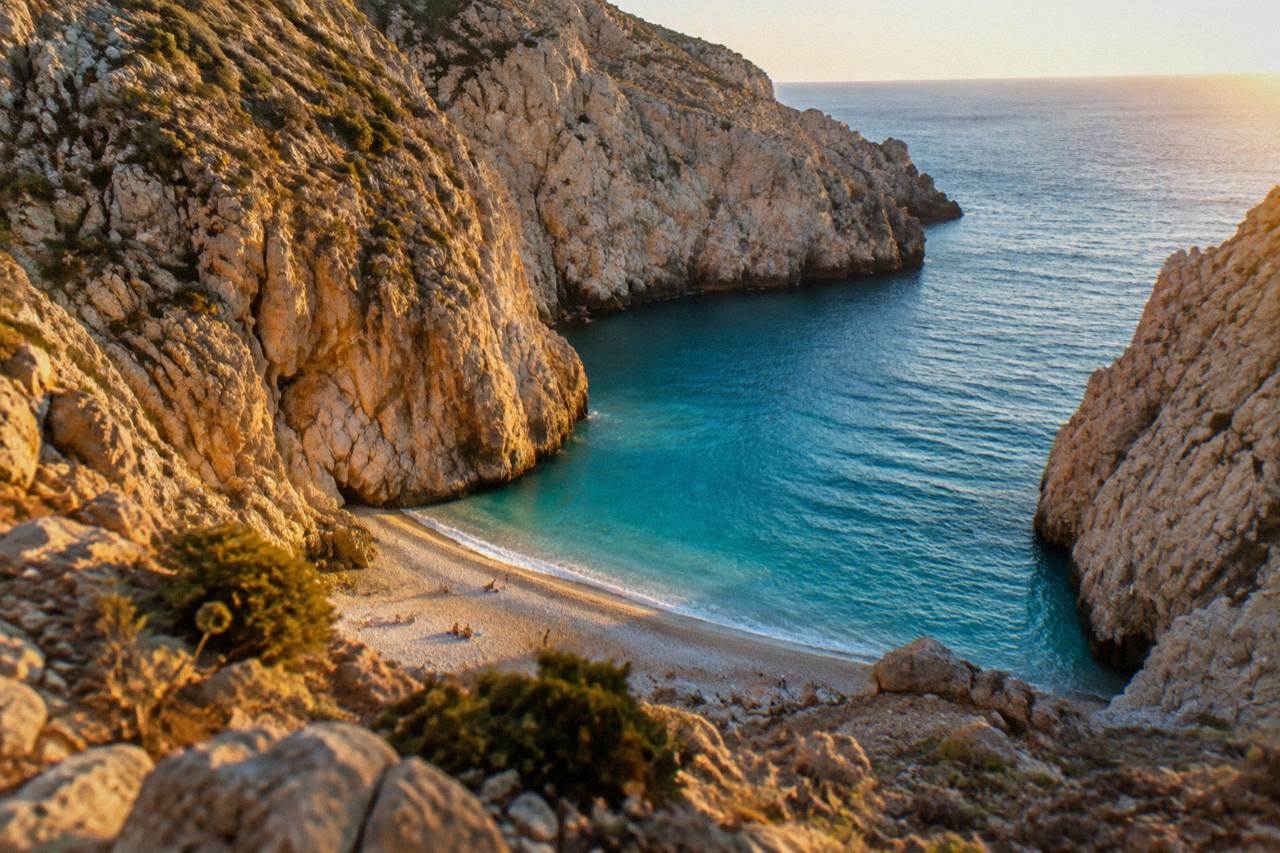
Seitan Limania is a narrow sandy cove wedged between near-vertical cliffs on the north coast of the Akrotiri peninsula, reached from Chania by road and then a steep, rocky descent on foot. There is no entry charge and no booking, but the path, not the sea, is what decides whether the day works, and the descent is the reason the beach stays quiet outside peak hours.
Seitan Limania is a small cove on the northern coast of the Akrotiri peninsula, the headland that shelters Chania's approaches on the north-west side of Crete, Greece. The beach sits at the foot of a V of steep rock, and the final stretch of every visit is made on foot, down a rough path cut into the cliffside. The name is used interchangeably with "Seitan Limani" in Greek signage and local speech, and the place has become one of the most photographed stretches of coast within a short drive of the city. What follows is a desk guide: what the cove is, how to plan the access, what the HNMS Chania Souda station records say about the weather by month, and how to fold the beach into a wider day on the peninsula.
What Is Seitan Limania Near Chania?
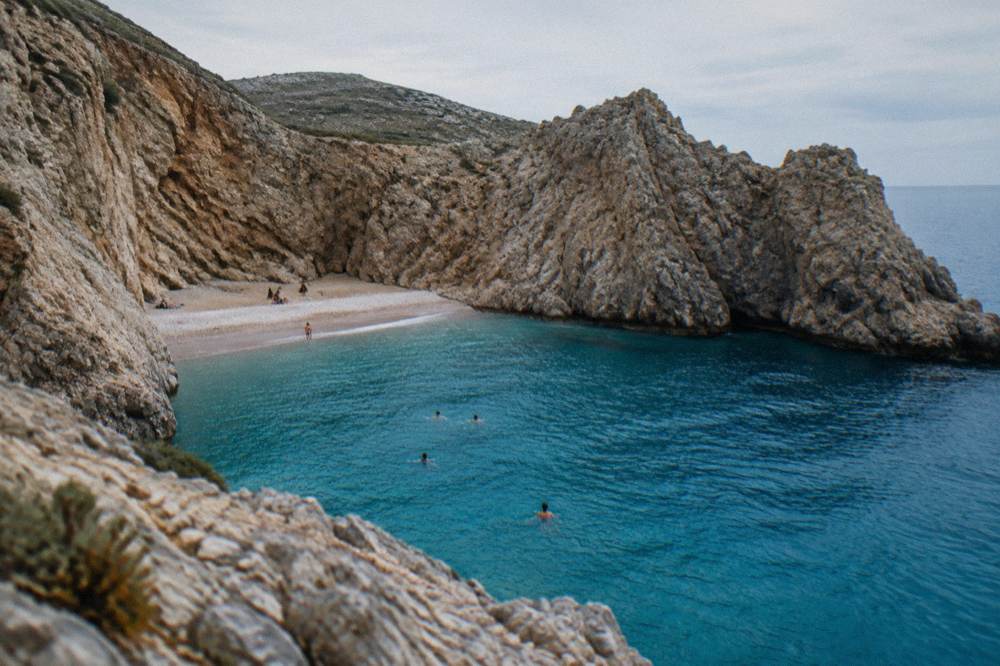
Seitan Limania is a narrow, sandy cove set between steep rock walls on the north coast of the Akrotiri peninsula, the headland east of Chania that also carries the city's airport and a string of quieter beaches. The beach has no entrance charge and no ticket, but the final approach is a steep, rocky footpath rather than a promenade, so the cove reads as a short hike with a swim at the end rather than a drive-up beach. The setting is the draw: pale rock rises on three sides, the sand drops sharply into deep blue water, and the whole inlet is only a few dozen paces wide at the top of the sand.
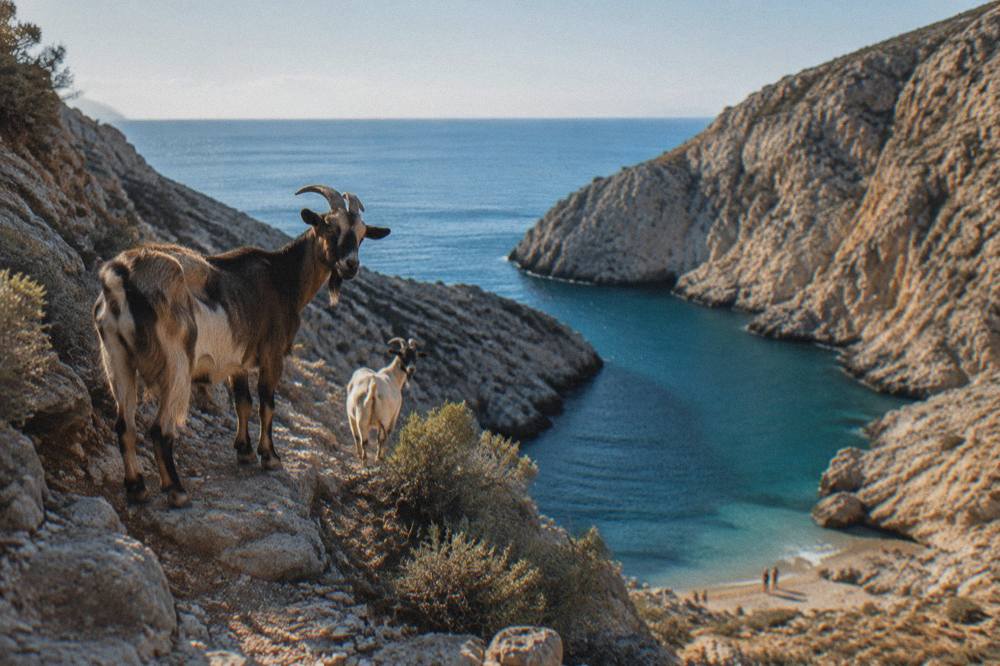
The word "seitan" in the local name is often translated as "devilish" or "cunning", a reference to how difficult the approaches to this stretch of coast were for boats and shepherds alike, while "limania" is a form of the Greek word for a small harbour or haven. Older charts treat the inlet as an anchorage rather than a beach. Goats still graze the slopes above the sand, and they are a reliable feature of any visit, standing on ledges that look impossible from the path.
The cove sits on the wild side of the Akrotiri peninsula, the same headland that holds the calmer, family beaches of Marathi, Stavros and Kalathas. Those beaches are wide and gently shelving; Seitan Limania is the opposite, deep water close to shore and rock on every side. Choosing between them is really a choice between a beach day and a short adventure, and the rest of this guide treats them as complements rather than rivals.
How Difficult Is The Path Down To Seitan Limania?
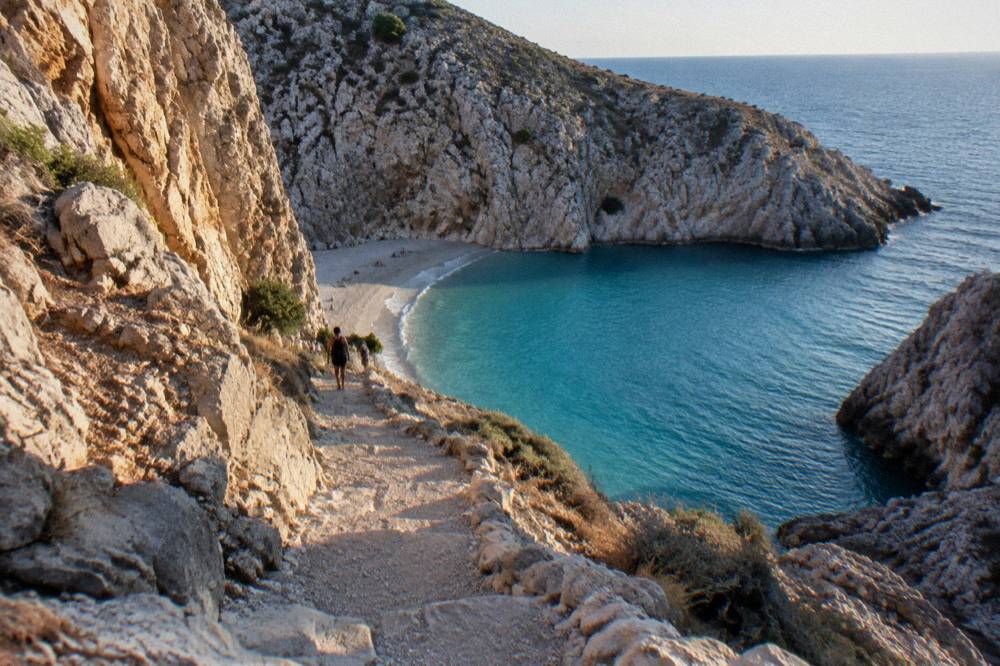
The descent to Seitan Limania is a steep, rocky goat track with loose stones and bare rock, not steps or a maintained trail, so closed shoes with grip, both hands free and plenty of water are the standard preparation. There is no entry fee, no gate and no booking, and the return climb back up is the harder half of the walk. The walk takes as long as it takes, and any minute count copied from an online review would be a guess dressed as a fact.
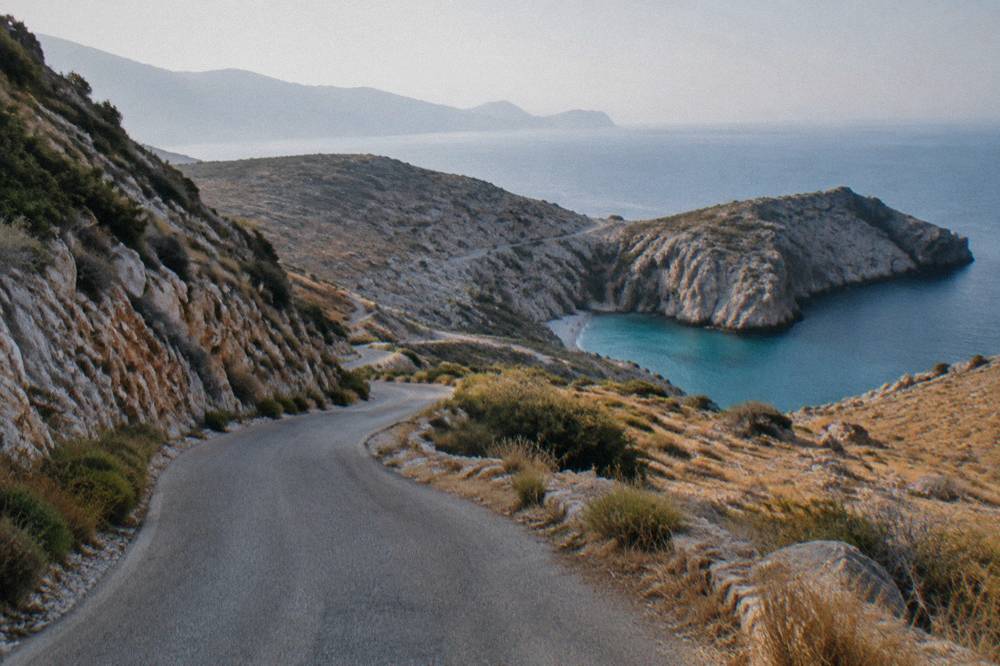
What can be said plainly is the shape of the route. The road from the Chania side of the peninsula winds to a parking area above the coast, and from there the path drops toward the cove over bare rock and rubble. The angle is steep enough that going down feels exposed and coming back up feels like exercise. Footwear is the single item that decides the day: sandals and smooth-soled shoes are a poor match for the surface, and the path is where injuries happen, not in the water.
The cove is therefore not an every-party beach. Small children, anyone with knee or ankle trouble, and anyone unwilling to carry their own shade and water should weigh it against the gentler Akrotiri options linked above. For everyone else the reward is water that drops deep quickly, a sand strip with no road behind it, and a cliff amphitheatre that photographs well from the path itself, which is worth remembering: the classic image of the cove is taken from the upper path, and a visitor who turns back before the sand still leaves with the picture.
A steep path is also a filter, and it explains the rhythm of the day. The car park fills first because the capacity above the cliff is smaller than the beach's audience in July and August, and the path is busiest in the middle of the day. An early or late start changes the walk itself, cooler rock, emptier sand, softer light for photographs, and costs nothing. The climate table further down shows why: midsummer mornings are the one window when the rock is not yet hot underfoot and the July mean maximum sits above 30 degrees.
When Is The Best Time Of Year To Visit Seitan Limania?
May, June, September and early October are the best months for Seitan Limania by the HNMS Chania Souda station records: sea-warm weather, monthly rainfall of 13.5 mm in May down to 1.4 mm in August, and mean temperatures from 20.2 to 26.3 degrees, while July and early August add heat, crowds and midday rock that turn the steep path into an endurance test. The figures below are station records for the period 1958 to 2010, published by the Hellenic National Meteorological Service, and they are the honest basis for any month-by-month plan.
| Month | Mean temperature C | Rainfall mm | Rain days |
|---|---|---|---|
| January | 11.0 | 129.5 | 16.3 |
| February | 11.0 | 104.0 | 14.5 |
| March | 12.7 | 76.0 | 11.5 |
| April | 15.9 | 31.5 | 7.7 |
| May | 20.2 | 13.5 | 4.2 |
| June | 24.7 | 3.4 | 1.2 |
| July | 26.7 | 1.0 | 0.4 |
| August | 26.3 | 1.4 | 0.6 |
| September | 23.2 | 15.4 | 3.2 |
| October | 19.4 | 67.7 | 9.3 |
| November | 15.8 | 77.0 | 11.2 |
| December | 12.7 | 101.9 | 16.1 |
Read the table as a planner rather than a forecast. January is the wettest month in the table at 129.5 mm across 16.3 rain days, and July the driest at 1.0 mm across 0.4 rain days. Between those poles, May to September is effectively dry, with 13.5 mm in May falling to 3.4 mm in June, and rain only starts to matter again from October, which records 67.7 mm. For a beach whose whole day is a steep path, wet rock is a real hazard: a rain day in October makes the descent much less sensible than the same rain over a drive-up beach.
Heat works the same way. The station records a July mean maximum of 30.7 C and an August mean maximum of 30.4 C, with mean minimums of 21.2 C in both months, so midsummer nights barely cool the rock. Shoulder months give mean maximums of 24.5 C in May and 27.4 C in September, which keeps the walk inside what most people would call reasonable effort.
| Season (months) | Mean temperature range C | Monthly rainfall range mm | What it means for the path and the swim |
|---|---|---|---|
| May to June | 20.2 to 24.7 | 13.5 down to 3.4 | Dry rock, warm days, cooler water than midsummer |
| September | 23.2 | 15.4 | Warm sea, thinner crowds, first chance of a shower |
| October | 19.4 | 67.7 | Mild walking, real rain risk, check the day not the month |
| November to April | 11.0 to 15.9 | 129.5 down to 31.5 | Path can be wet, swim is hardy rather than inviting |
What Should You Bring To Seitan Limania?
Bring closed grippy shoes, more water than feels reasonable, sun protection including something to sit under, and as little else as possible, because everything carried down the cliff has to be carried back up it, and the cove has no shop, no rental line and no shade structure of the kind a developed beach offers. A small first-aid kit earns its place on this path more than on any drive-up beach in the region, since a scrape on loose rock is the most likely mishap of the day.
The packing logic follows from the terrain. There is no kiosk at the sand, so water for the climb is the item that matters above all. There is no natural shade worth the name on a cliff face, so a hat, sunscreen and an umbrella or sarong for shade are not optional in the May-to-September window. And because the path is the risk, the shoes matter more than the towel: the towel dries, the ankle does not.
| Item | Why it matters at this cove |
|---|---|
| Closed shoes with grip | The path is steep, loose rock both ways; sandals are the common cause of turned ankles |
| Water beyond the day's obvious need | The return climb is the effort peak and there is nowhere to buy water at the sand |
| Hat and high-factor sunscreen | The rock walls reflect sun and the cove holds no reliable shade |
| Small first-aid kit | Nearest help is a steep path away; plasters handle the likely scrapes |
| Dry bag or zip bag for the phone | Swimming here is deep water close to shore, and the classic photo is taken from the path above |
| Nothing heavy | Every kilogram carried down is carried back up the same angle |
One more planning note belongs here rather than anywhere else: swimming at Seitan Limania means deep water quickly, and the depth is part of the cove's character. Confident swimmers enjoy it; anyone nervous in deep water should treat the inlet as a viewpoint and a paddle, and the gentler Akrotiri beaches mentioned earlier handle the full swim better. The desk states no safety statistic for this cove because none is verified in the site's records, and a reader deserves a straight "confirm conditions on the day" rather than an invented reassurance.
How Do You Get To Seitan Limania From Chania?
Seitan Limania is reached by road from Chania onto the Akrotiri peninsula, the same headland that carries Chania International Airport "Ioannis Daskalogiannis" (CHQ) about 14 km from the city centre, with the final stretch a winding peninsula road to a parking area above the cove and then the steep footpath down. The airport's own site carries the current public bus and taxi information for reaching the peninsula, and the desk prints no fare or timetable figure that the official pages do not state.
The drive itself is straightforward: out of the city along the peninsula, past the turn-offs for the quieter beaches and the monasteries, until the road narrows toward the north coast. The final approach is a winding road with bends and, in places, single-track feel, so the last kilometres take longer per kilometre than the first. Visitors hiring a car will find the peninsula drive is the easiest orientation drive in the region, since every side road eventually meets either the coast or the airport road back into town. The site's driving-in-Crete and car-rental guides, linked from the Chania car rental overview's sister pages on the wider site, cover the hire side in detail.
For a visit without a car, the honest answer is that Seitan Limania is awkward. Two workable shapes exist: combine the cove with a peninsula loop by taxi or hire car, or leave the cliffs to another trip and take a guided day instead. The guided options that fit an Akrotiri-and-around plan are the village day trip in the trio below, the 7 Villages of Apokoronas tour with lunch, which covers the near-inland side of the region, and the gentler water options such as the calm-water paddleboard tour from the harbour side. Check availability
Planning to drive the peninsula yourself? Book a rental car here.
Parking deserves a plain word. The area above the cove holds a limited number of cars, and in July and August it fills early, after which cars line the approach road and add walking distance to a day that already contains a cliff path. This is the practical reason every plan for a midsummer visit starts with an alarm: the second half of the morning costs more, in heat and in distance, than the first half saves in sleep.
What Else Can You Combine With Seitan Limania In One Day?
The Akrotiri peninsula packs several half-day sights within a short drive of Seitan Limania, including the monasteries of Agia Triada and Gouverneto, the calm beaches of Marathi, Stavros and Kalathas, and the taverna strip of Nea Chora back in the city, which makes the cove a natural anchor for a one-loop day rather than a standalone trip. Stavros in particular sits on the peninsula's north side and pairs naturally with the cove for anyone who wants one adventurous beach and one easy one in the same day.
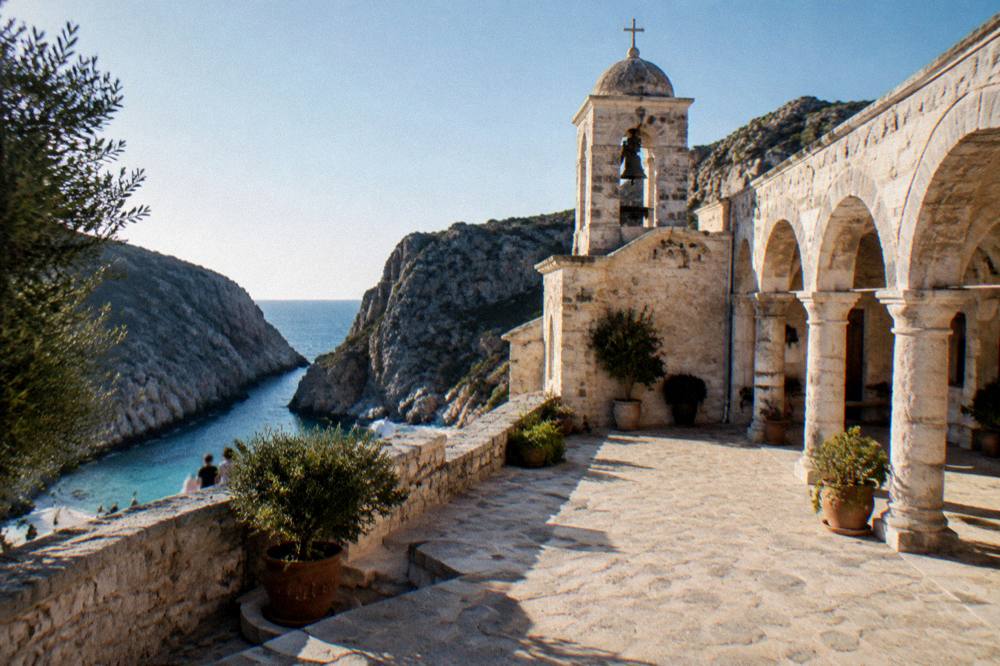
The monasteries give the day a second register. Agia Triada and Gouverneto Monastery sit inland of the north coast, and the drive between them and the cove is minutes, not hours. Dress codes at working monasteries are the one thing to plan for: covered shoulders and knees, and a check of visiting hours before setting out, since the desk carries no verified opening times for either house and a closed gate is a wasted leg of the loop.
Back toward the city, the peninsula's edges carry the easier water. Marathi and Kalathas shelve gently and suit a swimming stop after the cliff walk, and Stavros adds the amphitheatre of rock that closes the peninsula's north-west corner. A two-day plan that dedicates one day to the peninsula and one to the city, along the lines of the Chania two days itinerary, is the shape the desk suggests for a first visit.
For travellers who would rather trade the third beach for mountain country, the pairing that keeps the same "wild Crete, no effort on the path" promise is the Imbros gorge hike with the Sfakia coast, which moves the drama from a cliff path to a gorge and a south-coast swim. Check availability
Is Seitan Limania Safe, And What Are The Real Risks?
The real risks at Seitan Limania are the path and the deep water, in that order: the descent and climb over loose rock in poor shoes or midday heat, and a swim that reaches depth within a few strokes of the sand, are the two hazards that shape every incident this cove is known for, while the sea itself can bring swell onto a beach that has no lifeguard service the desk can verify. No safety statistic for this beach exists in the site's records, so this section gives checks a reader can make instead of numbers nobody has.
The checks are simple. Look at the sea from the top of the path before committing to the descent: if waves are breaking across the sand or the water in the inlet is churned white, the cove is not swimmer-friendly that day and the viewpoint is the whole visit. Check the sky against the season: rain days rise from 3.2 in September to 9.3 in October in the station table, and wet rock on this path is a reason to walk another day. Check your own footwear honestly at the car. And keep the climb-out time in the day's arithmetic, because the path takes longer up than down at any fitness level.
Goats, cliffs and photographs deserve one shared caution. The animals are unbothered by people and stand on seemingly impossible ledges, which tempts visitors toward the edge for a photograph. The drop from the upper path is real and unfenced in places. The classic image of the cove needs nothing more than the path itself and a phone held steady, and the desk's advice is that no photograph from this cliff is worth a step onto loose ground.
Why Is The Water At Seitan Limania So Clear?
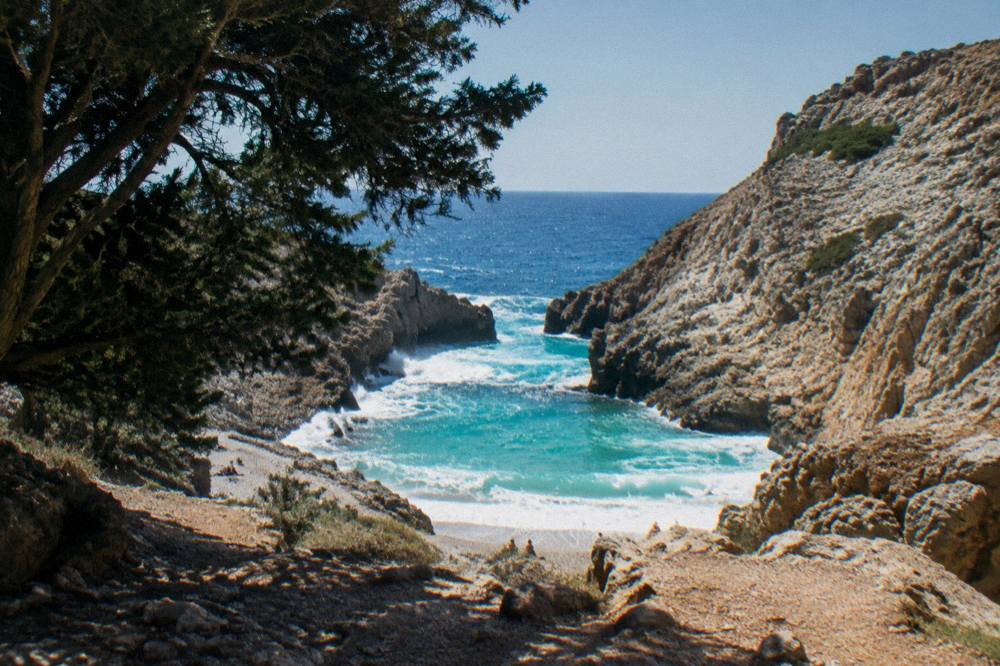
The water at Seitan Limania is clear because the cove is deep close to shore, sits on a rocky, river-free headland with no stream carrying sediment into the inlet, and exchanges water freely with the open Cretan Sea across its mouth, so there is little sand-stirring shallows and little land-runoff to cloud it. Depth is the visible difference within seconds of wading in: this inlet drops away where beaches like Marathi and Kalathas shelve gently, and depth plus rock instead of silty shallows is what the eye reads as clarity.
What can be said is what any swimmer can verify: deep inlets hold the day's heat differently from shelving beaches, and the water in May and October is noticeably cooler than in August. A live reading, where one is published, is a live reading, not a normal.
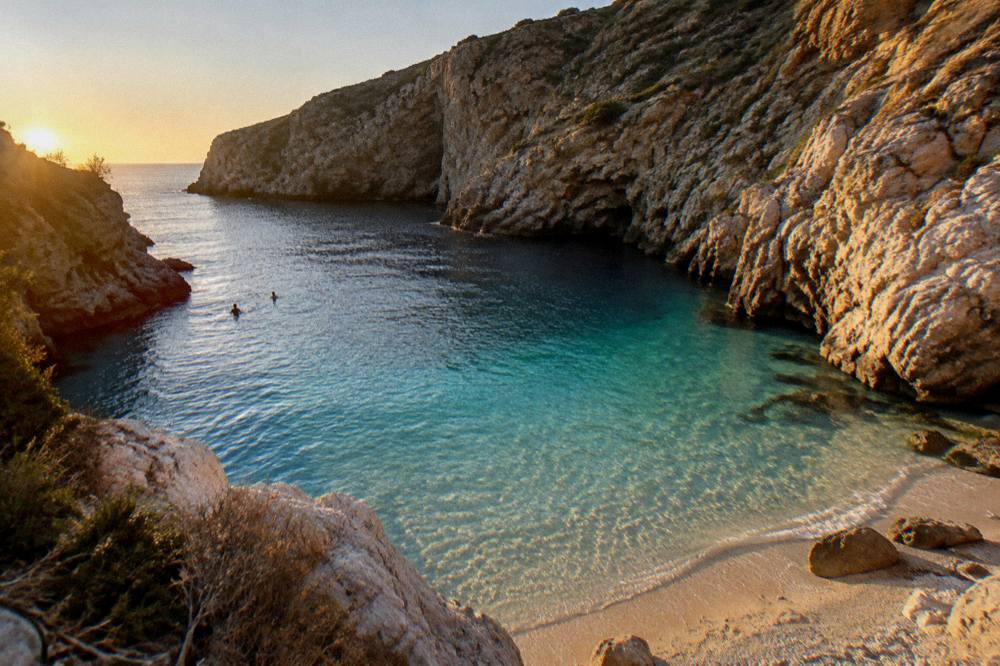
Clarity is also why the cove photographs so well from above. The gradient from pale sand through turquoise to deep blue is a depth gradient, and the upper path looks straight down that gradient. Late afternoon light, when the sun is lower and the crowds thinner, gives the calmer surface that makes the colour bands read cleanly, which is one more argument for shifting the visit off the midday peak in summer.
Where Does Seitan Limania Fit In A Chania Itinerary?
Seitan Limania fits best as the morning or late-afternoon anchor of an Akrotiri day, combined with one monastery, one calm beach and an evening back in the Old Town, and it earns its slot on the first or second full day of a stay of two days or more, before the long day trips to Balos, Elafonisi or the gorges take over. The cove needs half a day at most, including the path, and it pairs badly with nothing except another steep walk in the same heat.
For a short stay, the sequence is straightforward. Day one, the city: the Venetian Harbour, the lighthouse, the Old Town lanes and dinner at Nea Chora. Day two, the peninsula: Seitan Limania early, a monastery mid-morning, Marathi or Stavros for an easy swim, and the airport road home. The what not to miss in Chania question and the things to do in Chania round-up cover where the cove sits in the wider ranking, and this guide's honest line is that it is a highlight for visitors who want the dramatic cove specifically, and a skip for anyone whose party makes the path a bad idea.
For a longer stay, the peninsula day slots into the front of the week and the big day trips follow: Balos and Gramvousa from Kissamos, Elafonisi on the far south-west corner, Samaria when its status allows, and the south-coast villages. Two rules of thumb keep the week sane. Put the cliff walk before the gorge walk, not the day after, and leave one free afternoon per week for wind, because the north-westerly that prevails in July and August can close the north-coast coves to sensible swimming while leaving the city side calm.
The guided alternatives deserve their own paragraph, because a guided day does the driving, the timing and the water-carrying. The 7 Villages of Apokoronas tour with lunch trades the cliff for village country and a shared table. The small-group paddleboard tour in calm waters puts the same blue water under a board instead of under a cliff path. Check availability
What Do People Get Wrong About Seitan Limania?
The common mistakes at Seitan Limania are underestimating the path, arriving at midday in July and August, treating the deep water as a casual paddle, and expecting facilities or shade that the cove does not have, and each of those four errors is avoidable with a start time, the right shoes and an honest reading of the sea from the top of the path. None of them is a reason to skip the beach; all of them are reasons to plan it rather than improvise it.
The footwear mistake is the most frequent and the most expensive. Flip-flops on a steep rubble track are a turned ankle with a delay attached, because the walk out is uphill and help is a path away. The timing mistake follows: the station's July mean maximum of 30.7 C lands on bare rock by noon, and the same crowd that filled the car park fills the path. The water mistake is quieter, a confident swimmer and a nervous one reading the same inlet differently, and the answer is on the surface: deep water starts within steps of the sand.
The facilities expectation is the easiest to fix in advance. The cove is uncommercialised by nature and by geography, and what a visitor carries down is what exists at the sand. That is also the cove's virtue, and the Chania Crete Travel Guide keeps its honest line throughout: the beaches with the beds and the tavernas are a peninsula drive away, and the beach with the cliffs asks for shoes, water and an early start. Planned that way, Seitan Limania is one of the most rewarding half-days on the Akrotiri peninsula, and the photographs taken from its upper path are the ones that follow a visitor home.
Common Questions About Seitan Limania Chania
Is Seitan Limania worth visiting?
For visitors who want a dramatic, cliff-ringed cove and accept a steep rocky path as the price of admission, yes, and the upper path alone gives the classic view of the inlet. For parties with small children, mobility limits or no appetite for loose rock underfoot, the calmer Akrotiri beaches such as Marathi, Stavros and Kalathas are the better use of the day.
How difficult is the walk down to Seitan Limania?
The path is a steep goat track over bare rock and loose stones, with no steps and no handrail. Closed shoes with grip, water and an early or late start are the standard preparation.
Is there an entrance fee for Seitan Limania?
No entrance fee or ticket applies to the beach. Access is by the peninsula road and then the footpath, and parking above the cove is limited, which is why midsummer visits are planned around an early arrival.
When is the best month for Seitan Limania?
By the HNMS Chania Souda station records, 1958 to 2010, May, June and September give mean temperatures of 20.2 to 24.7 C with monthly rainfall of 13.5 mm falling to 3.4 mm in June, and September records only 15.4 mm. July and August are hot, with mean maximums above 30 C, and October sees rainfall jump to 67.7 mm, which makes wet rock on the path a real possibility.
Can you swim at Seitan Limania?
Yes, and the water is deep within a few strokes of the sand, which is exactly why confident swimmers rate it and nervous swimmers should treat it as a viewpoint. Check the sea from the top of the path before descending: if waves are breaking across the inlet, that day belongs to the viewpoint rather than the swim.
How do you get to Seitan Limania from Chania without a car?
Not easily. The cove sits on the Akrotiri peninsula beyond the easy beach strip, and the desk publishes no bus route or frequency for it because none is verified. A hire car, a taxi loop of the peninsula, or a guided day that covers the region are the workable shapes, and the airport's own site carries current public transport information for the peninsula area.