How To Pronounce Chania
Chania, the harbour city on the north-west coast of Crete in Greece, is pronounced with two syllables in Greek, and the first sound is one English does not have. Here is how to say it and how to handle the Greek spelling on signs.
Short answer
**Chania is pronounced roughly "HAH-nya", two syllables, with the stress on the first syllable.** In Greek the name is spelled with a letter that makes a soft throat-friction sound, closer to the "ch" in the Scottish word "loch" than to an English "sh" or "k". Locals hearing an English speaker say "HAH-nya" will recognise the city instantly, so the two-syllable shape matters more than the exotic first sound.
Chania, the coastal city on the north-west coast of Crete in Greece, carries a name that trips up almost every traveller who reads it before hearing it. The spelling, with that leading "Ch", invites three wrong guesses: a hard "Ch" as in "chair", a hard "K" as in "karate", or a drawn-out three-syllable "Chah-nee-ah". None of these is what a local says. This guide from the Chania Crete Travel Guide editorial desk lays out the sounds syllable by syllable, explains the Greek letter behind the confusion, and gives the same treatment to the harbour, the lighthouse, the beaches and the gorges whose names appear on every sign, menu and bus timetable in the region. Each section stands alone, so a reader can jump straight to the name that is causing trouble.
How Do You Pronounce Chania?
Chania is said in two syllables, "HAH-nya", with the stress firmly on the first syllable and the second syllable spoken quickly, almost swallowed, so the whole name takes no longer to say than the English word "piano" cut in half. The "i" in the middle is not pronounced as its own syllable. It combines with the following letter to make the "nya" sound, exactly as the "nia" works in the English words "onion" or "billion". Say "onion", drop everything but the last sound, put "HAH" in front of it, and the shape of the city's name is already there.
The first sound is the part that separates a Greek speaker from an English one. In Greek the city's name begins with the letter chi, which is written in the Latin alphabet as "Ch" but is not an English "ch" sound. It is a soft, breathy friction made at the back of the throat, the same sound as the "ch" in the Scottish word "loch" or the German "ach". Air passes, the throat barely vibrates, and nothing in the mouth touches.
Three practical notes make the difference between recognisable and perfect:
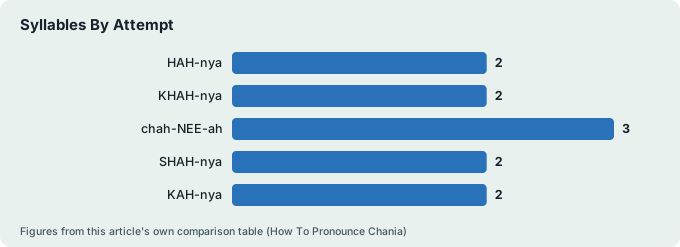
| Attempt | Syllables | Verdict | Why |
|---|---|---|---|
| HAH-nya | 2 | Correct | Stress on the first syllable, "nya" as in "onion" |
| KHAH-nya | 2 | Correct, closer to Greek | Uses the throat "ch" of "loch" for the first sound |
| chah-NEE-ah | 3 | Recognisable but wrong | Three syllables, stress moved to the middle |
| SHAH-nya | 2 | Recognisable | An English compromise many travellers land on |
| KAH-nya | 2 | Understandable | Turns the Greek letter into a plain "k" |
Nobody in a taverna, taxi or museum will fail to understand any row of that table. The two-syllable shape with first-syllable stress is what carries recognition; the throat sound is refinement. Practice it quietly once on the flight, and it will be in place by the time the aircraft doors open at Chania International Airport "Ioannis Daskalogiannis", about 14 km from the city centre on the Akrotiri peninsula. A visitor planning a wider trip can pair this page with the site's Chania trip length guide, where the name appears in every itinerary line.
How Do You Say The Greek Letter At The Start Of Chania?
The first letter of Chania in Greek is chi, and its sound is a voiceless fricative made at the back of the mouth, like the ending of the Scottish word "loch" or the middle of the German city name "Bach"; it is neither the English "ch" of "church" nor a plain "k". English genuinely lacks this sound at the start of words, which is why every English speaker adapts it on arrival, usually to a simple "H".
The mechanics are simple to describe even if they take a minute to master. The tongue sits low and back, the same position as for a "k", but instead of sealing and releasing, it only narrows the airflow. Air rubs past, producing friction, and the vocal cords stay silent for the whole sound. Practice with "loch", then "bach", then try putting that same friction in front of "AH-nya" without stopping the air. That is the Greek word.
Two common landing spots exist for English speakers, and both are fine in daily use:
| English substitute | Sounds like | How close to Greek |
|---|---|---|
| HAH-nya | "Ha" as in "hot" | Very recognisable, drops the friction |
| KHAH-nya | "Loch" opening | Essentially the Greek sound |
| KAH-nya | "Car" opening | Recognisable, replaces friction with a stop |
| chah-NYA | "Church" opening | Recognisable, adds a sound Greek does not use here |
The same letter opens several other names on any Chania itinerary, so learning it once pays off repeatedly. It appears in the airport's official title, Chania International Airport "Ioannis Daskalogiannis", whose personal name carries the same friction. Travellers flying in can see the full name and airport layout on the Chania airport guide, and the transfer options on the airport to town page.
How Do You Pronounce The Other Place Names Around Chania?
The names around Chania follow a handful of fixed Greek patterns: "Sfakia" is said "sfa-KEE-a", "Elafonisi" is "el-af-o-NEE-see", "Falassarna" is "fa-la-SAR-na", and "Imbros" is simply "EEM-bros", all with the stress falling on the marked syllable. Greek words always carry one stressed syllable, and once the stress is placed, the rest of each name falls into line. The table below covers every name a visitor is likely to say aloud on a week in the region.
| Name | Syllable guide | Stress | Note |
|---|---|---|---|
| Chania | HAH-nya | First | Throat "ch" in Greek, "h" works in English |
| Souda | soo-THA | Second | The port for the Piraeus ferry, about 7 km east |
| Sfakia | sfa-KEE-a | Second | Region and villages in the south-west |
| Chora Sfakion | HO-ra sfa-KEE-on | First / second | "Chora" means the main town of an area |
| Agia Roumeli | a-YA roo-ME-lee | Second / third | End point of the Samaria walk |
| Xyloskalo | ksee-lo-SKA-lo | Third | Samaria entrance on the Omalos plateau |
| Elafonisi | el-af-o-NEE-see | Fourth | The "i" endings are short and sharp |
| Falassarna | fa-la-SAR-na | Third | West-coast beach |
| Kissamos | kee-SA-mos | Second | Departure port for Balos cruises |
| Paleochora | pa-le-o-KHO-ra | Fourth | South-coast town, throat "ch" again |
| Gramvousa | gram-VOO-sa | Second | The island paired with Balos |
| Akrotiri | a-kro-TEE-ree | Third | The peninsula holding the airport |
A few patterns unlock the whole table. The combination "ai" is always "eh", so "Agia" is "a-YA" and "Agia Marina" is "a-YA ma-REE-na". The letter "g" before "a" or "o" in these Latin spellings is a soft, throaty sound closer to a gentle "y" or a voiced friction, so "Gramvousa" can sound like "yram-VOO-sa" from a local, though a plain "g" is always understood. And final vowels are never silent: every "a", "o" and "i" at the end of a Greek word is pronounced.
The "Agia" pattern alone covers several days of sightseeing: Agia Marina and Agia Roumeli appear in the beach and gorge plans, and each is said the same way. Readers mapping a full week can fold these names into the best tours from Chania roundup, where each destination has its own page.
Is It Wrong To Say "Chah-Nee-Ah" In English?
Saying "chah-nee-ah" with three syllables is not wrong in any way that matters: it is the natural English reading of the spelling, every local will understand it, and English has simply borrowed the name with its own shape. City names bend when they cross languages. The English name for the Greek capital is not the Greek name, and English speakers say "Copenhagen" rather than the Danish original without anyone counting syllables. The same courtesy extends in both directions.
What helps communication is the stress. If a visitor keeps three syllables but moves the stress forward, "CHAH-nee-ah", the name lands more cleanly than a middle-stressed "chah-NEE-ah". Dropping to two syllables, "HAH-nya", is the single biggest upgrade available, and it costs no new sounds at all.
Where the two-syllable form earns its keep is in fast, practical settings: a taxi from the airport, a bus window conversation, a phone call to a hotel, a booking confirmation read back over a counter. Single-word answers move quickly, and "HAH-nya" matches the rhythm the listener expects. The getting around Chania guide covers those exact settings, buses and all, and the KTEL routes are detailed on the KTEL buses page.
Does The Stress Matter More Than The Sounds?
Yes: in Greek, stress is meaning-bearing and every word has exactly one stressed syllable, so placing the stress on the first syllable of "HAH-nya" does far more for being understood than producing the throat "ch" sound perfectly ever will. English reduces unstressed vowels and tolerates movable stress; Greek does neither. A Greek listener tracks the stressed syllable the way an English listener tracks the whole word, and a misplaced stress can make a familiar name briefly unrecognisable even when every individual sound is correct.
The rule extends to every name in the region. "SOO-da" for the ferry port beats a fuzzy "soo-DA", and "el-af-o-NEE-see" with the fourth-syllable stress is instantly parsed where a level "el-a-fo-ni-si" is not. On signs and printed matter, Greek uses an acute accent mark over the stressed vowel, so the visitor who can read that one mark can pronounce any Greek place name on the island: find the marked vowel, stress that syllable, give every other vowel its full short sound.
Three habits cover nearly every situation a traveller meets:
| Setting | What to say | Why it works |
|---|---|---|
| Taxi from the airport | HAH-nya | Two syllables, first stress, instantly parsed |
| Asking for a bus to the beaches | Use the beach name with its stress | Driver matches the stressed syllable |
| Ordering or booking | Please and thank you in Greek plus the name | Stress carries recognition, politeness carries warmth |
| Reading a sign aloud | Find the accent mark, stress that vowel | Works for any Greek word on the island |
Readers planning months ahead may also want the seasonal picture; the Chania weather guide and the best time to visit page carry the HNMS Chania Souda station table, where the same place names reappear in climate context.
Where Will You Hear The Name Said Around The City?
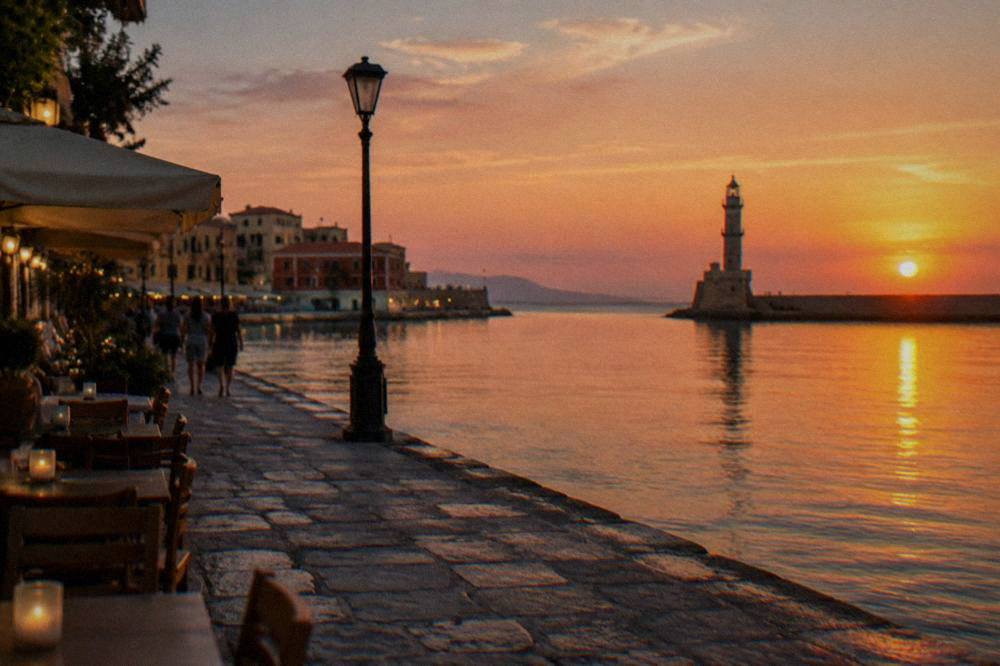
The name is spoken constantly in the city itself: on the harbour cruise departures, on the KTEL bus announcements at the Kydonias street station, at the airport named for Ioannis Daskalogiannis, and in every taverna greeting along the Venetian Harbour, always as "HAH-nya" with the first-syllable stress. Arrival is the first live lesson. The airport's own pages give the official name and the transport options, and the moment a traveller steps out, the word is in the air at the taxi rank and the bus stop.
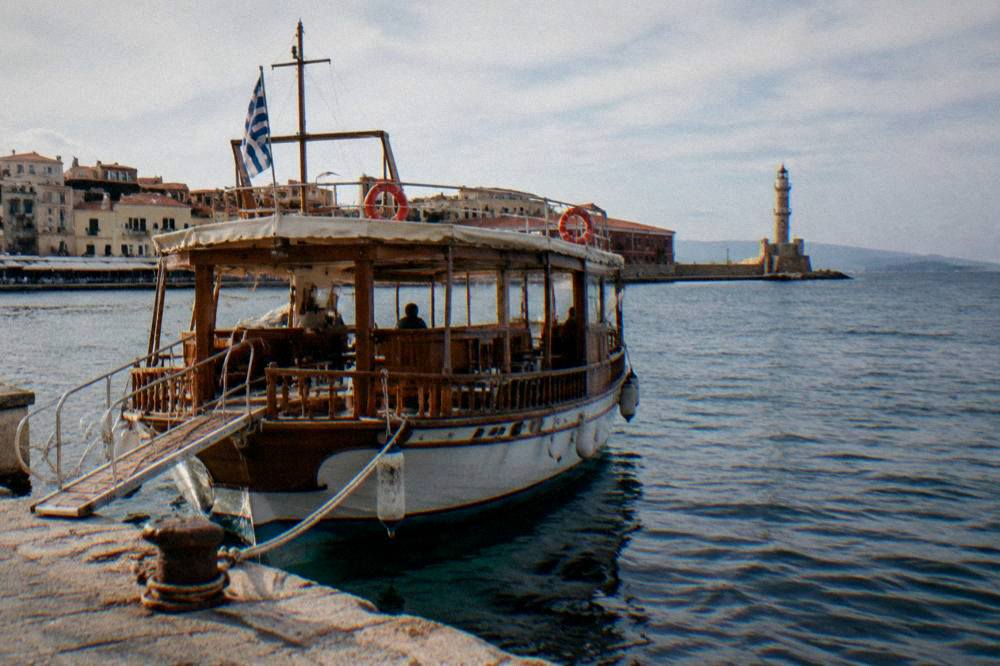
The harbour is the second classroom. Excursion boats that leave the Venetian Harbour for Lazaretta Island and Agioi Theodoroi announce their destinations over the water, and the boat crews say each name at speaking speed, twice, which is exactly the practice a learner needs. A short cruise turns into an ear-training session: the guide names the lighthouse, the shipyards and each stop, and the sounds repeat until they stick.
Food settings are the friendliest of all. Ordering by pointing works everywhere, but saying a dish name with its stress placed correctly changes the exchange from transaction to conversation. The site's Cretan food guide lists the dishes whose names follow the same stress rules as the place names, and a guided tasting walk puts a local speaker next to the visitor for the length of the route. The walking food tasting tour in the town of Chania runs through exactly these streets, with a guide who names each stop and each tasting in Greek; Check availability on the operator's live listing. More options sit in the Chania walking tours roundup.
What About The Names On Menus And Wine Labels?
Menu and wine names around Chania follow the same two rules as place names: one stressed syllable per word and every vowel pronounced, so "tsikoudia" is "tsi-koo-THEE-a" and "kalitsounia" is "ka-lee-tsoo-NYA", with the "d" between vowels softening to a "th" sound. That softening is a standard Modern Greek shift, and it appears in "dakos", said "THA-kos", the barley rusk dish found on nearly every menu in the Old Town. The "ts" combination behaves as one sound, exactly as in English "cats".
Wine labels add one more useful pattern: the "Moschofilifero" style tongue-twisters are rare here, and the local labels favour shorter names. Whatever the label, the accent mark on the Greek spelling points to the stressed syllable, and asking the server to say the wine's name is received as interest, never as a test. The desk's reporting on the Chania restaurants page notes the same dishes appearing under variant spellings, and the spelling variations matter less than the stress. A traveller who has the two rules, one stress per word and no silent vowels, can order anything in the city.
Common Questions About How To Pronounce Chania
How do you pronounce Chania?
Chania is pronounced "HAH-nya", two syllables with the stress on the first. In Greek the first sound is a soft throat friction like the "ch" in "loch", but an English "h" is fully understood.
Is Chania pronounced with a hard "ch" like "church"?
No. The "Ch" spelling comes from the Greek letter chi, which makes a back-of-the-throat friction sound, not the English "ch". Using a plain "h" sound, "HAH-nya", is the closest easy substitute.
Is it wrong to say "chah-nee-ah" with three syllables?
It is not wrong in any way that affects communication. Locals will understand it. Keeping the stress forward, "CHAH-nee-ah", or dropping to two syllables, "HAH-nya", sounds closer to the Greek.
How do you pronounce Souda, the ferry port?
Souda is said "soo-THA" with the stress on the second syllable and the "d" softened to a "th" sound. The port sits about 7 km east of the Old Town and serves the overnight Blue Star Ferries crossing to Piraeus.
Say the name once with two syllables and the stress forward, and the city answers. The throat sound can wait for the second glass of wine.