Which Is The Nicest Part Of Crete To Stay In?
This guide compares Chania with Rethymno, Heraklion and the south coast.
Crete is the island that Chania sits on the north-west corner of, and it is big enough that the choice of where to sleep shapes the whole trip. The municipality of Chania alone counts 111,375 permanent residents (2021 census) across 356.12 km2, and the island runs far beyond it to Rethymno, Heraklion and the south coast ports. The desk has gone through the transport routes and the day-trip geography to answer one question honestly: which part of the island is the nicest place to stay, and for whom.
Which Is The Nicest Part Of Crete To Stay In?
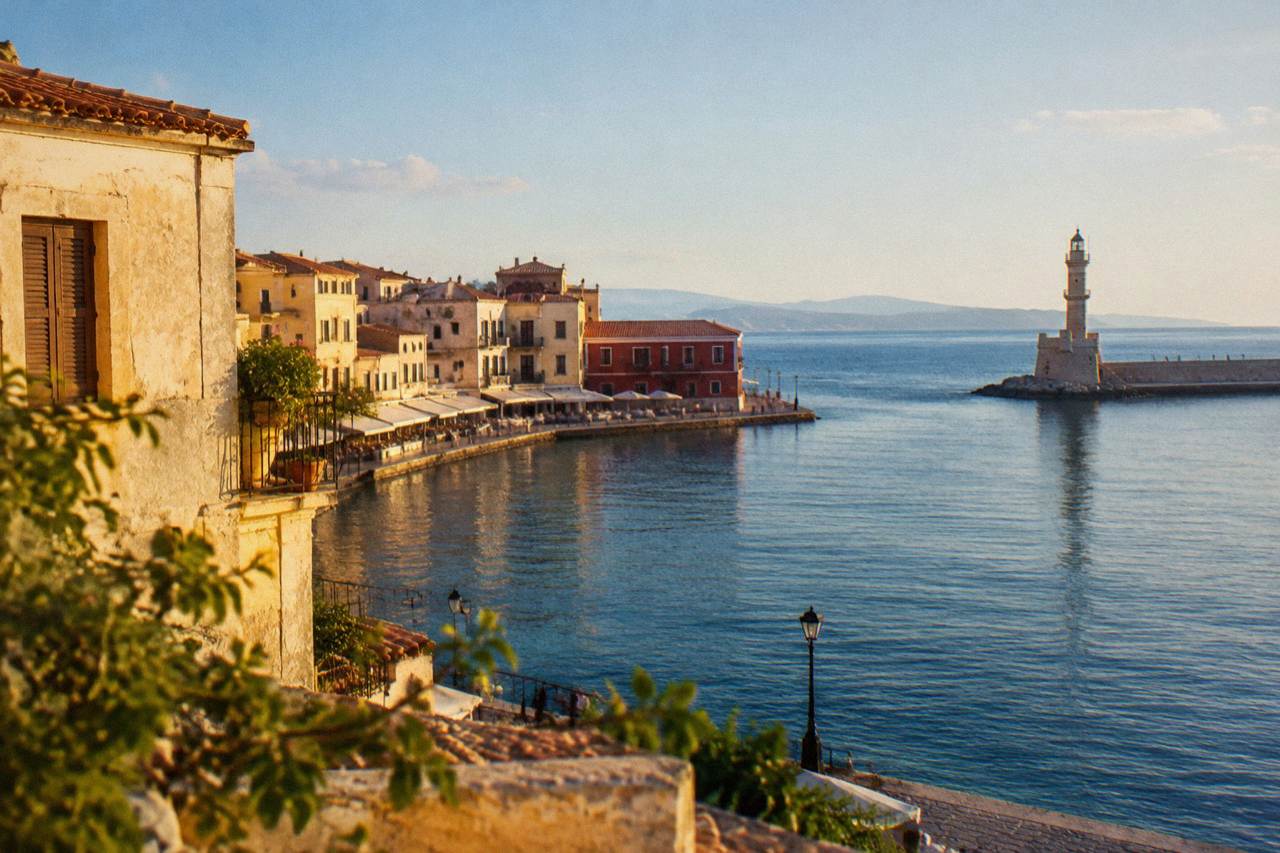
The nicest part of Crete to stay in is the north-west coast around Chania for a first trip, because it combines a walkable historic city with the island's famous west-coach beaches, Balos and Elafonisi, within day-trip range, while Rethymno suits a smaller-town stay and Heraklion suits travellers whose priority is Knossos and archaeology.
That is the short version, and the rest of this page unpacks it. The Venetian Harbour at Chania was first built between 1320 and 1356, and the Old Town still sits around it, with seven surviving Neoria shipyards from an original seventeen and a lighthouse built about 1595 to 1601 on its mole. No other base on the island puts that kind of old core next to the White Mountains and to boat departures for the beaches the island is known for.
The reason the west wins for a general visit is geography. Balos and Gramvousa boats leave from Kissamos port, Elafonisi sits on the south-west corner, and Samaria Gorge starts at Xyloskalo on the Omalos plateau. All of these are reachable as organised day trips from Chania, and the KTEL bus station on Kydonias street runs routes toward Kissamos, Paleochora, Omalos and, in summer, Elafonisi. Basing in Heraklion puts those beaches hours out of reach.
To turn that geography into a day on the water, book a Balos boat cruise here.
Readers deciding between the two biggest cities can go deeper with Chania or Heraklion compared, and the question of how many days in Chania is enough shapes the base choice too.
Is Chania The Best Base For A First Trip To Crete?
Chania is the strongest base for a first trip because the city itself holds a full day of sightseeing, the airport is about 14 km from the centre, the Piraeus ferry leaves from Souda port about 7 km east of the Old Town, and every major west-coast excursion, Balos, Elafonisi, Samaria and Imbros, runs from here as a guided day trip or by public bus.
The airport point matters more than it looks. Chania International Airport "Ioannis Daskalogiannis" (CHQ) is operated by Fraport Greece on the Akrotiri peninsula, and its own site carries the public bus and taxi information for the transfer. Anyone arriving by sea should note that ferries to Piraeus leave from Souda, while the Venetian Harbour serves excursion boats. The Blue Star Ferries overnight service departs Souda at about 21:30 with a crossing of about 9 h 15 min, and the operator's route page carries the current timetable.
Two practical warnings belong in any honest answer about the west as a base. First, Samaria Gorge normally opens 1 May to 31 October, but storms in late September and early October 2026 destroyed sections of the path, staff describe a 2026 reopening as extremely difficult, and works are aimed at readiness in May 2027, so the NECCA status must be checked before the gorge is planned into an itinerary. Second, Balos carries only a EUR 1 Kissamos municipal fee collected on the boat ticket for over-13s; a proposed visitor cap from August 2026 is not in force. The desk's pages on Samaria Gorge and Balos Lagoon and Gramvousa carry the details.
A base in Chania also keeps the sea close at hand. The desk's related pick for this page is a beginner scuba session with a PADI instructor, one of several water-based activities that run straight off the local coast: Check availability. The Chania Crete Travel Guide covers the full range of boat trips, gorge hikes and tastings that depart from the city.
What Are The Nicest Areas To Stay In Around Chania?
Within the Chania area the nicest stay depends on the trip type: the Old Town for harbour views and walkability, Nea Chora for a beach within walking distance of the centre, Agia Marina and Platanias for a resort stay west of the city, Halepa for a quiet residential base, and Kissamos for a small-town base directly beside the Balos boat departures.
The Old Town needs no car for the everyday rhythm of the trip, and the desk has covered how walkable Chania Old Town is separately. Halepa, a short way east, holds the Archaeological Museum of Chania at 15 Skra Street, full ticket EUR 15 and concession EUR 8, though its opening arrangements should be checked on the museum's own visit page before a visit. Here is how the main areas compare:
| Area | Character | Verified anchor fact |
|---|---|---|
| Old Town and Venetian Harbour | Historic core, harbourfront, no car needed | Harbour first built 1320 to 1356; Firka Fortress from 1620, grounds free |
| Nea Chora | Fishing quarter with a sandy beach at the edge of the centre | Beach reachable on foot from the Old Town edge |
| Agia Marina and Platanias | Resort strip west of the city | Base for jeep and quad safaris departing from Platanias |
| Halepa | Quiet district east of the centre | Archaeological Museum at 15 Skra Street, EUR 15 full ticket |
| Kissamos | Small town 40 km-scale west, beside the Balos boats | Balos and Gramvousa cruises depart the port daily to 31 October 2026, operator-reported |
Accommodation anywhere in Greece collects the climate crisis resilience fee per room or apartment per night, with seasonal rates by category, and the amount is confirmed at booking rather than assumed. The desk's where to stay in Chania guide maps these areas street by street, and the question of the best area to stay in Chania goes deeper for readers already committed to the city. Visitors weighing reputation should also read whether Chania is a tourist trap, which separates the verifiable from the folklore.
What About Rethymno, Heraklion And The South Coast?
Rethymno is the alternative for a smaller, quieter old town with a beach attached, Heraklion is the base for Knossos and the archaeological museum rather than for beaches, and the south coast around Paleochora and Sfakia suits travellers who want the Libyan Sea, boat-only villages such as Loutro, and fewer services, with each of these trading away some of the west-coast day trips that a Chania base keeps open.
The trade-offs are concrete. From Heraklion, Balos and Elafonisi are a long drive before the day even starts; from Chania, Knossos is the long excursion instead, though guided full-day tours to Knossos and Heraklion run from the Chania area. The south coast changes the character of the sea: Paleochora and Sougia are the seasonal departure points for boats to Gavdos, and Agia Roumeli, the finish of the Samaria walk, is reachable only by boat or on foot, with boats to Sougia or Chora Sfakion at about 17:30 before a KTEL bus back. The desk's pages on Rethymno, Heraklion and Knossos and Loutro and Sfakia carry each option in detail.
Budget behaves differently by base as well, and the honest line is that the desk prints no nightly rate anywhere: prices move by season, and the cost question for Chania is answered with what is verifiable rather than with invented ranges. The same caution applies to islands compared with Crete generally; on this page only the Crete-wide comparison is in scope.
When Is The Best Time To Stay On The North-West Coast?
The best time to stay on the north-west coast around Chania is May to September for dry weather, with July the driest month of the HNMS Chania Souda station table at 1.0 mm of rain and only 0.4 rain days, and May or September the calmer compromise, since May still averages 13.5 mm of rain on 4.2 rain days while October jumps to 67.7 mm on 9.3 rain days.
These are station records for the period 1958 to 2010 from the HNMS Chania Souda station, which sits at 148 m inland of Souda Bay, and they are the figures the national service publishes, not a newer normal. January is the wettest month in the table at 129.5 mm across 16.3 rain days, and July is the warmest at a mean of 26.7 C. The seasonal shape of the year, and what it means for a stay, looks like this:
| Month | Mean C | Rain mm | Rain days |
|---|---|---|---|
| Jan | 11.0 | 129.5 | 16.3 |
| Mar | 12.7 | 76.0 | 11.5 |
| May | 20.2 | 13.5 | 4.2 |
| Jul | 26.7 | 1.0 | 0.4 |
| Sep | 23.2 | 15.4 | 3.2 |
| Oct | 19.4 | 67.7 | 9.3 |
Two timing notes follow from the season itself rather than the weather table. The Balos boats run daily departures to 31 October 2026 on the operator's published season, so an October stay still catches the beach boats, while rain starts to matter from October onward. And the Samaria situation described above means a 2026 or 2027 gorge walk must be confirmed against the NECCA status rather than assumed from the normal 1 May to 31 October window. Travellers from the United States should also note that EES is fully deployed across Schengen since 10 April 2026 and ETIAS is not in operation, with no applications being collected as of October 2026.
Common Questions About Where To Stay In Crete
Which is the nicest part of Crete to stay in for beaches?
The south-west holds the famous ones: Elafonisi on a Natura 2000 protected coast, Balos reached by boat from Kissamos or by an unpaved road from Kaliviani, and Falassarna nearby. A Chania or Kissamos base puts all three in day-trip range.
Is it better to stay in Chania or Heraklion?
Chania suits a first visit built around the old town, the west-coast beaches and the gorges; Heraklion suits a stay focused on Knossos and the archaeological museum. The desk compares the two cities directly in its Heraklion versus Chania guide.
Is Chania Old Town a good place to stay without a car?
Yes for the city itself: the Old Town sits around the Venetian Harbour and everything in it is walkable, and KTEL buses run from Kydonias street to the regional destinations, including Heraklion, Rethymno, Kissamos and Paleochora.
Does a stay in Crete cost more in one area than another?
The desk prints no nightly rate for anywhere on the island, because rates move by season and category. What is verifiable is that every accommodation collects the climate crisis resilience fee per room per night at seasonal rates, confirmed at booking.
Can you stay on the south coast of Crete?
Yes: Paleochora and Sougia are the seasonal departure points for boats to Gavdos, and Loutro on the south coast is reachable by boat. These bases trade the north-coast resorts for the Libyan Sea and quieter surroundings.
The honest summary is that "nicest" has no single answer on an island this size, but the north-west coast around Chania is the base that loses the least: the city carries the history, the beaches sit inside a day trip, and the transport links, an airport about 14 km out and a ferry port at Souda, hold the whole plan together.