What Is The Prettiest Town In Crete?
Chania, on the north-west coast of Crete in Greece, is the island's prettiest town for most guidebook reasons: a Venetian Harbour, an Old Town of restored alleys and the White Mountains behind. Here is the case, the rivals and how to see it.
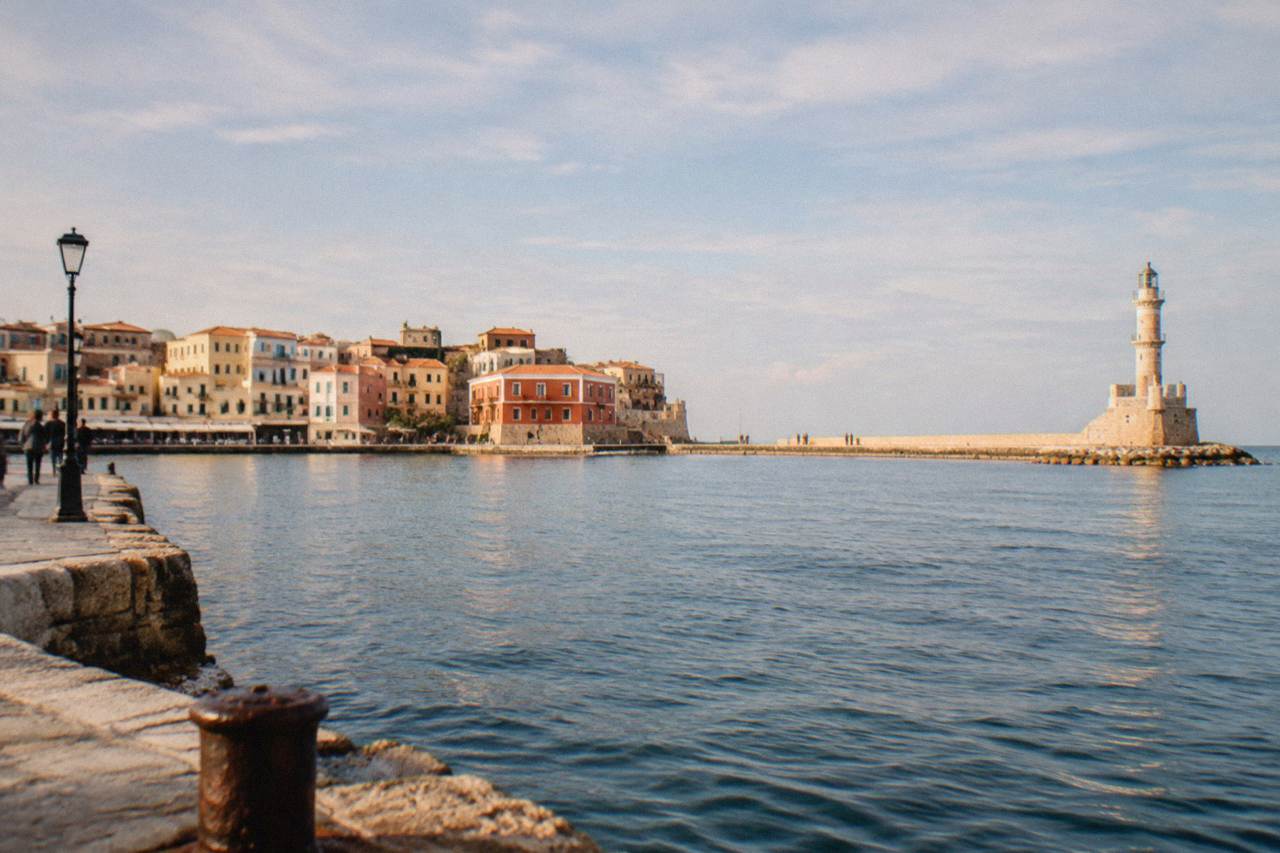
The prettiest town in Crete is Chania, the coastal city on the island's north-west shore in Greece, and the case rests on things a visitor can stand in front of: the Venetian Harbour first built between 1320 and 1356, the lighthouse at the end of its mole, a lagoon-shaped basin of pastel facades, and the White Mountains rising immediately behind the rooftops. No other town on the island combines a working harbour of that age with a mountain wall that close. The municipality counts 111,375 permanent residents at the 2021 census, yet the pretty part, the Old Town, is compact enough to cross on foot.
This page sets out the argument in the desk's reporting voice, names the towns that contest the title, and gives the practical routes from a Chania base. The one honest caveat is that "prettiest" is a judgement, so every claim below ties to something a primary source states: a construction date, a museum ticket price, a meteorological table, a ferry timetable.
Why Is Chania Considered The Prettiest Town In Crete?
Chania earns the title on density: within a few hundred metres it holds a harbour first built between 1320 and 1356, a Venetian lighthouse raised around 1595 to 1601 and restored in the Egyptian era of 1830 to 1840, seven surviving shipyards from an original seventeen, and an Ottoman-era Old Town of alleys stacked behind the water. No other Cretan town puts a comparable set of layers in one walkable frame, and the White Mountains close the backdrop to the south.
The harbour is the anchor. The Venetians built it between 1320 and 1356, with dredging and a wall recorded in 1515, and its outline still defines the city: the mole carrying the lighthouse, the Neoria shipyard sheds, seven survivors of an original seventeen from the 15th to 16th century, and the Firka Fortress of 1620 at the harbour mouth, whose grounds are free to walk. The lighthouse stands on a Venetian base and was restored during the Egyptian administration of the island, operating since 1839. The Chania Crete Travel Guide covers each of these landmarks in its own page, because each rewards a separate look.
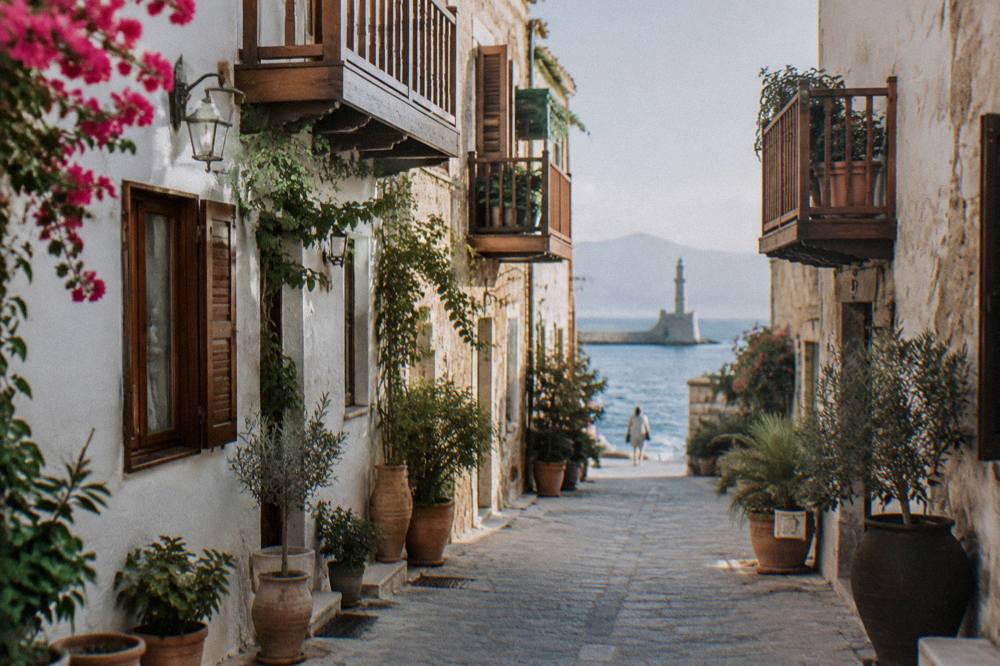
Behind the harbour, the Old Town runs uphill in restored lanes. Ottoman rule began with the conquest of Chania in 1645, and the domestic architecture of that period survives in the upper quarters, while Crete's union with Greece in 1913 closed the story. The result is a town where a single street can carry a Venetian doorway, an Ottoman balcony and a Greek flag, which is precisely the mix people mean when they call a place pretty.
The Archaeological Museum of Chania sits a short way out at 15 Skra Street in Halepa, with a full ticket at EUR 15 and a concession at EUR 8. The museum's own visit page should be checked for current opening arrangements before a visit.
What Is The Prettiest Town In Crete?
The answer this guide gives is Chania, on Crete's north-west coast: a Venetian Harbour city of roughly 111,375 residents whose Old Town, lighthouse, shipyards and mountain backdrop out-photograph every rival on the island, with Rethymno the strongest alternative for visitors who want a smaller version of the same Venetian harbour idea. Rethymno is the honest runner-up, and the comparison is close enough that the choice usually comes down to base convenience rather than beauty alone.
Rethymno, about an hour east by road, holds its own Venetian fortifications and a harbour town core, and it is close enough to visit from Chania as a day trip by KTEL bus from the station on Kydonias street. The desk's fuller treatment of the pairing is in Chania or Rethymno compared. Heraklion is the third name in the conversation, but it is a large working city whose draw, Knossos, sits outside the centre; the Chania or Heraklion comparison sets out that trade.
For framing, here is what the pretty core of Chania actually contains, with the dates the record gives:
| Sight | Period on record | Status today |
|---|---|---|
| Venetian Harbour | First built 1320 to 1356, wall recorded 1515 | Working excursion-boat harbour |
| Lighthouse (Faros) | Built about 1595 to 1601, restored 1830 to 1840, operating 1839 | Landmark on the harbour mole |
| Neoria shipyards | 15th to 16th century | Seven survive of an original seventeen |
| Firka Fortress | Built 1620 | Grounds free to enter |
| First city walls | 1336 to about 1356 | Fragments in the Old Town |
| Second city walls | From 1536, Michele Sanmicheli's design | Fragments in the Old Town |
If the question is "which town should I photograph", Chania wins on the harbour and the mountains together. If it is "which town should I sleep in for a week of day trips", Chania wins again, because Balos, Elafonisi, Samaria, Imbros, Falassarna, Rethymno and Knossos all run from here.
Which Other Crete Towns Contend For The Title?
Rethymno is the main contender, a smaller harbour town east of Chania with its own Venetian-era core, followed by the south-coast villages of Loutro and Sfakia, whose appeal is whitewash and still water rather than monumental architecture, and by Kissamos and Paleochora, which serve mainly as gateways to Balos and the south coast boats. None of them matches Chania's concentration of dated landmarks, but each offers a different register of pretty.
Loutro, reached by boat from Chora Sfakion, is the strongest pure-visual rival: a small white village on a bay with no through road of consequence, and a guided day trip from Chania exists that includes the boat tickets. Paleochora, on the south coast, is a working town with a long beach and the seasonal boats to Gavdos, and Kissamos, to the west, is the port where the Balos and Gramvousa cruises leave. The desk describes all of these as day trips or comparisons from Chania, since a stay in the city reaches every one of them.
The practical point is that visitors do not have to choose. A week based in Chania can carry a Rethymno day by bus, a Loutro day by guided tour, and still leave the evenings free on the harbour. The question of how long to give the city is handled in how many days in Chania is enough.
Can You See The Prettiest Parts Of Crete Without A Car?
Yes, though not all of them: the Old Town, the harbour, the beaches within walking range of Chania and the KTEL bus routes to Rethymno, Heraklion, Kissamos, Paleochora, Omalos and, in summer, Elafonisi are reachable without driving, while Balos by land and several south-coast coves realistically need a boat tour, a 4x4 transfer or a hire car. The split is clean, and a car-free week in Chania covers more than a car-free week anywhere else on the island.
The bus station sits on Kydonias street, and the operator's own site is where routes and times should be confirmed, since the desk prints no timetable. For the beaches that buses do not reach well, tours close the gap. The pink sand of Elafonisi, a Natura 2000 protected area where entry is reported to be free and taking sand, shells or plants is prohibited, pairs naturally with Falassarna on a guided day trip such as Check availability for the Elafonisi and Falassarna guided tour with snacks. Its from-price excludes nothing at the beach itself, since entry is free; what is and is not included sits on the operator's live listing.
Balos is the other car-free case. Boats leave Kissamos port daily to 31 October 2026 on the operator's reported schedule, and the only confirmed charge beyond the ticket is a EUR 1 Kissamos municipal fee collected on the boat ticket for over-13s. A time-slot visitor cap was proposed in August 2026 but is not in force. The unpaved road from Kaliviani to a parking area, then a walk down, is the alternative for drivers, and the difficulty of that route is weighed in is it difficult to get to Balos Beach.
When Is Chania At Its Most Photogenic?
The HNMS Chania Souda station table for 1958 to 2010 shows the town at its clearest and driest from May through September, with July rainfall averaging 1.0 mm and mean temperatures of 26.7 C, while the harbour light is softer in the shoulder months of April, May and October, when rainfall of 31.5 mm to 67.7 mm per month buys emptier lanes. The trade-off is straightforward: high summer for blue water, spring and autumn for the town itself.
The station sits at 148 m, inland of Souda Bay, so the table describes the town's air rather than the beach shallows:
| Month | Mean C | Rain mm | Rain days |
|---|---|---|---|
| Apr | 15.9 | 31.5 | 7.7 |
| May | 20.2 | 13.5 | 4.2 |
| Jun | 24.7 | 3.4 | 1.2 |
| Jul | 26.7 | 1.0 | 0.4 |
| Aug | 26.3 | 1.4 | 0.6 |
| Sep | 23.2 | 15.4 | 3.2 |
| Oct | 19.4 | 67.7 | 9.3 |
Source: HNMS Chania Souda station, station records 1958 to 2010. Humidity in the same table runs from 50 percent in July to 73 percent in January, and the prevailing wind is west, turning north-west in July and August. Photographers chasing the harbour at dawn will find the lighthouse and the mole doing the work in any season, and the desk's page on the best time to visit Chania develops the month-by-month choice.
One correction worth carrying: the island has no railway, and the overnight Blue Star Ferries crossing to Piraeus leaves from Souda port about 7 km east of the Old Town, with a departure around 21:30 and a crossing of about 9 h 15 min on the operator's published timetable, never from the Venetian Harbour, which serves excursion boats.
What Should You Not Miss In The Prettiest Town?
The unmissables in Chania are the Venetian Harbour walk from the Neoria to the Firka Fortress, the lighthouse mole at sunset, the lanes of the Old Town between Splantzia and Topanas, the Municipal Market building, and one table of fresh food at a harbour taverna, all of which sit inside a walkable core that the desk's not-miss page maps in full. The set costs almost nothing: the fortress grounds are free, the harbour is a public quay, and the lanes are public streets.
To turn those lanes into a puzzle trail, book an Old Town scavenger hunt here.
Food is half of the town's appeal. Cretan cooking in Chania runs on olive oil, cheese, honey and seafood, and the desk's pages on what food Chania is known for and what not to miss in Chania cover the specific dishes and the bakeries worth queuing at. A guided tasting walk stitches the two halves together, town and table, for visitors who want the food explained rather than merely eaten.
For the wider island, the what should I not miss in Crete page ranks the island-wide list, and the beach question has its own answer at what is the prettiest beach in Crete.
Common Questions About The Prettiest Town In Crete
What is the prettiest town in Crete?
Chania, on the island's north-west coast, is the prettiest town in Crete: its Venetian Harbour, lighthouse, shipyards and Ottoman-era Old Town, with the White Mountains behind, form the densest concentration of photogenic layers on the island. Rethymno is the closest rival.
Is Rethymno prettier than Chania?
Rethymno is smaller and quieter, with its own Venetian-era core, but it does not match Chania's harbour setting or mountain backdrop. The honest answer is that Rethymno is a scaled-down version of the same idea, and it works well as a day trip by bus from Chania.
Can you visit Chania's prettiest sights on foot?
Yes. The Old Town, the Venetian Harbour, the lighthouse mole and the Firka Fortress grounds form one continuous walkable area, and the desk's page on whether the Old Town is walkable covers the terrain and distances.
How many days does the prettiest town in Crete need?
Two days cover the Old Town and harbour properly, and four to five allow the main day trips, Balos, Elafonisi and a gorge, to run from the same base. The desk's dedicated page on how many days in Chania is enough breaks down each length of stay.
Is Chania a tourist trap?
The harbour front has tourist-priced tables, as any popular quay does, but the town behind it is a living city of 111,375 residents with a covered market, working bakeries and residential lanes. The desk's page on whether Chania is a tourist trap sets out the checks, posted prices and itemised bills, that keep the question honest.
The title argument stands: pretty in Crete means layers, water and mountains in one frame, and Chania is the only town that holds all three. Pick a shoulder month, sleep inside the Old Town, and let the buses and boats carry the rest of the island to you.