Which Is Nicer, Chania Or Rethymnon?
A fact-based comparison of Chania and Rethymnon for travellers deciding where to base on Crete: harbours, beaches, day trips, climate records and transport links.
Chania, on the north-west coast of Crete in Greece, and Rethymnon, roughly half way along the island's north coast, are the two towns travellers weigh against each other when a Crete trip allows only one base. Both are Venetian-era harbour towns with an Old Town, both sit on the Aegean, and both are reached from Chania International Airport "Ioannis Daskalogiannis" (CHQ), which the airport's own page places about 14 km from Chania city centre. The comparison below sticks to what published sources state: the municipality's own census figures, the HNMS Chania Souda station table, the KTEL route list and the museums' own pages. Where a claim about Rethymno is not in the desk's verified material, this page says so rather than guessing, and points to the comparisons the site holds, such as which side of Crete is nicer and is it better to stay in Chania or Heraklion.
Which Is Nicer, Chania Or Rethymnon?
There is no published ranking that declares one town nicer than the other, so the answer rests on what each place verifiably offers: Chania is the larger city, at 111,375 permanent residents in the 2021 census across a 356.12 km2 municipality, with the bigger working harbour, the airport 14 km away and the full west-coast day-trip range on its doorstep, while Rethymnon is the smaller town between the two, reached by a direct KTEL bus route listed on the Chania bus station's own schedules. Visitors who want beaches, gorges and boat trips stack the odds toward Chania. Visitors who want one compact old quarter and a position mid-island, between Chania and Heraklion, get that in Rethymnon. The rest of this page lays out the published numbers behind both cases.
The starting point is scale. Chania's municipality, with 111,375 permanent residents at the 2021 census, is the second city of Crete by population. That shows up in what the city can support: an archaeological museum with a EUR 15 full ticket at 15 Skra Street in Halepa, a maritime museum, a fortress from 1620 with free grounds, and a long-distance bus station on Kydonias street with routes the operator lists to Heraklion, Rethymno, Kissamos, Paleochora, Omalos and, in summer, Elafonisi. Rethymno appears on that route list as a destination, which is the point: from Chania, Rethymno is a day trip on a scheduled bus, while the reverse trip cuts a visitor off from the west-coast beaches unless they drive.
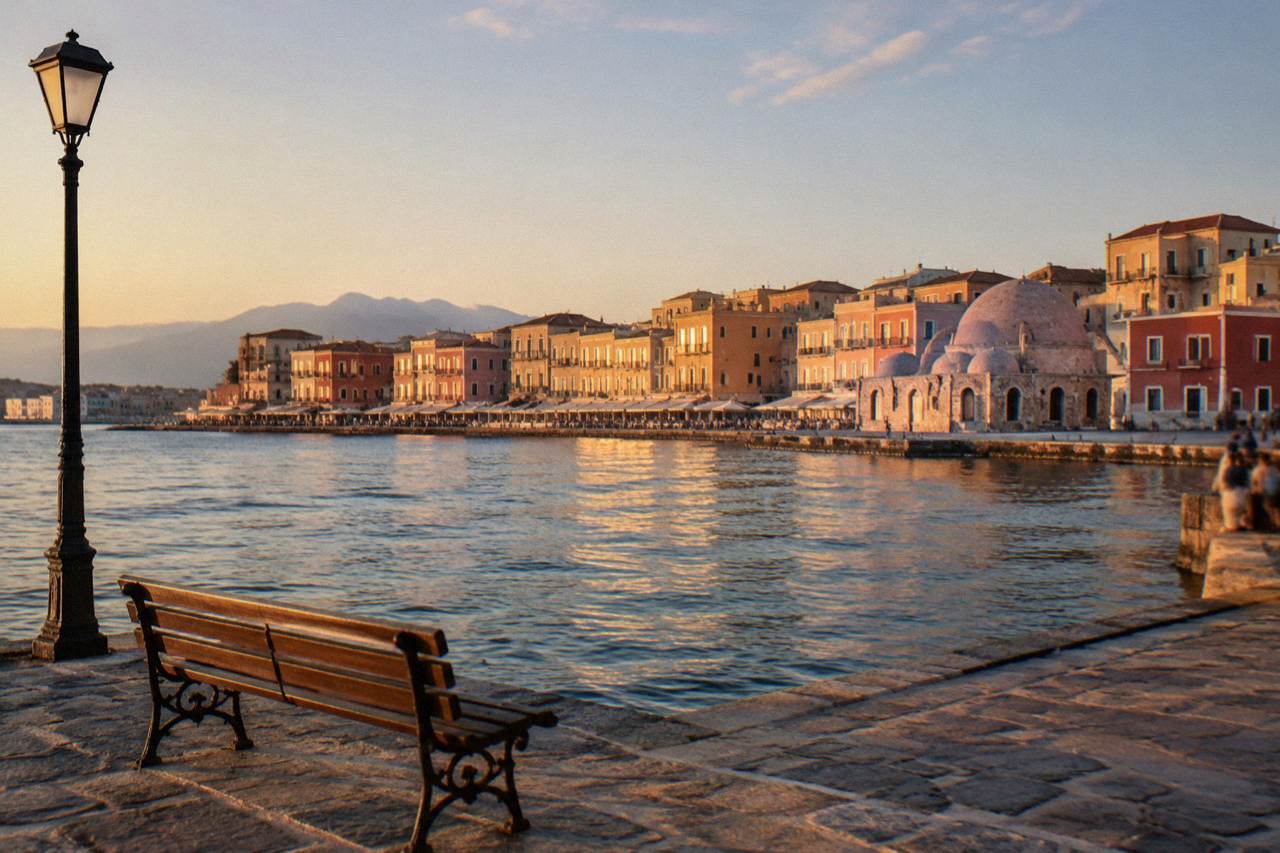
Harbour character differs in ways a reader can check rather than take on trust. Chania's Venetian Harbour was first built between 1320 and 1356, with dredging and a wall recorded in 1515; its lighthouse was built about 1595 to 1601 and restored during Egyptian rule between 1830 and 1840. The Neoria, the Venetian shipyards, survive as seven buildings of an original seventeen from the 15th to 16th century. These are dated, published facts about Chania's waterfront. For Rethymno's old town the desk holds no equivalent verified chronology, so no claim about its harbour's age or scale is made here; what is safe to say is that Rethymno is the town sitting between Chania and Heraklion, which makes it the natural base for splitting a trip between Knossos and the west.
Where Do The Two Towns Sit, And What Can You Reach From Each?
Chania sits on the north-west coast with the White Mountains to its south and the west-coast destinations, Balos and Gramvousa, Elafonisi, Falassarna, Samaria and Imbros, all reached from its bus station or from Kissamos port, while Rethymno sits mid-north-coast and serves Heraklion and Knossos more conveniently, with the KTEL network listing both towns on the same Chania route. The geography, not the architecture, is what separates the two bases. Balos and Gramvousa cruises depart from Kissamos port, which is on Chania's side of the island, and the operator's own season page showed daily departures running to 31 October 2026. Elafonisi, a Natura 2000 protected area where entry is reported free and taking sand, shells or plants is prohibited, is a summer KTEL route from Chania and a long haul from anywhere east.
Samaria Gorge matters for the comparison too. The gorge is a one-way walk from Xyloskalo on the Omalos plateau down to Agia Roumeli, with boats from Agia Roumeli to Sougia or Chora Sfakion at about 17:30 and a KTEL bus back, and the Omalos road starts from the Chania side. The gorge normally opens 1 May to 31 October, but storms in late September and early October 2026 destroyed sections of the path, staff have called a 2026 reopening extremely difficult and no final decision is on record, with works aimed at readiness in May 2027. Anyone booking a hike should check the NECCA status before committing. The individual ticket is EUR 10 through the NECCA e-ticket portal, free for EU residents under 18 and over 65, and tour prices exclude the separate entrance and ferry charges.
For a traveller based in Rethymno, each of these west-coast days becomes a longer drive. For a traveller based in Chania, Knossos and Heraklion remain reachable, on the KTEL route the operator itself lists. That asymmetry, the west being reachable only from the west, is the strongest structural argument in the comparison, and it is visible in the tour supply: the full-day Samaria gorge trek from Chania and the Balos and Gramvousa cruise from Kissamos both start on Chania's side of the island, while the Balos and Gramvousa trip with pickup is one of the few products that collects from Rethymno as well, precisely because the beach sits far to the west of it.
Which Town Has The Better Old Town To Walk?
Chania's Old Town wraps around the Venetian Harbour with dated layers the visitor can see in order: harbour works from 1320 to 1356, first walls from 1336, second walls from 1536 on Michele Sanmicheli's design, Firka Fortress from 1620 and Ottoman rule from the 1645 conquest, while Rethymno's old quarter is compact and sits against its own fortress and harbour, though the desk holds no verified chronology for it and no comparison of the two old towns' sizes or conditions is published anywhere this page can cite. What can be said honestly is structural. Chania's old quarter is walkable and the site covers it in detail, from Splantzia and Toppaas to Halepa; the question of whether Chania Old Town is walkable has its own answer page. Rethymno's old town is better treated as a mid-island stop than measured against numbers nobody publishes.
To cover those layers on two wheels, book a city bike tour here.
The museum comparison also runs in Chania's favour on published detail. The Archaeological Museum of Chania lists a EUR 15 full ticket and an EUR 8 concession at 15 Skra Street, and asks visitors to leave 20 minutes before closing; its visit page is the place to confirm current days and hours before going. Firka Fortress at the harbour mouth has free grounds and a construction date of 1620. For Rethymno's museums the desk carries no verified prices or hours, so this page prints none, and a reader should check each museum's own page before planning around it. A pattern emerges across these comparisons, and it is worth naming: Chania wins on documented depth, Rethymno wins on central position, and neither wins on a metric that does not exist. The full index of guides sits on Chania Crete Travel Guide.
Does The Weather Differ Between Chania And Rethymnon?
No published comparison exists between the two towns' weather, because the only official climate table this desk reports is the HNMS Chania Souda station record for 1958 to 2010, measured inland of Souda Bay at 148 m, and no equivalent verified Rethymno station table is held, so any claim that one town is sunnier, hotter or drier than the other would be invented. What the Chania Souda table does show is what a visitor on this coast should plan around: a July mean of 26.7 C with 1.0 mm of rain across 0.4 rain days, against a January mean of 11.0 C with 129.5 mm across 16.3 rain days. Rain starts to matter again from October, at 67.7 mm, and May through September is dry. Rethymno sits on the same north coast roughly an hour east, and no source here justifies calling its weather different.
| Month | Mean Temperature (C) | Rain (mm) | Rain Days |
|---|---|---|---|
| January | 11.0 | 129.5 | 16.3 |
| February | 11.0 | 104.0 | 14.5 |
| March | 12.7 | 76.0 | 11.5 |
| April | 15.9 | 31.5 | 7.7 |
| May | 20.2 | 13.5 | 4.2 |
| June | 24.7 | 3.4 | 1.2 |
| July | 26.7 | 1.0 | 0.4 |
| August | 26.3 | 1.4 | 0.6 |
| September | 23.2 | 15.4 | 3.2 |
| October | 19.4 | 67.7 | 9.3 |
| November | 15.8 | 77.0 | 11.2 |
| December | 12.7 | 101.9 | 16.1 |
These are station records from the HNMS Chania Souda table, published for the period 1958 to 2010, the newest table the service publishes, and they are labelled as such rather than as a 1991 to 2020 normal. Humidity in the same table runs from 50 percent in July to 73 percent in January, and the prevailing wind is west, turning north-west in July and August, a general summer pattern the table records without speeds. For timing a trip around this coast, see the site's fuller Chania weather guide and the answer on the best time to visit Chania. Nothing in the table separates Chania from Rethymno, and honesty requires saying so.
How Do The Two Towns Compare On Verified Numbers?
On every figure this desk can source, Chania is the larger and better documented base: 111,375 permanent residents at the 2021 census, an airport about 14 km from the centre, a ferry port at Souda about 7 km east of the Old Town with Blue Star overnight sailings to Piraeus departing about 21:30 and taking about 9 hours 15 minutes, and a bus station whose own route list includes Rethymno, while no equivalent population, traffic or ferry figures for Rethymno are held here at all. The table below gathers only what is published, and leaves blank what is not.
| Measure | Chania | Rethymno |
|---|---|---|
| Municipality population (2021 census) | 111,375 | Not held in verified sources |
| Airport distance | CHQ about 14 km from the centre | Served via CHQ or Heraklion, no verified distance |
| Long-distance ferry | Blue Star from Souda port to Piraeus, about 21:30 departure, about 9 h 15 min crossing | Not held in verified sources |
| KTEL link | Chania station on Kydonias street, Rethymno on the route list | On the Chania to Heraklion route |
| Archaeological museum | EUR 15 full, EUR 8 concession, 15 Skra Street | Not held in verified sources |
| Dated harbour works | First built 1320 to 1356 | Not held in verified sources |
The blanks are the finding. A traveller who wants to compare museum prices or ferry timetables between the two towns will find published numbers for Chania and will have to check Rethymno's own listings directly, because no figure for Rethymno on these measures is in the desk's verified material and none will be invented here. What the numbers that do exist show is a city with an airport, a ferry port and a bus hub, next to a smaller town whose advantage is position between Chania and Heraklion, closer to Knossos than Chania is.
For readers deciding on a whole-island strategy rather than a single base, the site's answer on how many days are enough for Crete and the comparison of Chania versus Heraklion cover the eastern alternative, while the page on where to avoid staying in Crete covers the areas worth skipping on either coast.
So Which Base Should You Pick?
Pick Chania if the trip is built around the west-coast beaches and gorges: Balos and Gramvousa boats leave from Kissamos port, Elafonisi is a summer bus route, Samaria starts from the Omalos plateau, and all of it sits closer to Chania than to Rethymno; pick Rethymno if the trip splits east and west, with Knossos and Heraklion on one side and the Chania old quarter on the other, reached by the KTEL route that links all three towns. Neither choice loses the other town, since the bus network connects them, but only the Chania base keeps the boat and gorge days short. The related question of which side of Crete is nicer has its own answer page with the fuller island geography.
Two practical caveats close the argument. First, Samaria's status is genuinely uncertain after the autumn 2026 storm damage, so any gorge-centred plan should check the NECCA status first and hold the Imbros gorge as the alternative, since Imbros is also served by guided hikes from Chania. Second, the climate crisis resilience fee is collected by accommodation per room or apartment per night with seasonal rates, in both towns, and the amount should be confirmed at booking rather than assumed. Beyond those, the choice is geography: west-coast beaches from Chania, or mid-island reach from Rethymno, with the published numbers favouring Chania for anyone whose list starts with Balos.
For the beach-first visitor, one product stands in for the whole argument. Check availability on the Balos and Gramvousa cruise from Kissamos, the day trip that only makes sense from the western base, and see whether the west coast is what your trip is for.
Common Questions About Chania And Rethymnon
Which is nicer, Chania or Rethymnon?
No published ranking settles it. Chania is the larger city with the airport 14 km away, the bigger documented old harbour and the west-coast day trips on its doorstep; Rethymno is smaller and sits mid-island between Chania and Heraklion. Beach and gorge trips favour Chania, an east-west split favours Rethymno.
Is Rethymno close enough to Chania for a day trip?
Yes. The Chania long-distance bus station on Kydonias street lists Rethymno on its routes, so the two towns are connected by scheduled KTEL buses. The desk holds no verified journey time or fare for the route, so confirm both on the operator's own site before travelling.
Can you do Balos and Elafonisi from Rethymno?
It is a long day. Balos and Gramvousa cruises depart from Kissamos port, which is on Chania's side of the island, and a small number of tours collect from Rethymno. Elafonisi is a summer KTEL route from Chania. Both beaches sit well west of Rethymno.
Does Samaria Gorge work from either town?
The gorge is a one-way walk from Xyloskalo on the Omalos plateau, reached from the Chania side, and Omalos is a KTEL route from Chania. Note that storms in late September and early October 2026 damaged the path, staff call a 2026 reopening extremely difficult, and works are aimed at readiness in May 2027, so check the NECCA status before planning.
Is the weather different in Rethymno?
No verified comparison exists. The only official table this site reports is the HNMS Chania Souda station record for 1958 to 2010, which shows a July mean of 26.7 C and 1.0 mm of rain. Both towns sit on the same north coast, and no source held here separates their weather.
The short version: base in Chania for the west, visit Rethymno by bus, and let the beaches decide.