What Day Is Market Day In Chania?
Chania's covered Municipal Market runs as a daily market rather than a weekly one, while the weekly street markets of Crete rotate by town. Here is how to plan a market visit around Chania.
Chania, the coastal city on the north-west coast of Crete, answers the market-day question differently from smaller Cretan towns: the city's main market, the covered Municipal Market just inside the Old Town, is a permanent daily market, so there is no single weekly market day to time a visit around. That said, Crete also has a tradition of rotating weekly street markets, and their days differ from town to town, so a visitor who wants the open-air stall experience has to match the day to the place. This page sets out what is fixed and what has to be confirmed locally, and how to fold a market visit into a Chania itinerary.
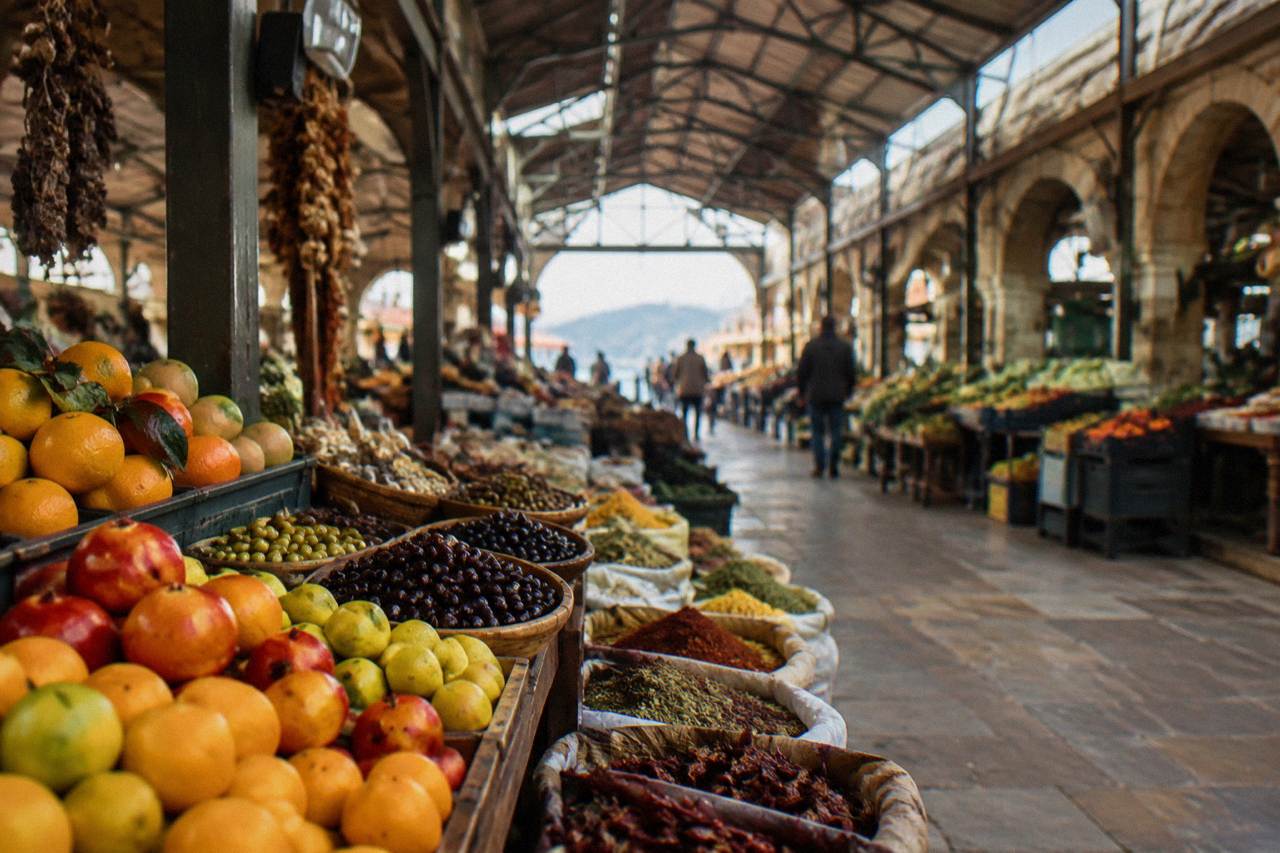
The covered Municipal Market sits a short walk from the Venetian Harbour, and the municipal market guide covers the building itself, its stalls and what to buy there. Around it, the Old Town's food shops, bakeries and covered halls trade on the same daily rhythm, which is why the one day in Chania itinerary slots a market stop into the morning without needing a particular day of the week.
What Day Is Market Day In Chania?
In Chania itself there is no single market day, because the city's principal market, the covered Municipal Market beside the Old Town, operates as a permanent daily market with fixed indoor stalls rather than as a weekly event. The weekly street-market tradition in Crete rotates its days from town to town, and no verified town-by-town schedule for those street markets is published here, so the day to aim for depends on which town's market you mean and should be confirmed locally before travelling to it.
That distinction is the whole answer in miniature. A visitor standing in Chania Old Town is already inside the market economy: olive sellers, cheese counters, spice stalls, bakeries and fish traders work the same stalls every day of the tourist season and, at reduced rhythm, through winter. Nothing about the covered market's schedule needs to be timed the way a French or English weekly market does. This site's what not to miss in Chania page treats the market hall as a standing sight for exactly that reason.
The weekly rotation is a different animal. Across Crete, towns hold open-air street markets on fixed weekdays, typically once a week, where growers and traders lay out stalls along a street or square. Chania municipality covers 356.12 square kilometres and held 111,375 permanent residents at the 2021 census, and its surrounding towns each keep their own day. No verified day-by-day schedule for those street markets exists in this site's records, so the honest instruction is to ask at your accommodation or the local municipality office, or watch for the stalls going up, rather than to trust a day quoted on a random travel forum.
A practical compromise many visitors land on: use the covered Municipal Market in Chania as the guaranteed daily option, and treat any weekly street market you happen across in Kissamos, Paleochora or the inland villages as a bonus rather than a planned centerpiece. The two days in Chania itinerary is built on that assumption, with the market on one morning and a day trip on the second day.
Is The Covered Municipal Market Open Every Day?
The Municipal Market in Chania functions as a daily covered market through the main season, and the building's own operating hours and any seasonal closures, including public holidays and the winter lull, are posted by the market and the municipality, so the current day-by-day schedule should be checked before an early-morning visit. No hour table for the market appears in this site's records, and a market hall of this kind can and does change its winter hours from year to year.
The building is the anchor of the city's food shopping. It stands at the edge of the Old Town, a short walk from the Venetian Harbour and the shops described in the what is Chania famous for answer, and its stall categories have stayed stable for generations: olives and olive oil, cheeses, herbs and spices, honey, fruit and vegetables, fish and meat, plus bread and pastries. A shopper planning a picnic or a self-catering week does the whole circuit indoors.
Two things genuinely affect a visit, and neither is the day of the week. The first is season: coastal Crete's visitor numbers swell in summer, and the market's stall occupancy and opening span follow that rhythm. The second is weather on market-day-adjacent plans. The HNMS Chania Souda station table, covering station records from 1958 to 2010, shows how sharply the rain calendar shapes a morning outdoors in this city:
| Month | Mean temperature (C) | Rain days |
|---|---|---|
| Jan | 11.0 | 16.3 |
| Feb | 11.0 | 14.5 |
| Mar | 12.7 | 11.5 |
| Apr | 15.9 | 7.7 |
| May | 20.2 | 4.2 |
| Jun | 24.7 | 1.2 |
| Jul | 26.7 | 0.4 |
| Aug | 26.3 | 0.6 |
| Sep | 23.2 | 3.2 |
| Oct | 19.4 | 9.3 |
| Nov | 15.8 | 11.2 |
| Dec | 12.7 | 16.1 |
A covered hall is the right market for January's 16.3 rain days, and the same table explains why summer visitors barely think about it: July averages 0.4 rain days. That is a real planning advantage the indoor market holds over the open-air street tradition, whatever day of the week it falls on.
What Should You Buy At A Chania Market On Any Day?
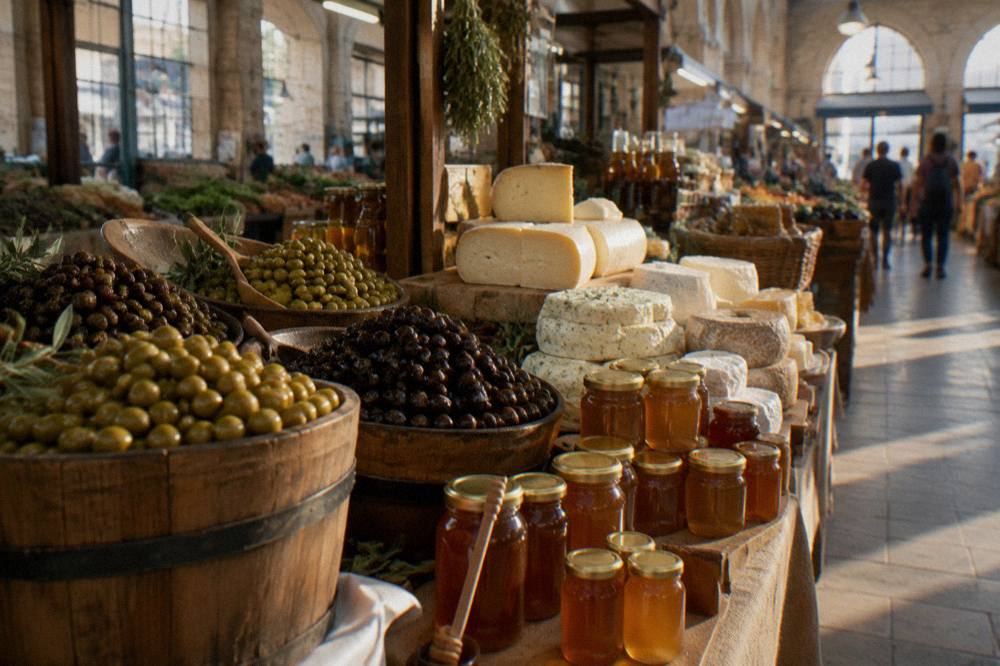
The products worth buying at Chania's markets are the island's pantry staples: olive oil and olives, Cretan cheeses, thyme honey, herbs and mountain tea, spice mixes, rusks and breads, and seasonal fruit, and because the covered market trades daily there is no need to buy everything in one visit. Prices are posted at each stall, and the bill should arrive itemised, which lets a shopper compare stall to stall across several mornings.
Cheese is the category where the counter conversation matters most, since the island's graviera, mizithra and other local cheeses differ in age and milk, and stallholders will usually cut a taste. Olive oil labels in Greece carry the harvest year and acidity, which are the two facts worth reading at the stall rather than the shape of the tin. Honey from the White Mountains to the south of the city, herbs, and the spice mixes used in Cretan cooking round out the shelf-stable purchases that travel well.
For visitors who want those flavours explained rather than simply purchased, a guided tasting does the work a stallholder has no time for. The site's Chania food guide maps the dishes, and a tasting tour such as Check availability for the Elafonisi, Elos, honey and wine day trip pairs a market-adjacent food education with a beach day west of the city.
The stall-by-stall differences are the reason a daily market rewards repeat visits. One morning for cheese and oil, another for fruit and bread, and a third for whatever the season has just brought in, is a rhythm that suits a five-day stay better than one overloaded basket on a single day. The five days in Chania itinerary leaves room for exactly that pattern.
How Do Weekly Street Markets Around Chania Work?
Weekly street markets on Crete, the open-air stall rows that towns hold on a fixed weekday, rotate their days across the island's towns, and no verified schedule for the towns around Chania appears in this site's records, so the day for any specific town's market must be confirmed locally, at your accommodation or with the municipality, before you set out. Chania's own covered Municipal Market remains the daily alternative that needs no scheduling at all.
What is safe to say about the street-market tradition is structural rather than calendrical. These markets are where local growers sell directly, so the produce reflects the district and the week's harvest, and they typically run from early morning to early afternoon. Prices at a street stall are usually displayed per kilo, and haggling is not part of the culture, so the posted price is the price. Beyond those general points, the operating reality of any given town's market belongs to the town.
Getting to a market town from the city is a bus question. The Chania long-distance KTEL bus station sits on Kydonias street, with routes to Kissamos, Paleochora and the other towns where street markets might coincide with your visit, though schedules shift seasonally and no fare or timetable is printed here. The getting around Chania overview collects the day-trip logistics.
A food-focused day trip is the other way to meet Cretan producers where they work. Beyond the Elafonisi and Elos trip above, an organised tasting route visits oil, wine, cheese and honey producers in a single day:
Rain reshapes a market plan more than the calendar does. From October the station table shows 67.7 mm of rain against 1.4 mm in August, and rain days climb from under one to more than nine, which pushes a market morning indoors and argues for the covered hall over an open-air stall row. The rainy day in Chania itinerary is built for those weeks.
Can You Combine A Market Morning With A Day Trip From Chania?
A market morning in Chania combines naturally with an afternoon or full-day trip, because the covered market's daily schedule means you can shop first and still reach a departure point in time, and the same logic applies in reverse for trips that return by early evening. The constraint to check is not the market's day but the excursion's departure time and pickup point, both of which sit on the operator's live listing.
The geography does the favour. The Municipal Market stands at the Old Town's edge, the excursion boats leave from the Venetian Harbour and Kissamos port for Balos and Gramvousa, and the island day trips west to Elafonisi or south into the gorges leave from pickup points around the city. A visitor can buy oil, cheese and honey in the morning, drop the bags at the hotel, and be on a boat or bus without conflict. The three days in Chania itinerary sequences exactly this pattern.
The pairing also solves a souvenir problem. Market purchases bought on the last morning risk being rushed or forgotten; bought on day one or two, they can be packed properly. The site's Chania Crete Travel Guide homepage collects the day-trip options that fit after a market morning, from Balos catamaran days to gorge hikes, and the related tours on this page are a fair sample of what a market-and-trip day can hold.
Common Questions About Market Days In Chania
What day is market day in Chania?
Chania's covered Municipal Market is a permanent daily market rather than a weekly one, so no single day is market day in the city itself. Weekly open-air street markets rotate by town across Crete, and the day for any town near Chania should be confirmed locally before you travel to it.
Is the Municipal Market in Chania open every day?
The covered market trades daily through the main season, with any holiday or winter changes posted by the market and the municipality. Check the posted hours before an early visit, since this site prints no hour table for the hall.
Do the weekly street markets of Crete have a fixed island-wide schedule?
Each town keeps its own weekday for its street market, and no verified island-wide schedule appears in this site's records. Ask at your accommodation or the local municipality office for the town you plan to visit.
What is worth buying at the Chania market?
Olive oil, olives, Cretan cheeses, thyme honey, herbs, spice mixes, rusks and seasonal fruit are the staples. Prices are posted per stall, and an itemised bill lets you compare between sellers across more than one morning.
Does the weather affect a market visit in Chania?
It can. The HNMS Chania Souda station table for 1958 to 2010 shows 16.3 rain days in January against 0.4 in July, so the covered hall is the reliable option in the wet months while summer mornings stay dependably dry.