Is Chania A Party Town?
Chania is not a clubbing capital: nightlife here means harbour tavernas, cocktail bars in the Old Town and late Cretan dinners. What the city's own layout and climate record say about evenings in Chania.
Chania, a coastal city of 111,375 permanent residents on the north-west coast of Crete in Greece, is not a party town in the way the phrase is usually meant. There is no superclub district, no strip of all-night venues and no island-famous beach party within the city itself. What Chania has instead is a dense, walkable Old Town around the Venetian Harbour, first built between 1320 and 1356, where the evening economy runs on tavernas, wine bars, cocktail terraces and a slow public promenade along the water. The loud, high-volume clubbing associated with parts of Crete is concentrated in resorts further east along the north coast, not here.
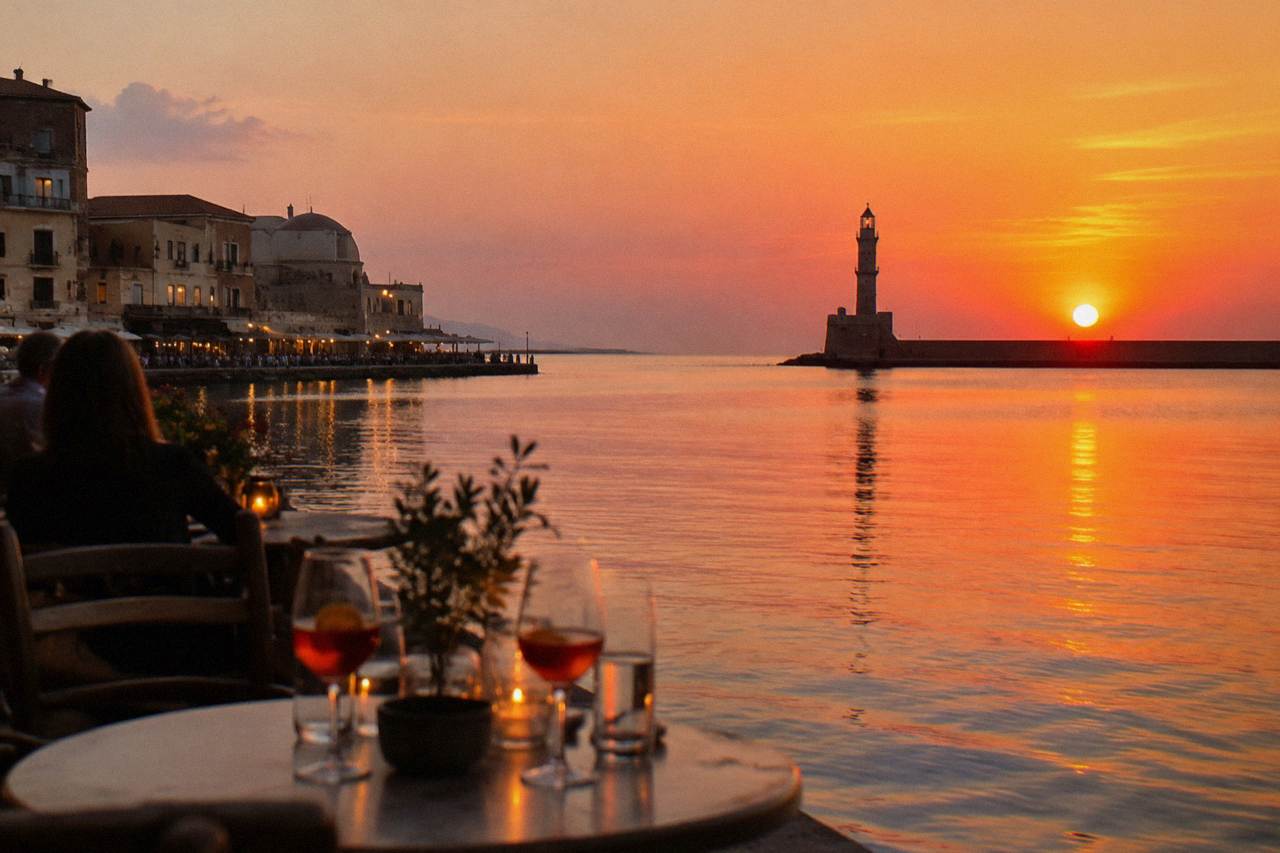
That distinction matters for planning. A visitor who wants nightlife until sunrise will find Chania understated; a visitor who wants a long dinner, a nightcap with the lighthouse in view and a quiet room afterwards has picked the right city. This page sets out where evening life actually happens in Chania, how loud the Old Town gets, when the city is quietest, and what the alternatives to clubbing look like. The Chania Crete Travel Guide desk reports what the city's own geography, its published climate record and its tour listings say.
Is Chania A Party Town?
No. Chania is an evening city, not a party town in the Malia or Ibiza sense. Nights mean long Cretan dinners in the Old Town, cocktail bars in converted harbor buildings and lanes off the waterfront, live music that is often traditional Cretan rather than DJ sets, and licensing that winds down instead of a club scene that runs to sunrise. The city's identity is built around its Old Town and the Venetian Harbour, where the seven surviving Neoria shipyards of the original seventeen, from the 15th to 16th century, now house cultural uses rather than nightclubs. The scale of the place, 111,375 residents across the municipality, is a regional city, not a resort built around nightlife.
Compare the two experiences a night in Chania actually offers. The first is food: Cretan restaurants in and around the Old Town, dinner running late by northern European habits, raki served after the meal. The second is drinking: cocktail bars in converted harbour buildings and lanes off the waterfront, busy in season, quieter from November to April. Live music exists, often traditional Cretan rather than DJ sets. None of this adds up to a party town in the Malia or Ibiza sense, and nothing in the city's own makeup suggests it is trying to.
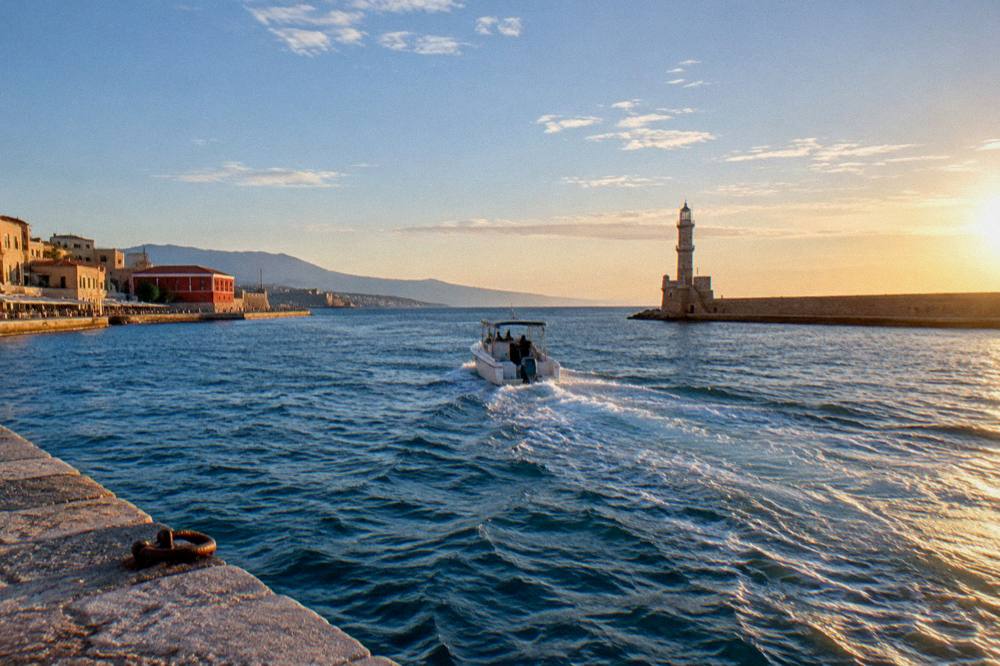
The harbour itself enforces the mood. The lighthouse, built between about 1595 and 1601 and restored on its Venetian base during the Egyptian era of 1830 to 1840, is the endpoint of the evening walk rather than the start of a crawl. Firka Fortress, built in 1620 at the harbour mouth, has free grounds by day; at night the area around it is part of the promenade. The architecture of the evening is stroll, dinner, drink, home.
Where Does Evening Life Actually Happen In Chania?
Evening life in Chania concentrates in three zones: the Venetian Harbour front with its tavernas and bar terraces, the lanes of the Old Town behind it where cocktail bars and wine bars sit in restored buildings, and the Splantzia quarter on the east side, known for smaller bars and later kitchens. Beyond those zones, the seafront suburbs west of the centre, such as the Nea Chora and Agia Marina stretch, add hotel bars and beach tavernas with a family tempo. Nothing here is a dedicated nightlife district in the clubbing sense.
The harbour front is the loudest of the three, and "loud" here means chairs, music from speakers and boat engines from excursion boats tied up for the night, not bass. Splantzia, around its square and church, runs later and draws a local crowd. The Old Town lanes between them hold the middle ground. This is a compact geography: the Old Town is genuinely walkable end to end, which is one reason the question of whether Chania Old Town is walkable and the question of where to sleep overlap so heavily.
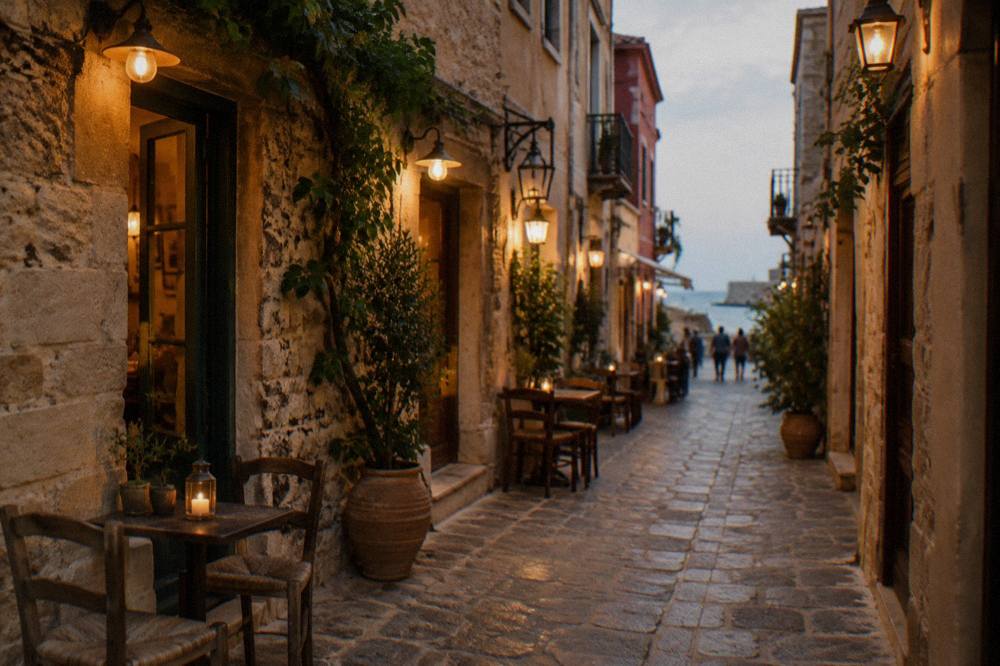
For anyone deciding where to base themselves, the same geography answers it. Staying inside the Old Town puts the evening action at the door and the noise with it; staying a short way out, towards Nea Chora or the Halepa side, keeps the walk short and the room quiet. The page on the best area to stay in Chania works through the trade-offs, and the question of whether Chania is a tourist trap covers the other side of the same coin, since busy harbour tables in high summer are part of that debate.
One structural point shapes all of it: Chania's day-trip economy, the boats, gorges and beach runs to Balos, Samaria, Elafonisi and Falassarna, starts early, and a city whose visitors are on a 07:00 departure does not stay out until 05:00. The tour listings reflect this. The Full-Day Balos Cruise From Kissamos is one of the city's biggest sellers, with Check availability as the live listing, and it is a morning-start product by design. Note that its price excludes the separate municipal fee collected on the boat ticket.
Is The Old Town Loud At Night?
It can be, in the streets immediately behind the harbour front, where bars and restaurants pack tightly into converted buildings and music carries in the warm months; two streets back, in the lanes towards Splantzia's edges and the residential quarters, the night is quiet. The sound profile follows the density of tables, and table density follows the harbour. Anyone sensitive to noise should treat the first row of streets off the water as an evening-noise zone in season and choose accommodation a block or two deeper into the fabric.
Season decides the volume more than any bylaw could. In July and August the Old Town is at peak occupancy, evenings are warm enough that every door and terrace is open, and the hum runs late. From late October the rain returns, tables move inside, terraces close and the same lanes are near-silent by midnight. The HNMS Chania Souda station table, records from 1958 to 2010, shows why: July averages 1.0 mm of rain across 0.4 rain days, while October records 67.7 mm and November 77.0 mm. Outdoor nightlife in Chania is, in effect, a dry-season activity, and the dry season here is real: May through September averages between 13.5 mm and 1.0 mm of rain a month.
The sunset cruise is the clearest single example of what Chania's evening culture is: a short, guided run on the water as the light drops over the harbour, back in time for dinner. It is the city's most-booked evening product on this site's roster, and it says more about the local night than any club listing would.
When Is Chania Quietest?
Chania is quietest from November through March, when the HNMS Chania Souda station record, 1958 to 2010, shows monthly rainfall between 67.7 mm and 129.5 mm, rain days near 11 to 16 a month, and mean temperatures from 11.0 C to 15.8 C: a working city with its terrace economy folded away. Shoulder months cut both ways. May, at a 20.2 C mean with 13.5 mm of rain, is dry and warm with a fraction of the summer crowds; October, at 19.4 C, is still pleasant but the rain has already returned.
| Month | Mean Temp C | Rain Mm | Rain Days |
|---|---|---|---|
| Jan | 11.0 | 129.5 | 16.3 |
| Feb | 11.0 | 104.0 | 14.5 |
| Mar | 12.7 | 76.0 | 11.5 |
| Apr | 15.9 | 31.5 | 7.7 |
| May | 20.2 | 13.5 | 4.2 |
| Jun | 24.7 | 3.4 | 1.2 |
| Jul | 26.7 | 1.0 | 0.4 |
| Aug | 26.3 | 1.4 | 0.6 |
| Sep | 23.2 | 15.4 | 3.2 |
| Oct | 19.4 | 67.7 | 9.3 |
| Nov | 15.8 | 77.0 | 11.2 |
| Dec | 12.7 | 101.9 | 16.1 |
The figures are station means from the Hellenic National Meteorological Service's Chania Souda station for 1958 to 2010, recorded inland of Souda Bay at 148 m; the service publishes no newer table for this station. For a nightlife question they do quiet work: the same dry months that fill the terraces, May to September, are the months a visitor will hear them. Anyone wanting the city's evening charm without the peak-season volume should read this table as a calendar and aim for the shoulder edges.
Winter visitors get a different city entirely. A rainy-evening Chania is an indoor city: tavernas, the Archaeological Museum of Chania at 15 Skra Street in Halepa, where the full ticket is EUR 15 and the concession EUR 8, and the quiet lanes of Splantzia and Topanas. The museum asks visitors to leave 20 minutes before closing, and its hours should be confirmed on its own visit page before a trip, since published times for it conflict. The page on how many days in Chania is enough covers pacing through both versions of the city.
What Does Chania Offer Instead Of Clubbing?
Instead of clubbing, Chania offers evening eating as the main event, short boat trips at sunset, live Cretan music in small venues, and a harbour promenade that functions as the city's shared living room, with the island's high-energy nightspots reachable only as a deliberate trip elsewhere. The city's own history is the evening backdrop: Venetian harbour works from 1320 to 1356, the second city walls from 1536 on Michele Sanmicheli's design, Ottoman rule from the 1645 conquest, and union with Greece in 1913, all of it lit and walkable after dark.
The alternatives sort into four kinds of night, none of which involve a queue or a wristband:
| Evening Type | Where In Chania | What It Looks Like |
|---|---|---|
| Long dinner | Old Town lanes, Splantzia | Taverna kitchens, Cretan dishes, raki to finish |
| Harbour drink | Venetian Harbour front | Bar terraces facing the lighthouse and Neoria |
| Sunset on the water | Old Port departures | Short guided cruises returning by dinner |
| Walk and gelato | Harbour mole, Firka end | The promenade out towards the lighthouse base |
Food is the serious one. Cretan dining runs long, the island's wine and olive oil traditions are part of the menu rather than a garnish, and the site's answers on what food Chania is known for go into the dishes worth ordering. Cooking classes and tasting tours, including a four-product tasting run covering olive oil, wine, cheese and honey, are the daytime complement: they fill the hours a club city would waste. On cost, the honest framing is on the is Chania expensive page rather than in any number typed here.
The boat-based evenings deserve their own word. A guided sunset cruise, the small-group sail to Agioi Theodoroi with a meal, or the two-island traditional boat run are all evening-adjacent products that define what the city considers a good night. None of them is a party product, and that is the point. The visitors who book them are the same visitors walking back to quiet rooms.
Common Questions About Chania Nightlife
Is Chania a party town?
No. Chania is an eating-and-drinking city with bars, tavernas and small live-music venues around the Venetian Harbour and Splantzia, not a clubbing destination. The high-volume resort nightlife associated with Crete is found in resorts along the north coast east of here.
Where do people go out at night in Chania?
Three zones: the Venetian Harbour front for tavernas and bar terraces, the Old Town lanes behind it for cocktail and wine bars, and the Splantzia quarter for smaller, later bars with a local crowd.
Is Chania Old Town noisy at night?
The first rows of streets behind the harbour front can be loud in July and August, when every terrace is open. Two streets deeper into the Old Town, and in the residential quarters, nights are quiet.
What time do bars close in Chania?
No fixed licensing hour is published in the sources this site reports, and hours move with the season: late in summer, far earlier from late autumn through winter. Confirm with the venue or the listing before planning a late night.
Is Chania good for a couples trip rather than a party trip?
Yes. The city's evening profile, long dinners, harbour walks, sunset boat trips and wine bars, suits couples far more than groups chasing clubs. The site's page on Chania for couples covers it in detail.
Which part of Crete is the party island side?
The club-focused resort nightlife on Crete sits in dedicated resort towns along the north coast east of Chania, notably the Malia and Hersonissos stretch near Heraklion. Chania is not part of that circuit.
The short version stands: Chania is a city for evenings, not for parties. Plan around dinner, the water and an early boat the next morning, and the city delivers exactly what it promises.